
How to Get More Referrals for Your Private Practice: An 8-Step System

When Zanda co-founder and registered psychologist Damien Adler ran his private practice, one general practitioner kept sending clients his way. The reason? Damien sent incredibly detailed update letters back to the doctor about every client they referred. For anyone learning how to get more referrals, it’s a good example of how simple, consistent communication keeps referrers coming back.
Every private practice likely already has people sending clients its way: the client who told their sister about you, the general practitioner who keeps your details on file, the school staff member who mentions your name to parents. Learning how to get more referrals for private practice means turning those moments into a system you run with intention.
Marketing, at its core, means telling the right people what you do and how you help, so they can see that you’re the right fit. As Jessica Gibson, Chief Buzz Officer at Zanda, puts it:
“If you just reframe your marketing perspective, you’ll really see it’s not salesy at all.”
A friend’s recommendation or a doctor’s referral carries more weight than any ad when someone is choosing who to trust with their health, and this guide turns word of mouth marketing for health practices into an 8-step system you can run every week. It draws on advice from Damien, along with the Zanda marketing team and practice owners in our community.
What is a referral program for a health practice?
For a health practice, a referral program is a repeatable system for earning and nurturing recommendations from clients, other practitioners, and schools. It runs on trust, clear communication, and steady follow-through.
That definition looks different from what you’ll find if you search for referral program ideas. Most of those guides come from software companies and small-business blogs, and they describe give-$10-get-$10 offers, account credits, and double-sided rewards. That might work for a meal-kit subscription, but referral rewards in healthcare can run into advertising and anti-kickback rules. A referral program for private practice swaps rewards for relationships.
Client referrals vs professional referrals
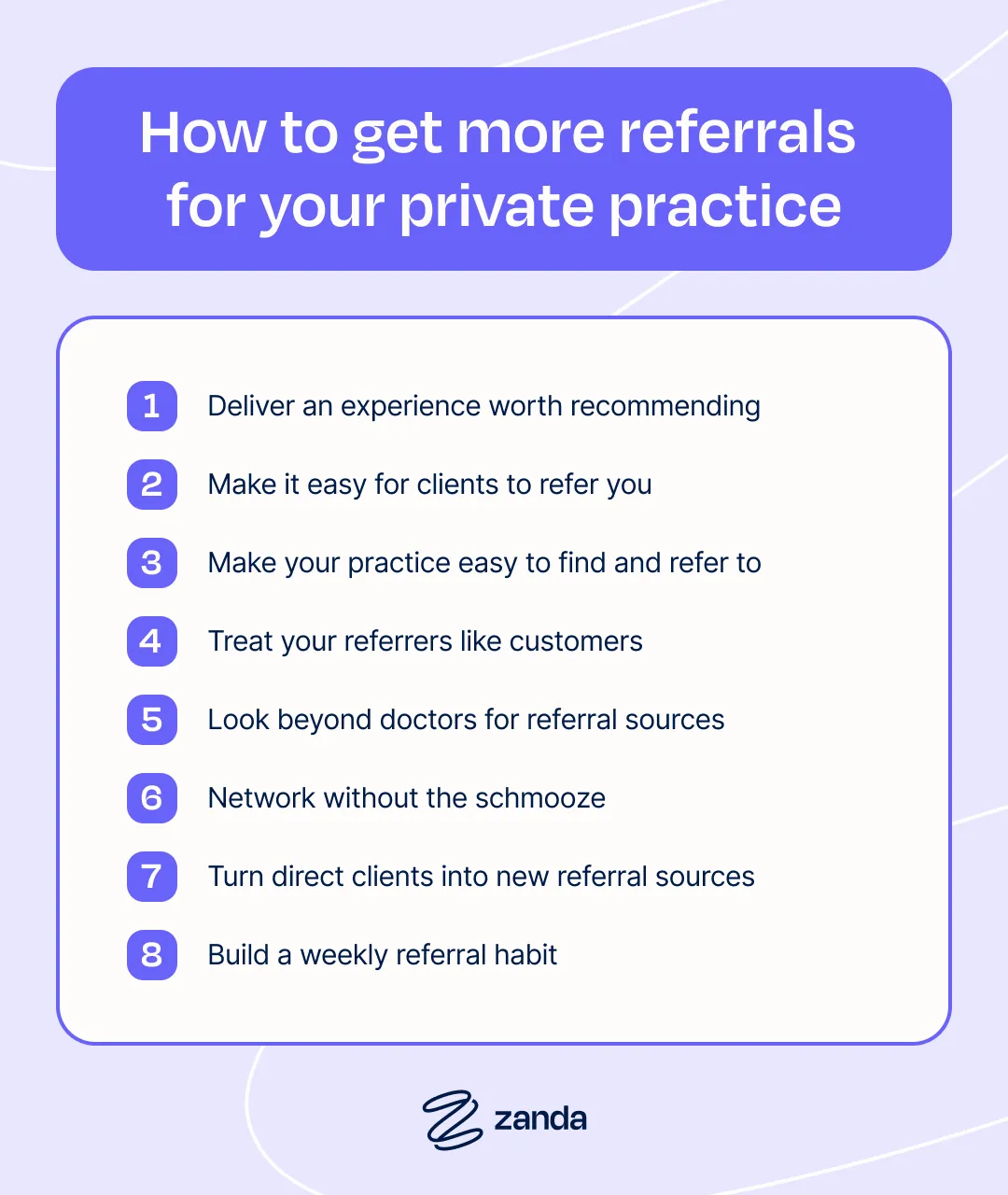
Before you map out a referral plan, it helps to know where referrals come from. Almost all of them arrive through one of two streams: your clients, who tell friends and family about you, and professional referrers (general practitioners, specialists, schools, and fellow practitioners) who send people your way. Steps 1 to 3 cover how to get more client referrals, Steps 4 to 7 cover professional referrers, and Step 8 is the weekly habit that keeps both streams moving.
Why trust comes before tactics
Fiona Harrington, Vice President of Marketing at Zanda, co-founded the Australian business reviews platform Word of Mouth Online, which grew to more than 400,000 reviews before its acquisition in 2015. She describes trust this way:
“Know, like, and trust. It’s visibility, likability, credibility.”
Referrals are the payoff. People hand over their health (or their child’s, or their parent’s) to someone they’ve heard good things about from a person they already trust. Every tactic in this guide works best once that trust exists.
What a health referral program shouldn’t include
Keep these guardrails in place before you start. This is general information rather than legal advice, so check the rules for your profession and region.
- Australia: The Australian Health Practitioner Regulation Agency (Ahpra) advertising guidelines, based on section 133 of the National Law, prohibit using testimonials about clinical care in advertising for a regulated health service. They also require you to state the terms and conditions of any gift, discount, or inducement, and that includes practice materials like waiting room brochures. The rules apply to Ahpra-registered professions such as psychology, physiotherapy, occupational therapy, and podiatry. Self-regulated professions such as speech pathology, dietetics, and counseling can treat them as best practice alongside their association’s code and consumer law.
- United States: The federal Anti-Kickback Statute prohibits offering anything of value to induce or reward referrals for services payable by federal health care programs, and the Office of Inspector General (OIG) at the US Department of Health and Human Services applies it to all referral sources, clients included. Many states add rules of their own.
- United Kingdom: There’s no blanket testimonial ban like Ahpra’s, though regulator standards (such as those from the Health and Care Professions Council) and the Committee of Advertising Practice (CAP) Code still apply.
Wherever you work, these best practices keep you on safe ground:
- No rewards for referrals. Skip cash, gifts, discounts, or account credits in exchange for referrals, whether they go to clients or to referring professionals.
- Consent first. Get client consent before you share any information with a referrer.
Step 1: Deliver an experience worth recommending
When we asked Damien how to get more client referrals, his answer was simple:
“The best way to get client referrals is to give your clients a really good experience.”
Clinical excellence sits at the heart of that experience, and the non-clinical parts carry a lot of weight too. A great session leaves a far stronger impression when it’s easy to book and everything around it feels polished and professional, which comes down to details like:
- booking that takes a minute
- a reminder the day before
- sessions that start on time
- fees that are clear before the first appointment
- a quick check-in after that first visit to see how the client is settling in
Online booking and automated text message reminders take care of the first two (and free up your front desk for the conversations that need a person).
Every letter, brochure, and outreach plan in this guide builds on a client experience worth recommending, which is why this step comes first. For more ideas, see how to increase perceived value at your clinic.
Step 2: Make it easy for clients to refer you
Damien’s go-to tactic is a good-quality brochure in the waiting room, something a client can take home and pass along (or tuck into a bag for the right moment). In his words:
“Everyone’s got a friend who probably needs some help.”
A good take-home brochure covers:
- who you help, in plain language and in your clients’ own words (start with how you define who you help)
- the services you offer
- how to book, including online booking
- whether you offer telehealth
- your location and contact details
- a clear call to action, like a QR code that links to your online booking page or website
Leave out testimonials and outcome claims, since several regions restrict them (see the guardrails above). Some clients only see you by telehealth and never sit in your waiting room. For them, a digital version on your website or in a welcome email does the same job. The rest of the waiting room checklist covers the other details that shape that first impression.
Should you ask clients for referrals?
If you’re wondering how to ask clients for referrals, Damien’s approach is to give clients a clear, easy way to recommend you whenever they choose. A direct ask can put a client in an awkward position, especially in mental health, where clients have a right to keep their care private. Making referrals easy to spot lets clients share your practice on their own terms:
- a take-home brochure in your waiting room
- a short line in your email signature with a link to book, such as “Friends and family can book with us online here.”
- a page on your website that explains how friends and family can book with you
Whatever your profession, check your code of conduct before you build a direct ask into your process.
Step 3: Make your practice easy to find and refer to
The 5-minute findability audit
Once someone hears your name, the next thing they do is look you up. Check that your website, LinkedIn profile, Google Business Profile, and any professional directory listings all describe your practice the same way, with the same services, specialties, and contact details. Jessica suggests a quick test:
“Ask a friend to look you up, and see if they can tell you what you do in ten seconds.”
Plain language beats clinical shorthand here, so a referrer scanning your site between appointments (or a client searching on behalf of a family member) can see what you offer at a glance.
What referrers need to know before they refer
Referrers want to send people to a practice that can see them soon, so one of the simplest ways to get more patient referrals is to put the practical details where they’re easy to find:
- telehealth availability
- typical wait times
- how to send a referral (a referral page or form, or a secure email address)
- funding or insurance options, where they apply
Wait times matter most, so keep yours up to date. Managing your waitlist well pays off here, and so does knowing how to turn website visitors into bookings.
Step 4: Treat your referrers like customers
Professionals who refer to you are trusting you with the people in their care, and the more confident they feel, the more patient referrals you’ll see from them. Every time a general practitioner, specialist, or fellow practitioner refers someone to you, they put a little of their own reputation on the line. As Damien explains:
“They want to be able to refer that patient and have the patient be happy with the referral. That reflects back on [them] as a physician.”
Damien suggests thinking about what referrers need from the relationship. The answer usually comes down to information: knowing their client arrived, how treatment is going, and when it wraps up.
Close the loop with feedback letters
Acknowledge each referral, update the referrer at meaningful milestones, and confirm when treatment ends (with your client’s consent). Damien gives the example of a physical therapist who lets the client’s general practitioner know that treatment can cause temporary pain flare-ups. That way, if the client mentions a flare-up at their next doctor’s visit, the doctor already has the context. “They’re not going to end up embarrassed,” as Damien puts it.
Our guide to the referral feedback letter (with template) covers what to include at each stage.
Introduce yourself with a one-page letter
A referral introduction letter covers your specialties, typical wait times, what makes your practice different, and how to reach you, with a team page attached showing photos and qualifications. The guide to the one-page referral introduction letter walks through each section and includes a free template.
Both letters give referrers confidence that the people they send your way are in good hands. A referrer who knows their clients are well looked after is far more likely to send the next one your way.
Step 5: Look beyond doctors for referral sources
While your local general practitioners and doctor’s offices might be the first place you look for referrals, some of the most reliable referrers in your community work in other corners of healthcare and everyday life. When you’re figuring out how to build a referral network in healthcare, remember that allied health referrals can also come from:
- other health practitioners, including allied health providers in different professions, complementary practices, and even practices that look like competitors on paper
- community spaces outside healthcare, such as schools, childcare services, gyms and Pilates studios, sporting clubs, and other local groups
Competing practices surprise people the most, but practitioners rarely serve exactly the same clients, even within one profession. Niches, age groups, approaches, and availability all differ. A psychologist who works mostly with adults has good reason to refer a teenager to a colleague who focuses on adolescents, and those relationships add reach instead of competing for it.
Choose sources that connect to your caseload. A children’s occupational therapist might look to schools and childcare services, while a sports therapist would start with local clubs and gyms. For doctors specifically, see our guide to getting more referrals from doctors and to building relationships with other health professionals.
How one practice owner built her referral network
Cassandra Gavel, an accredited mental health social worker and director of Guided By You (GBY) Therapy in Sydney and Adelaide, shared how she built her early referral base in the Zanda webinar on adding groups, supervision, and scale to a private practice. When she started out, she couldn’t yet offer Medicare rebates (through Australia’s national health insurance scheme), so most general practitioner referrals went to psychologists instead. She widened her circle to colleagues in her own profession and others, including occupational therapists, physical therapists, and dietitians:
“A lot of my referrals started to come through those streams.”
She joined a peer group of local health practitioners through the practice hub she worked from, attended group supervision, and went to specialist training in trauma therapy and eating disorders, exchanging cards and keeping in touch with the clinicians she met along the way. That network kept paying off as her practice grew. The first participants in her therapy groups came from colleagues who had clients they knew would be a good fit, and one of her supervisees later passed her name along for a professional training opportunity. As Cassandra puts it:
“It’s word of mouth that’s actually going to be your best friend.”
Step 6: Network without the schmooze
Damien is quick to push back on the idea that referrals depend on working a room:
“When people think of networking, they think that you need to be this extroverted, really good schmoozer at events. …You can do it without ever needing to go to these events.”
His alternative relies on consistent touchpoints:
- letters to practitioners in your area
- short introduction materials
- a working relationship with practice managers, who often decide which letters reach the doctor’s desk
As he puts it:
“Nurture the relationship with the practice managers.”
Each of these slots into a regular workday, so you can build relationships and still keep your evenings free.
Give more away than feels comfortable
Fiona’s advice runs against instinct:
“The more you give away for free, the more people will come to you.”
Sharing templates, frameworks, and resources with other practices builds trust faster than guarding them. A short education session for a referrer’s team works the same way (a lunch-and-learn on when to refer to a dietitian, for example).
Step 7: Turn direct clients into new referral sources (the “reverse referral”)
A reverse referral is when a client comes to you directly and, with their consent, you send an update to their general practitioner or another treating provider. It improves care coordination, and it often starts a new referral relationship.
Damien describes it as a simple conversation with the client:
“With consent from the patient, you say, hey, it’d be really good if we can loop in your physician.”
This runs the usual referral path backward. Instead of waiting for a doctor to send clients your way, you start the relationship by keeping that doctor informed about someone already in their care. A doctor who receives a clear, useful update about a shared client has every reason to think of you next time.
Damien is clear that this works because everyone benefits. “Done well, done right, with consent, it’s fine,” he says. “From everyone’s perspective, it’s a winner.” The client gets coordinated care, the physician gets context, and the practice gains a relationship.
A few guardrails keep it that way:
- Get explicit consent and record it.
- Send a clinical update with substance, and keep marketing material out of clinical correspondence.
- Follow your local privacy obligations (such as the Australian Privacy Principles, the Health Insurance Portability and Accountability Act in the US, or the UK General Data Protection Regulation) and your professional code.
In Zanda, you can capture consent in your intake forms and send updates from letter templates with merge fields, so a reverse referral takes a few minutes per client.
Step 8: Build a weekly referral habit (and track what works)
Fiona’s rule for marketing applies here too:
“Consistency beats intensity.”
Small, regular actions outperform an occasional burst of outreach, because referrers remember the practice that stays in touch. As Fiona puts it, “Staying in constant communication is really a huge part of marketing.”
Your 30-minute weekly referral routine
Block out 30 minutes each week (the same time slot makes it easier to stick with) and use it to:
- Reach out to a referrer or two
- Send one new introduction letter
- Send feedback letters as a standing part of each client’s care
- Thank one of your top referrers
- Once a month, review your referral sources
Most of that time goes into writing, which is where BizzyAI: Write, the Zanda AI writing assistant, comes in. Describe the letter, email, or text message you need (an introduction to a new local practice, an update letter for a referring general practitioner, a thank-you to a long-time referrer) and it drafts one in minutes, pulling in details like the client’s referral information and upcoming appointments from their record. You review the draft, adjust anything that needs your own voice, and send it, so those 30 minutes stay focused on the relationships themselves.
Track where your referrals come from
Record the referrer or referral source for every new client, then review the numbers monthly: who’s referring, how often, and who’s gone quiet. A referrer who sent you six clients last year and none this quarter is worth a call or a letter to reconnect with past referrers.
Zanda stores referrer records alongside each client, so referral reports show these patterns in a few clicks, and tasks remind you when a follow-up is due. See how to track referrers and referrals in Zanda.
Say thank you without breaking the rules
Handwritten notes and referral thank-you letters show appreciation with minimal compliance risk, which matters most in the US, where gifts to referral sources can raise anti-kickback concerns.
Be easy to recommend
Fiona sums up the whole approach:
“Let’s start viewing marketing as really authentic communication. That’s all it is.”
Every step in this guide to getting more referrals for your private practice comes back to giving people an experience worth talking about, keeping the people who refer to you informed, and making it simple for anyone to pass your name along. Do that week after week, and those small, consistent efforts add up until your practice becomes the easy recommendation.
Zanda brings every part of that system together, from online booking and automated reminders to referrer records, referral reports, and BizzyAI: Write, which drafts your letters, emails, and text messages in minutes. Try Zanda free for 14 days and send your first referral introduction letter before the week is out.
Referral program FAQs
How can I get more patient referrals?
Getting more referrals for your private practice starts with a client experience people want to recommend. From there, make referring easy. Give clients a take-home brochure, keep your online listings clear and consistent, and send referrers regular feedback letters. Add new referral sources over time, such as schools and other practitioners, and spend 30 minutes a week on outreach so the habit sticks. The 8 steps above cover each part in detail.
Can you offer incentives for patient referrals?
Generally, avoid it. In Australia, Ahpra’s advertising rules restrict inducements and testimonials. In the US, the Anti-Kickback Statute prohibits rewarding referrals for federally funded services, and professional standards apply in every region. Thank-you notes and referral thank-you letters are the safe way to show appreciation.
Is it ethical to ask patients for referrals?
It can be, as long as clients feel free to say no. Making referrals easy and visible, through a brochure or website page, respects client privacy and avoids pressure. In mental health especially, consider the power imbalance in the therapeutic relationship and follow your professional code before asking a client directly.
How do I get referrals from doctors?
Start with a one-page referral introduction letter, then send feedback letters for every client a doctor refers, with your client’s consent. Consistency matters most, so keep those updates coming. Our guide on how to get referrals from doctors and our referral introduction letter guide cover both in detail.
What should I send a referrer after they refer a client?
Send a thank-you note after the first appointment, then feedback at meaningful milestones and when treatment ends, all with your client’s consent. These updates keep the referrer informed and involved in their client’s care, which makes them more likely to refer again.
Do I need to be good at networking to get referrals?
Simple, regular touchpoints like introduction letters, shared resources, and relationships with practice managers build referral sources at a pace that fits your week, and 30 minutes of steady outreach adds up faster than an occasional networking night.