
A Practice Owner's Guide to Preventing Practitioner Burnout

Ask a practice owner what burns their team out, and many will point to the work itself: the hard cases, the crisis sessions, the emotional weight. Damien Adler, a psychologist who ran his own practice for about 15 years, thinks they’re looking in the wrong place. In his experience, the bigger culprit is the paperwork and regulation. New data shows how widely that load is felt. In the Zanda State of Burnout in Allied Health report, based on a survey of 682 practitioners, nearly half (47.1%) rated their burnout risk as moderate or worse, and 59.4% named administrative workload as one of their top three operational constraints, more than any other option.
If you’ve ever asked for or received burnout support, it probably sounded something like this: set better boundaries, practice self-care, see a therapist of your own. Good advice, but as a practice owner, it can leave you feeling like burnout is mostly out of your hands, something your team manages on their own time, in ways you can’t really see or influence.
There’s more you can do than it might seem. Preventing practitioner burnout comes down to a practice’s systems: its schedule, its caseload policies, and how much room practitioners have to decompress. Damien Adler, co-founder of Zanda, ran his own psychology practice for about 15 years before selling it, and built the business around exactly that idea: the right groundwork, laid early, gives the people working for you the best possible shot at a sustainable career.
Damien puts it simply: “I wouldn’t say I got to the stage of burnout, but I definitely changed, and course corrected to prevent that.”
That experience, getting close enough to burnout to spot it and change course, shaped how he ran his practice once he owned it. He put a handful of tangible rules in place for his whole team: how schedules got built, how difficult cases got processed, even how the office itself was laid out. Every measure below traces back to that thinking, and is something you can put in place at your own practice, starting this quarter.
In this article:
- Why burnout is shaped by your practice’s systems, not just your team’s individual resilience
- What burnout looks like before it becomes a resignation
- Five specific measures, starting with the easiest to put in place
- How colleagues add a layer of support, and how solo practitioners can build their own
- What one practice’s unusually high retention looked like, and why
Why preventing practitioner burnout starts with your practice’s systems
Employee burnout in healthcare has been a problem for decades. The work itself asks a lot: hours that run long, sessions that draw on emotional and physical energy, and documentation requirements that nearly half of practitioners (49.1%) say have increased over the past three years (Zanda State of Burnout in Allied Health report).
No matter how much yoga and meditation a practitioner does on their own time, you, as a practice owner, have significant influence over their burnout risk simply through how you structure your practice. If you’re seeing turnover year after year, the pattern isn’t about any one person, it’s about the practice itself.
Damien built his practice with that in mind. He put a set of protections in place before burnout had the chance to set in, not after.
Signs of burnout in your team
Allied health burnout tends to build gradually, which is part of why it’s easy to miss. Researchers typically describe it across three dimensions: emotional exhaustion, depersonalization (a growing cynicism or detachment from the work), and a diminished sense of personal accomplishment, a framework developed by psychologist Christina Maslach. The warning signs tend to surface well before the condition itself becomes obvious, which is exactly when they’re easiest to miss.
In your practice, that can look like a practitioner who used to volunteer for extra cases now avoiding them, someone who was vocal in team discussions going quiet, or documentation that used to get done same day starting to pile up. Watch for physical symptoms too. A cross-sectional study of nearly 760 healthcare professionals found mild to moderate burnout symptoms were the most common presentation, with a smaller share showing severe symptoms, a reminder that burnout rarely announces itself all at once (Puigtió-Rebollo et al., 2025).
Damien’s own language for what unchecked overbooking produces is direct: “You get burnout, disengagement, negativity.”
Those last two words are the ones to watch. Disengagement and negativity often show up well before anyone says the word burnout: a practitioner who stops offering ideas in team meetings, shrugs off feedback, or starts talking about clients or the practice with an edge of cynicism. Treat them as early warning signs, not attitude problems. The earlier you can name these signs, the more options you have. Waiting until someone resigns leaves you with exactly one: replacing them.
Step 1: Start with paperwork and regulation
There’s a common assumption that burnout in healthcare comes from the emotional weight of the work itself, from sitting across from patients in crisis day after day. Damien pushes back on that directly: “It’s more the paperwork and regulation.”
The administrative burden in healthcare (documentation, compliance, and billing) is what Damien sees wearing teams down over time. It’s also the part of the job furthest from why most practitioners entered the field, which makes it the highest-leverage place to start.
Practical ways to reduce the admin load
Structured note templates cut documentation time without cutting its quality. Online intake forms move data collection out of session time. Automated appointment reminders take rebooking and no-show follow-up off your team’s plate entirely. AI-assisted documentation tools, like BizzyAI: Scribe in Zanda, reduce the time practitioners spend writing notes after a session ends, handing that time back for the parts of the job that drew them to the profession in the first place.
Get people out the door on time
One of the simplest ways to check whether these changes are working: are your practitioners finishing their day and leaving? Someone still in the building an hour after their last session, working through notes, is carrying a clinical documentation burden your systems failed to absorb.
Step 2: Build schedules around your practitioners, not just the calendar
Most therapist scheduling starts with the calendar: book every slot, close every gap, keep the day as full as possible. Damien built schedules around the practitioner instead.
Start part-time, and let full-time be earned
One structural policy Damien implemented was that new hires always started as part-time employees. As he explains: “We would actively discourage [full-time status], and we ended up with people full-time, but they needed to prove over time that it was sustainable, and then it would be stepped up.”
Damien’s team would offer half days, work them up gradually, and let full-time hours become something a practitioner earned once the pace proved sustainable for them.
Ask each practitioner about their daily working rhythm
Every practitioner processes a day of sessions differently, and Damien’s practice treated that as worth asking about directly rather than assuming. As he describes it: “We would talk to them about what their cycles were in a day. Some people prefer session, breather, session, breather, session, breather. Others prefer three in a row, then a gap in the middle.”
Some practitioners want a single long break in the middle of the day to mentally reset. Others prefer to move through several sessions back to back, then take their break once, later. Build the schedule around whichever version lets that specific person sustain the work.
Part-time schedules: which days, not just how many
For practitioners working part-time, the same thinking applies to which days they work, not just how many. Three days a week looks very different depending on whether those days are consecutive or spread out. Design around that distinction rather than defaulting to whatever fills gaps in the calendar.
Step 3: Make debriefing part of your practice’s infrastructure
Processing a difficult case alone is one of the more isolating parts of clinical work, and a quiet risk factor for therapist burnout. Without someone to talk it through with, a practitioner is left carrying it by themselves. Damien’s practice built a standing rule to address it directly: “You can ring us and talk about it. Then you can document that you’ve consulted, that there’s an agreement that this is the right way to go, and now you can let it go.”
If a practitioner was still thinking about a concerning case over the weekend, unsure whether they’d handled it correctly, they had a standing invitation to call and talk it through rather than sit with the uncertainty alone.
Documenting that consultation is what closes the loop, giving the practitioner something concrete instead of an open question they keep replaying, and permission to let it go once the call ends.
Step 4: Design your practice space for wellbeing
When designing his practice’s building layout, Damien made a controversial design choice. While most practices opt for more consult rooms (and thus more billable capacity), Damien’s practice carved out a shared, open office space where practitioners would land between sessions instead of retreating straight into another consult room. He even asked the builder for double-insulated walls between that shared space and anything external, so sound wouldn’t carry where it shouldn’t.
“You could come in with dark humor if you wanted, and create a literal safe space.” Damien jokes that every patient probably wonders what their therapist says behind closed doors. The truth is that practitioners need somewhere to put down the weight of the day, to vent, laugh, and talk through a tough session with someone who gets it, in a space built so none of it travels any further.
Step 5: Fix the incentive structure behind overbooking
Private practice compensation runs on billable hours, which creates an obvious temptation: the more patients a practitioner sees, the more the practice and the practitioner both earn. Damien names this pressure directly, and doesn’t let practice owners off the hook: “The temptation is for both practice owners and for practitioners to cram in as many people as you can. Short term, that looks good financially. The long-term cost is the burnout and disengagement.”
A fuller schedule this month means more revenue this month. But that equation doesn’t hold up over a year, or over the career of a practitioner your practice eventually loses.
The real cost of practitioner turnover
A practice that runs its practitioners into burnout isn’t running a more profitable business. It’s borrowing against a cost that shows up later: recruiting, onboarding, and ramping up a replacement, plus the patients who leave along with a departing practitioner, plus the institutional knowledge that walks out the door with them.
How working with colleagues supports practitioners
Working in a team changes more than your practitioners’ day-to-day experience. It changes the standard they’re held to when something goes wrong. Damien’s approach: “The standard you’re held to is, did you do what a reasonable practitioner would do in the similar circumstances, not did you do perfection.”
A practitioner working alone doesn’t have easy access to that standard. There’s no colleague to check a decision against, no consultation on record establishing that a reasonable clinician would have made the same call, just a heavier, unshared weight that group practice is built to distribute. Practice size alone doesn’t settle this, though. In our survey, solo practitioners reported burnout risk well below practices of 6 or more (13.5% rated it high or severe), and isolation showed up at every practice size, so the protection comes from regular contact with colleagues, whatever the size of the team.
If you’re a solo practitioner
That doesn’t mean going without the same protection. A peer consultation group, formal or informal, gives you a version of the same check-in Damien describes. Formal clinical supervision serves a similar function, particularly earlier in a career. The habit itself matters as much as the format: documenting a consultation, even an informal one, creates the same record that protects a practitioner working in a group.
The payoff: practitioner retention that outlasts industry norms
Staff turnover in private practice is a well-known problem. Practitioners commonly move from practice to practice every year or two, a pattern Damien’s practice broke: “People would stay with us for years and years and years.”
That retention became self-reinforcing. Damien built a relationship with a local university, teaching into their final-year program, and graduates who came through that relationship sought the practice out specifically once they knew what it offered.
Asked whether money drives retention, Damien’s answer was blunt: “If it is, it’s the wrong person.” His team stayed because the practice was built around their sustainability, a harder thing for a competitor to match than a bigger paycheck.
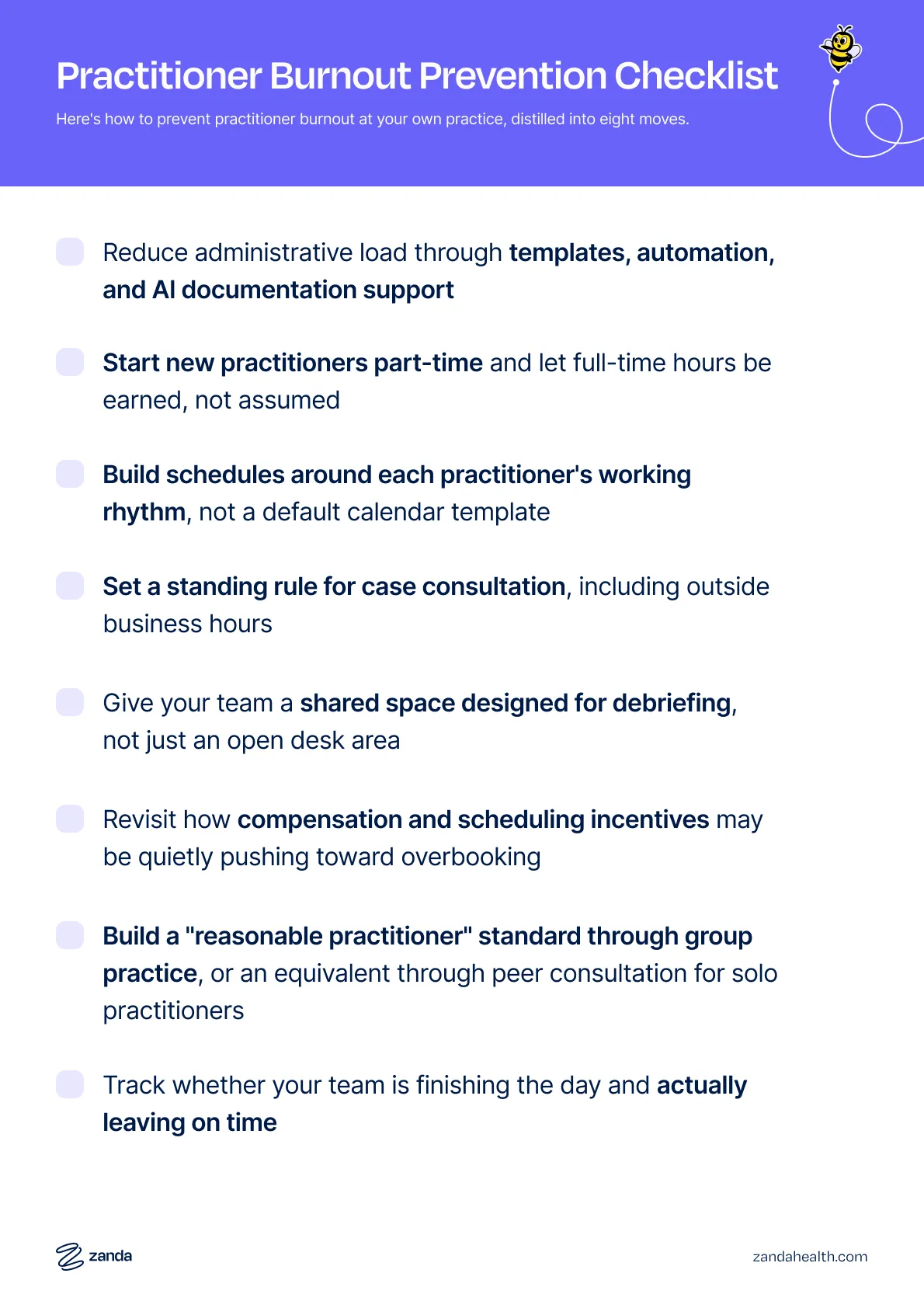
Practitioner burnout prevention checklist
Here’s how to prevent practitioner burnout at your own practice, distilled into eight moves.
Where to start
Burnout is often treated as something each practitioner has to manage alone, but the patterns in Damien’s practice point somewhere more useful: the systems around them. Schedules, consultation rules, the layout of the office, and above all the paperwork. None of these changes needs a big budget or a restructure. Pick one from the checklist and put it in place this quarter. If admin is where your team’s hours are disappearing, start there.
Frequently asked questions
What causes burnout in allied health practitioners?
In the Zanda State of Burnout in Allied Health report, seven everyday pressures were linked to higher burnout risk: feeling professionally isolated, feeling underpaid, heavy admin hours, heavy documentation hours, overwhelming technology, concern that AI will replace part of the role, and falling revenue and profit margin.
How do you prevent practitioner burnout as a practice owner?
Build burnout prevention into the structure of the practice itself: reduced administrative load, scheduling built around each practitioner’s working rhythm, a standing consultation rule for difficult cases, and a physical space that supports debriefing.
How many clients should a therapist see per day?
There’s no universal number. The right caseload depends on the individual practitioner’s working rhythm, the complexity of their cases, and how much non-billable work (documentation, consultation) surrounds each session.
What’s the difference between burnout and compassion fatigue?
Burnout is a gradual response to chronic workplace stress: exhaustion, cynicism, and a reduced sense of accomplishment. Compassion fatigue is sometimes used interchangeably with burnout, but it’s more specific to caregiving roles and develops from repeated exposure to others’ trauma or suffering (Cocker & Joss, 2016).
How can private practices reduce administrative burden?
Structured note templates, online intake forms, automated reminders, and AI-assisted documentation tools all reduce time spent on non-clinical work.