
Why We Put AI In Every Zanda Plan
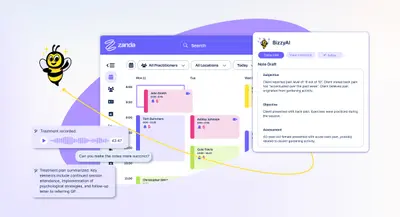
Almost half of allied health practitioners (47%) say their documentation requirements have increased over the past three years, and nearly one in five now spend nine or more hours a week on notes alone (with some logging 21+ hours). Those numbers come from our State of AI Adoption in Allied Health report, a survey of 682 practitioners across Australia, the UK, the US and beyond, and they confirm what most clinicians already feel by Thursday afternoon. The workload keeps growing, but so do the tools to help manage it.
Picture the version of your week where your notes are finished within the time you set aside for them. Appointment reminders go out on their own, intake paperwork lands in the client record before the first session, and invoices send (and get paid) without a single follow-up email. In session, your attention stays on your client instead of your keyboard. And when the last appointment wraps, you close the laptop and go enjoy your evening, knowing your practice is profitable, sustainable and still enjoyable to run.
That week already exists for plenty of Zanda practitioners, including Kathryn Theodosis, a chiropractor in Australia who has run more than 300 sessions with BizzyAI Scribe. Her notes are typically done by the end of each day, and she’s seeing 15-20% more clients on an average day without the work feeling heavier. “I don’t think there’s a health provider out there that went into practice because they wanted to write notes,” she says.
Why Zanda is all in on AI
We’re pro-AI at Zanda because we see its potential to completely change how private practices run, from the notes and letters that follow every session to the way practice owners plan, market and grow. Our co-founder Damien Adler, a registered psychologist who ran his own practice for fifteen years, puts AI in the same category as the internet and cloud computing: a jump step in what practice software can do. “The adoption of AI is essentially inevitable,” he says. “We’re just at the beginning.”
So here’s our goal, stated plainly: we want Zanda users to become daily AI users.
That goal comes straight from the data. Among practitioners who use AI every day, 71% have cut their documentation time by a quarter or more, compared with 44% of weekly users and 23% of occasional users. The returns grow with commitment, and the biggest shifts in workload happen once AI becomes part of how a practitioner works every day.
We see the same pattern on our own platform, where usage of BizzyAI Scribe grew 88% over the past year and AI note editing grew 92%. Damien sees it in conversation, too: practitioners who tried AI once and shrugged come back a few months later, unable to picture working without it. “If you get over that hump, people are like, oh, now I get it,” he said in our recent Health Practice Buzz webinar, The AI Divide.
Lowering the barrier to daily use
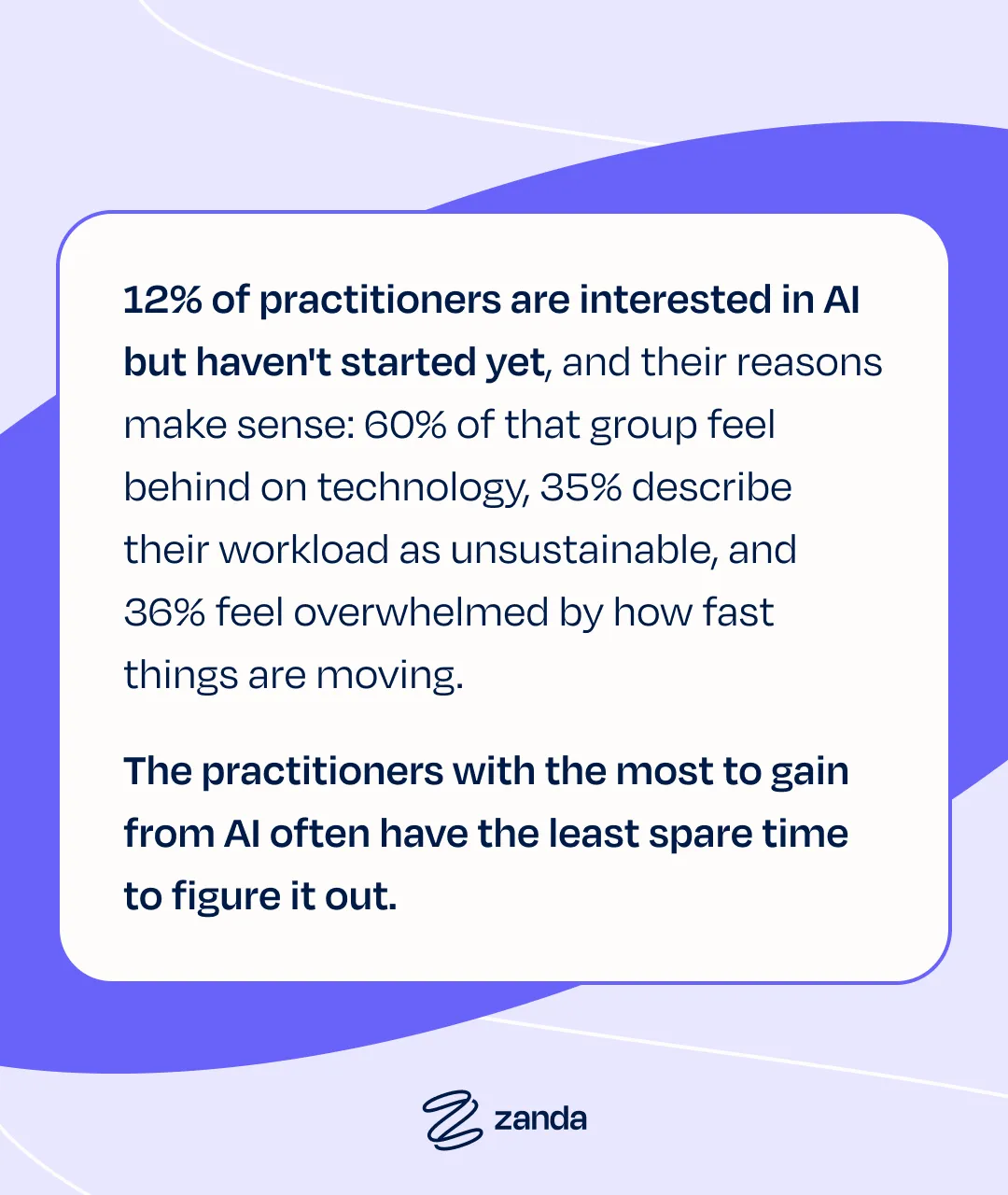
According to the same survey, 12% of practitioners are interested in AI but haven’t started yet, and their reasons make sense: 60% of that group feel behind on technology, 35% describe their workload as unsustainable, and 36% feel overwhelmed by how fast things are moving. The practitioners with the most to gain from AI often have the least spare time to figure it out.
That’s why we’ve changed how AI works in Zanda. We restructured BizzyAI and its pricing so more practitioners can use safe, effective and useful AI tools from day one, inside the software they already know. AI evolves quickly, and Zanda has always moved early on new technology that gives practitioners time back.
We also know practitioners have fair questions about AI, from where client data goes to what it means for the relationship in the room. We treat answering those questions as part of building the product, starting with the one that matters most.
Security and privacy come first
Clinical information is some of the most sensitive data there is, and practitioners carry legal, ethical and moral responsibility for protecting it. Damien is direct about the risk that comes with general-purpose tools: “It’s not appropriate to grab patient information and stick it into any of the models that are out there publicly.”
So we built BizzyAI to run in an environment Zanda controls. AI processing happens inside the platform, client data is never used to train AI models, and the platform holds ISO 27001 certification for information security management. Because BizzyAI lives inside Zanda, practitioners work with notes and client context directly, with no copying and pasting between a standalone AI app and their practice software. (Kathryn used a separate AI scribe for several months before switching, and named that single, integrated workflow as the deciding factor.)
Practitioners remain responsible for obtaining informed client consent before recording sessions, and every practice can switch AI features off completely if preferred.
AI gives practitioners more room to be human
The other concern we hear most often is about connection. Allied health runs on relationships, and as Damien pointed out in our webinar, research links the strength of the therapeutic relationship to client outcomes, whatever the treatment approach. Our survey reflects that caution: 61% of practitioners believe AI improves their efficiency, while 34% believe it improves patient outcomes, with daily users more likely to report an outcome benefit.
Damien argues this concern can be flipped on its head, because AI handling the documentation gives practitioners more room for the human side of care. “Knowing that there’s ambient note-taking occurring means you can be present in that consult,” he says. “There’s more eye contact, more capacity to pick up on body language, and just more mental space.”
Kathryn describes the same shift from the other side of the treatment table. Without the background chatter of “I need to note that down,” she stays fully present, and her clients notice. At follow-up visits they hear their own words reflected back to them, and her retention has improved as a result.
AI drafts, creates summaries and surfaces the right information at the right time, while the practitioner brings clinical expertise and stays responsible for the final record. Damien calls the end goal AI-enhanced practitioners and AI-enhanced practices, with technology helping each clinician be the best version of themselves in the room.
What’s new in BizzyAI
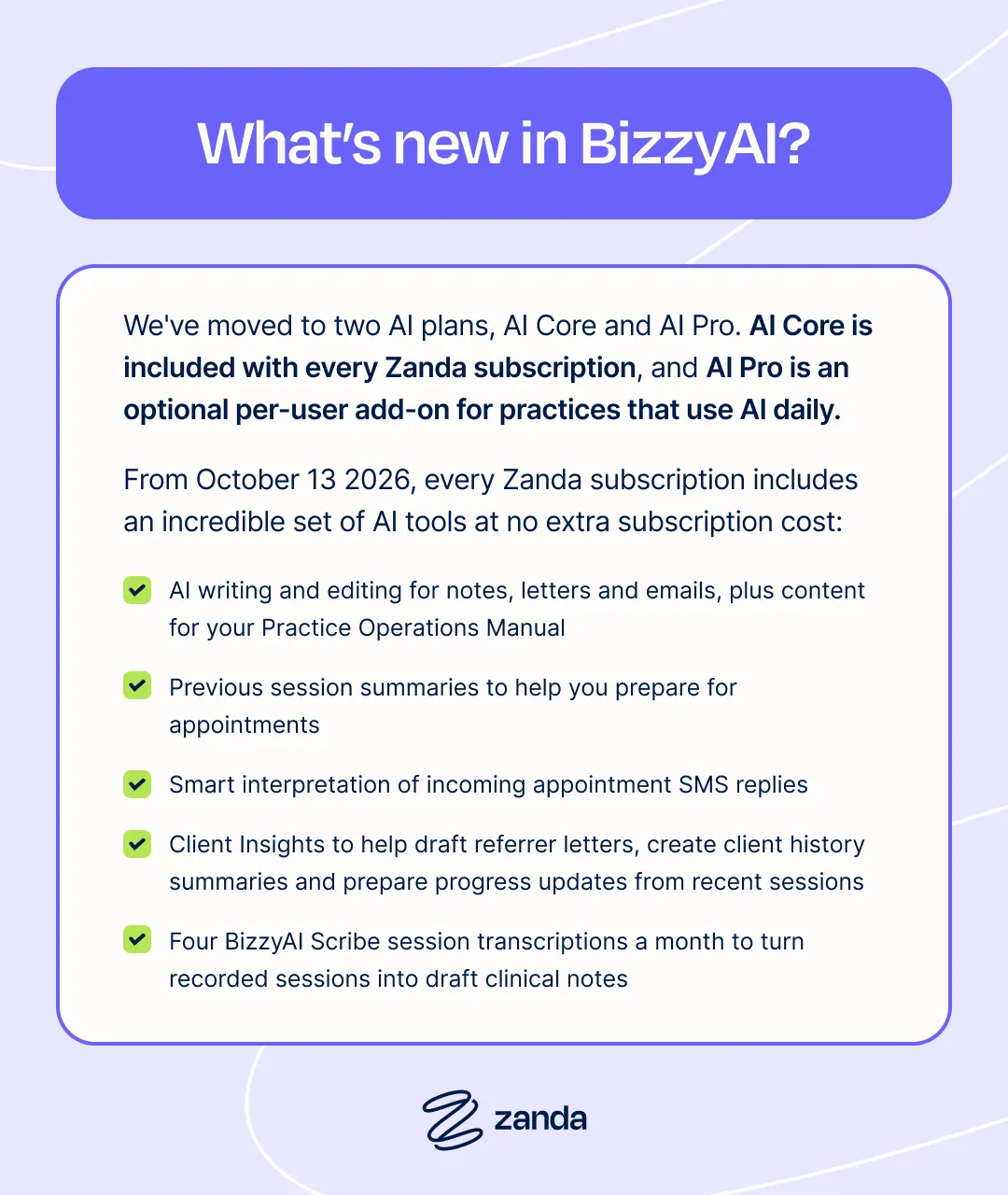
Here’s what’s actually changing: we’ve moved to two AI plans, AI Core and AI Pro. AI Core is included with every Zanda subscription, and AI Pro is an optional per-user add-on for practices that use AI every day.
From 13 October 2026, every Zanda subscription includes an incredible set of AI tools at no extra subscription cost:
- AI writing and editing for notes, letters and emails, plus content for your Practice Operations Manual
- Previous session summaries to help you prepare for appointments
- Smart interpretation of incoming appointment SMS replies
- Client Insights to help draft referrer letters, create client history summaries and prepare progress updates from recent sessions
- Four BizzyAI Scribe session transcriptions a month to turn recorded sessions into draft clinical notes
For practices that use AI every day, the optional AI Pro subscription adds unlimited Scribe transcriptions (subject to fair use) and the ability to draw on more client records and longer stretches of history. At less than $1 a day per user, it’s a flat monthly fee, so practices get predictable costs along with the confidence to use AI as often as they like.
See plan details and regional pricing on our pricing page.
A practice that works for you
Every practice deserves to be profitable, sustainable and enjoyable, and we believe daily AI use is one of the most direct ways to get there. As Damien puts it, the opportunity is “to give practitioners more choice about where their time goes: being present with clients, keeping on top of their practice, or finishing work on time.” For Kathryn, that looks like more clients, stronger relationships and notes that finish when her day does. We want that for every Zanda practice.