
Music Therapy Intake & Consent Forms (Free Templates)

Every new client starts with two documents: a music therapy intake form and a music therapy consent form. A good intake shapes how you approach the session: what music someone grew up on, what to use and what to avoid, what they’re actually hoping to get out of the work. Consent carries the same weight on the relational side, making sure everyone involved understands what a session looks like, what’s being recorded or shared, and what their rights are throughout. Get both right at the start, and the rest of the client relationship tends to follow naturally. If you’re still setting up your practice more broadly, our guide to starting a music therapy practice covers the wider setup.
These two templates cover the core music therapy forms almost every practice needs before a single session happens, well before progress notes or discharge summaries enter the picture.
Jump straight to the templates below, or keep reading for what to include and why.
Music therapy intake forms
A music therapy intake form tells you who they are, why they’re here, and what matters clinically before you ever pick up an instrument together.
What makes a music therapy intake form different from a generic allied health intake is the music-specific section: prior music therapy experience, musical training or background, preferred genres and artists, preferred instruments, and any songs or music to use or avoid (a specific memory tied to a specific song shows up more often than you’d expect, and knowing about it upfront changes how a session gets planned). Cultural or religious considerations around music choice belong here too.
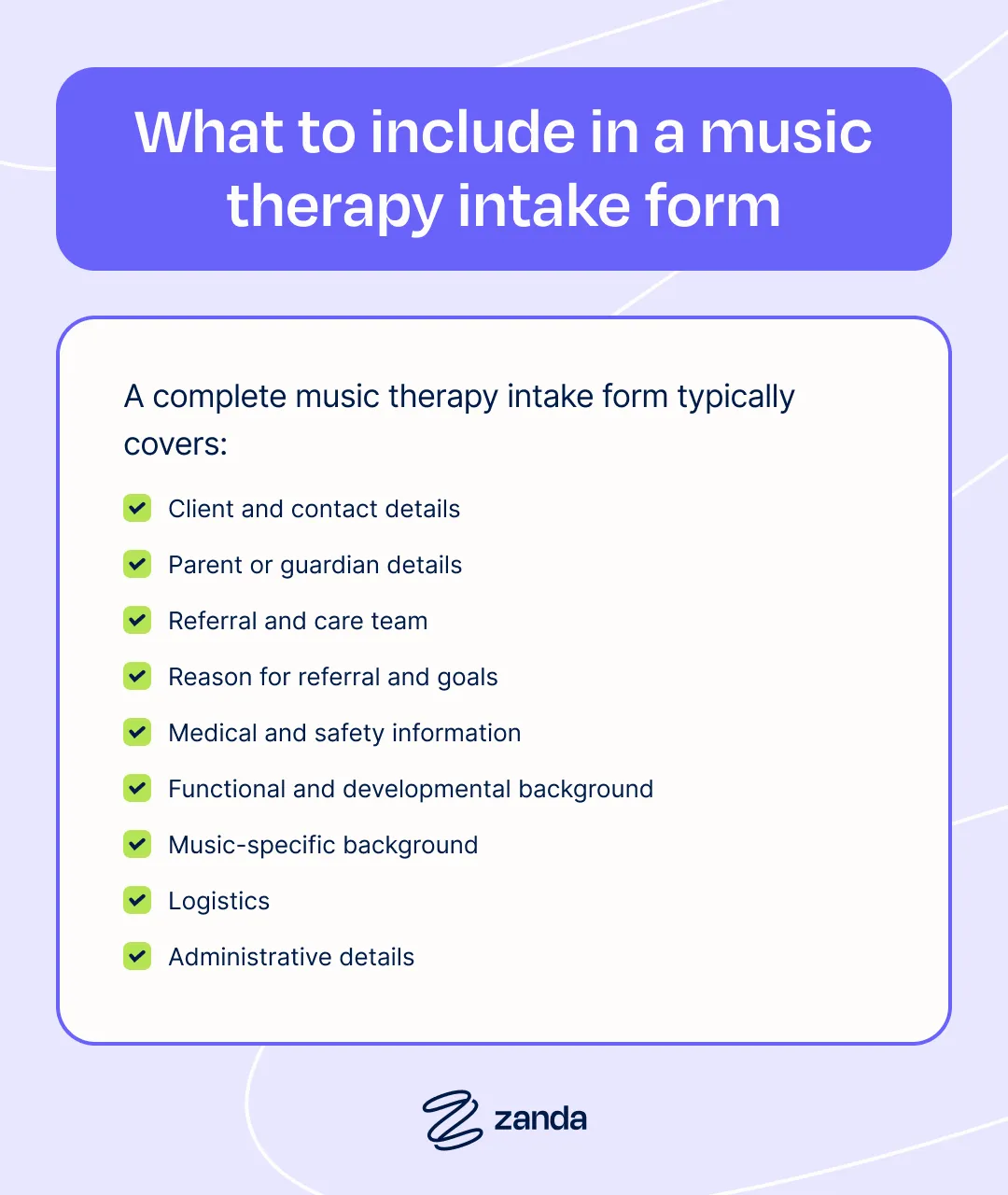
A complete music therapy intake form typically covers:
- Client and contact details: name, date of birth, age, gender, address, phone and email
- Parent or guardian details: guardian name, relationship to the client, who’s completing the form, who brings the client to sessions (essential for the large share of music therapy work that’s pediatric or disability-focused)
- Referral and care team: referral source, GP or physician, case manager or support coordinator
- Reason for referral and goals: presenting needs, what the client or family hopes to achieve
- Medical and safety information: diagnoses, medications, allergies, precautions, relevant history, other therapies the client receives
- Functional and developmental background: communication needs (including AAC or sign), motor skills, sensory considerations, cognition, social and emotional presentation
- Music-specific background: the section above, this is what sets a music therapy intake apart from any other allied health form
- Logistics: session type (individual or group, in-person, telehealth, or home visit), availability
- Administrative details: funding, insurance, or NDIS information, cancellation policy acknowledgement
Make it clear which fields are optional, and that completing every field isn’t a condition of being offered services. Families filling this out are often doing so at a stressful moment, and a form that feels like a wall of required fields can be its own small barrier.
Download our music therapy intake form template here.

Music therapy consent forms
A music therapy consent form covers informed consent, which is an ongoing process rather than a signature collected once at intake and forgotten. Circumstances change (a new recording request, a shift to telehealth, a new AI note-taking tool) and consent should keep pace with them.
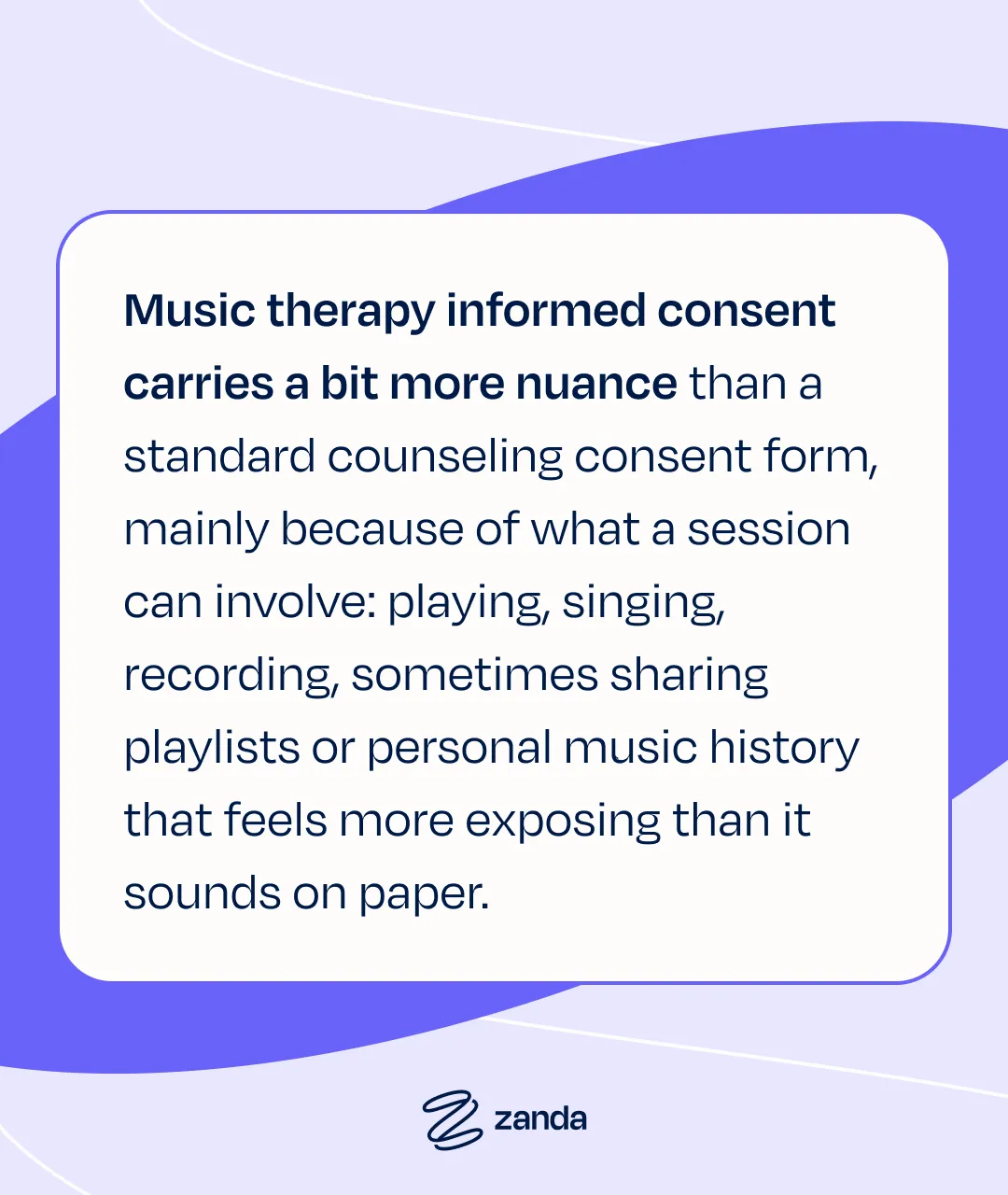
Music therapy informed consent carries a bit more nuance than a standard counseling consent form, mainly because of what a session can involve: playing, singing, recording, sometimes sharing playlists or personal music history that feels more exposing than it sounds on paper. A client or guardian signing off on “music therapy” without understanding that range hasn’t really given informed consent, they’ve just signed a form. Walking through what a session actually looks like before asking for a signature closes that gap.
A thorough music therapy consent form walks through:
- Nature of services: what music therapy involves and what to realistically expect, including that outcomes aren’t guaranteed and sessions may surface emotion
- Risks and benefits: a plain-language summary, no clinical jargon required
- Voluntary participation: the right to decline or stop at any point, and confirmation that optional consents (recording, electronic communication) don’t gate access to treatment
- Confidentiality and its limits: what’s kept private, and the exceptions: risk of harm to self or others, mandatory reporting of abuse or neglect, a court order or subpoena, or release with written authorization. This section should also cover how information may be shared with other providers, funders, or software vendors
- Minors and guardian consent: guardian authority to consent, handling for split or joint custody situations, and what information guardians receive versus what stays confidential to the young person
- Recording consent: this one’s specific to music therapy in a way general counseling consent forms don’t cover. Separate consent for audio or video recording, the purpose (clinical, supervision, training), storage and security, retention and deletion timelines, and a distinct consent for any promotional, social media, or research use
- Telehealth consent: how remote sessions work, the technology involved, the security realities of electronic communication, and confirmation that the same confidentiality protections apply
- AI note-taking consent: explicit consent that an AI tool may transcribe or assist with session notes, held to the same confidentiality standard as everything else, with clear terms on what’s retained and for how long (most consent templates don’t include this yet)
- Fees, payment, and cancellation policy: rates, payment terms, cancellation terms
- Acknowledgement and signature: client or guardian signature and date, therapist signature, and a date for review
Download our music therapy consent form template here.

A note on compliance
These templates are a strong starting point, and that’s exactly what they’re meant to be. Consent and privacy obligations vary by country and by professional body, so adapt the language to your jurisdiction and your association’s standards, and have a legal or compliance professional review the final version before you put it into use.
In Australia, that means aligning with the Privacy Act and the Australian Privacy Principles. In the US, HIPAA governs how client health information is handled. Either way, cross-check against your professional body’s ethics standards (AMTA, for example) before rolling these out with clients.
It’s best practice to revisit these forms periodically rather than setting them up once and leaving them untouched for years. Telehealth wasn’t a consideration on most consent forms a decade ago, and AI note-taking consent barely existed two years ago, so treat these templates as living documents that get reviewed alongside changes in how you deliver care.
Collecting intake and consent in Zanda
Emailing a PDF and waiting for it to come back signed is still how a lot of music therapy intake and consent happens, and it’s more friction than it needs to be for either side. Zanda lets clients complete and e-sign both music therapy intake forms and consent forms online, with responses saved straight to the client record instead of living in an inbox.
Forms pre-fill with details you already have, work on mobile so a parent can complete one from a waiting room, and store everything securely. It fits naturally into NDIS workflows, and if you’re using BizzyAI for session notes, a built-in AI-consent step pairs directly with the consent process above, so that specific clause isn’t something you’re tracking separately.
FAQ
What should a music therapy intake form include?
Client and guardian details, referral and care team information, presenting needs and goals, medical and safety history, functional or developmental background, and a music-specific section covering musical history, preferences, and any songs to use or avoid.
What should be in a music therapy consent form?
The nature of services, risks and benefits, voluntary participation, confidentiality and its limits, guardian consent for minors, recording consent, telehealth consent, AI note-taking consent, and fees and cancellation terms, followed by signatures.
Do I need separate consent to record music therapy sessions?
Yes. Recording consent should be distinct from general treatment consent, covering the purpose of the recording, storage and security, retention and deletion, and a separate consent for any promotional or research use.
How does consent work for child or minor clients in music therapy?
A guardian provides consent on the minor’s behalf, and in split or joint custody situations, both guardians’ signatures may be required. The form should also clarify what information guardians receive versus what stays confidential to the young client.
Do I need a specific consent form for telehealth music therapy?
Yes. Telehealth consent should cover how remote delivery works, the technology involved, the security considerations of electronic communication, and confirmation that the same confidentiality protections apply as in-person.
Do I need client consent to use AI for session notes?
Yes. Clients should give explicit consent for AI-assisted note-taking, with clarity on confidentiality standards and how long AI-generated notes are retained.
Are these templates legally compliant?
They’re a strong starting point, not a finished legal document. Consent and privacy requirements vary by jurisdiction and profession, so adapt the language and have a legal or compliance professional review the final version.