
Benefits of Music Therapy
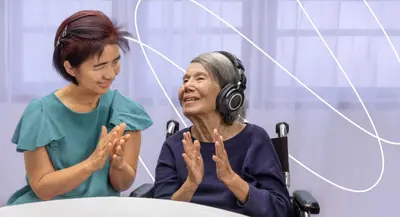
Music therapy extends past mood regulation into cognitive recall, physical rehab milestones, and social engagement, often within the same session. At its core, music therapy is simply the use of music by a qualified, registered therapist to support a person’s wellbeing. It’s tailored to the person, no musical skill required, and it’s typically used alongside other care rather than instead of it. If you haven’t read our guide to what music therapy actually is, that’s the place to start for the fundamentals.
So how does music therapy help, exactly? Here, we get into the mechanics behind it, what the research actually shows (including where the evidence is strong and where it’s still catching up), and what the music therapy benefits look like across different conditions and life stages.
Why does music therapy work?
Music therapy and the brain turn out to be closely linked: music engages more of the brain at once than almost any other activity we know of. A 2009 review by neuroscientist Stefan Koelsch found that listening to and making music activates sensory processing, attention, memory, emotional processing, and social cognition, often simultaneously, which is part of why music-based intervention shows up across such a wide range of conditions.
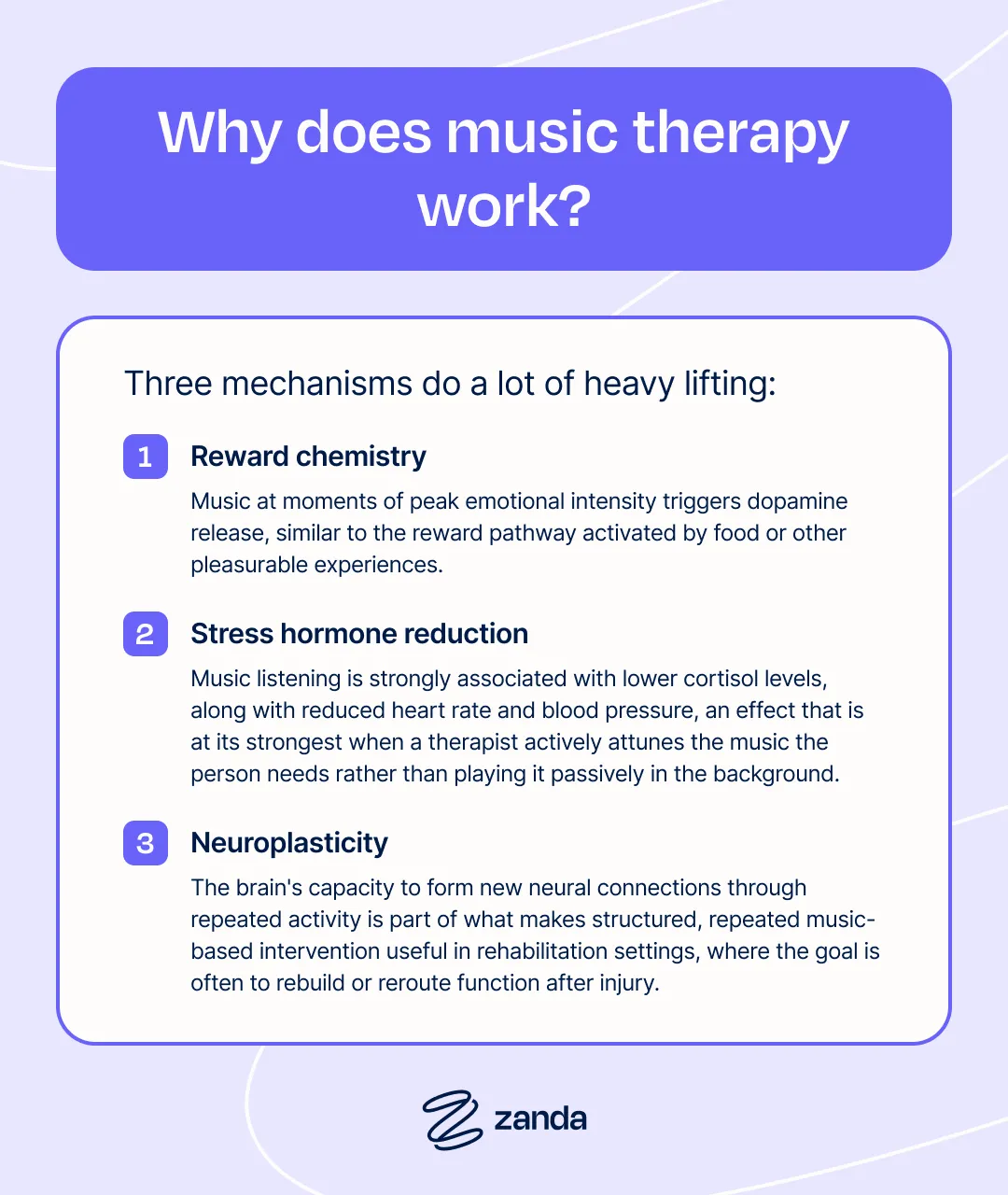
Three mechanisms do a lot of the heavy lifting:
- Reward chemistry. A widely cited 2011 study using PET imaging found that music at moments of peak emotional intensity triggers dopamine release in the striatum, the same reward pathway activated by food and other pleasurable experiences.
- Stress hormone reduction. A systematic review and meta-analysis on music therapy and stress reduction found that music listening is strongly associated with lower cortisol levels, the body’s primary stress hormone, along with reduced heart rate and blood pressure, and that the effect is strongest when a therapist actively attunes the music to the person’s needs rather than playing it passively in the background.
- Neuroplasticity. The brain’s capacity to form new neural connections through repeated activity. Research on musical training has linked regular musical engagement to measurable changes in gray and white matter in the frontal and temporal lobes, and that same plasticity is part of what makes structured, repeated music-based intervention useful in rehabilitation settings, where the goal is often to rebuild or reroute function after injury.
There’s also a fourth ingredient that isn’t about the music at all. The therapeutic relationship, the working bond between the person and a qualified therapist who shapes each session around their goals, is a core part of why music therapy works. It’s also what separates a structured intervention from simply pressing play on a playlist.
Mental and emotional benefits
The mental health benefits of music therapy are some of the best documented:
- Anxiety reduction through structured musical engagement
- Support for depressive symptoms, often used alongside standard care
- Mood and emotional regulation and general stress relief
- A non-verbal outlet for emotional expression when words are hard to find
- Improved self-esteem through mastery and creative participation
- Support processing trauma and grief
This is complementary to mental health care, not a substitute for therapy or medication. A 2017 Cochrane review found music therapy added to usual care produced improvements in depressive symptoms compared to usual care alone, and more recent systematic reviews have found similar effects. A 2022 update published in the European Journal of Public Health, reviewing effectiveness across autism, dementia, depression, insomnia, and schizophrenia, reached broadly the same conclusion: real but modest benefit, with room for stronger trial design.
Cognitive benefits
Music therapy supports attention, alertness, memory recall, and communication, which is part of why it shows up so consistently in dementia and Alzheimer’s care. Musical memory tends to be unusually resilient in dementia, and there’s a specific reason why:
- The brain regions that process long-known music, the caudal anterior cingulate cortex and ventral pre-supplementary motor area, show substantially less atrophy and metabolic disruption from Alzheimer’s disease than the rest of the brain
- These regions stay relatively intact until very late in the disease’s progression, according to PET and MRI imaging research
- That’s a plausible explanation for something families often notice firsthand: someone with advanced dementia who struggles to remember a face can still light up at a familiar song
For people with acquired brain injury or conditions that impair verbal language, music-based communication offers a channel that doesn’t rely on speech. Singing, rhythm, and structured musical cues can support word-finding and expression in ways that pure verbal therapy sometimes can’t.
Physical benefits
The physical benefits of music therapy include pain management for both acute and chronic conditions, relaxation with measurable physiological effects (shifts in heart rate and breathing among them), improved motor skills and coordination in rehabilitation settings, and better sleep quality.
Rhythm plays a specific role in motor rehabilitation. Timing cues from music help retrain movement patterns after a stroke or brain injury, giving patients a structured, repeatable framework for practicing motor tasks that pure physical therapy sometimes lacks. On the sleep side, several studies (including work building on an earlier Cochrane review) have found improved sleep quality and reduced pre-sleep anxiety following music-based intervention for people with insomnia.
Social benefits
Music therapy supports social connection in ways that are easy to underestimate. Group sessions, especially in aged-care and rehabilitation settings:
- Reduce isolation and loneliness
- Build communication skills
- Create a sense of group cohesion that’s harder to manufacture through conversation alone
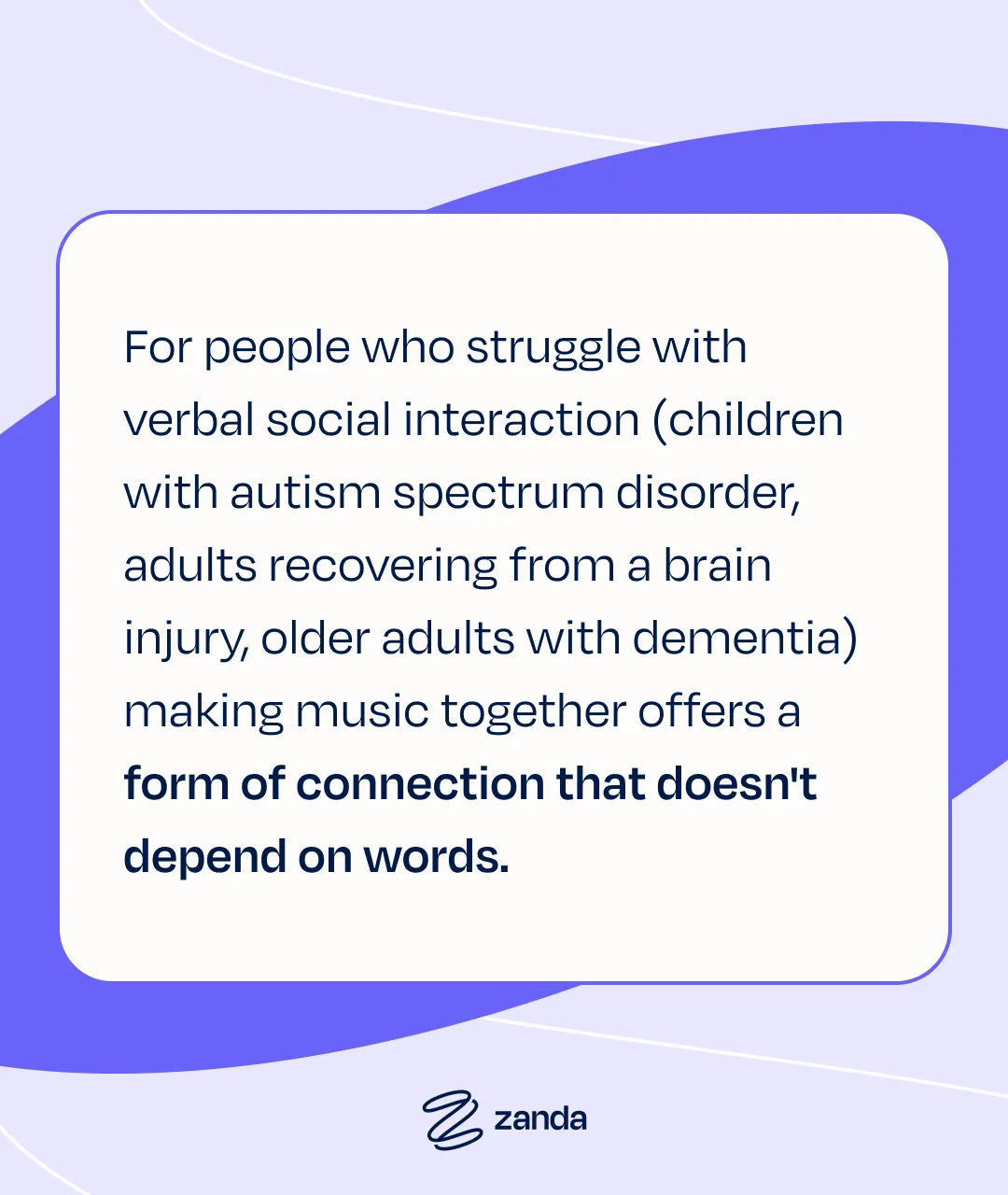
For people who struggle with verbal social interaction (children with autism spectrum disorder, adults recovering from a brain injury, older adults with dementia) making music together offers a form of connection that doesn’t depend on words.
Benefits across the lifespan
Children and autism. Music therapy supports social communication, behavior, and family relationships, giving children a structured way to engage that doesn’t rely on typical social scripts.
Consider a child like Jane, aged 7, who communicated almost entirely through echolalia before starting weekly music therapy sessions built around turn-taking on a drum kit. Eight months in, her family noticed she’d started initiating call-and-response games at home, something her speech therapist hadn’t seen in over a year of verbal-only sessions.
Adults and mental health. For anxiety, depression, and general stress, music therapy offers an emotional outlet that complements talk-based therapy rather than replacing it.
For example, John, a project manager with generalized anxiety, spent most of his first few sessions unable to name what he was feeling beyond “stressed.” His therapist shifted him toward songwriting instead of talking directly about the anxiety, and within a few weeks he’d written three short pieces that gave his care team language for triggers he hadn’t been able to describe out loud.
Older adults and dementia. Mood, behavior, and connection all benefit, often persisting even as other cognitive functions decline.
Gloria, 82 and living with mid-stage Alzheimer’s, no longer recognized her son’s face on some visits, but she sang every verse of “Moon River” without missing a word. Her care team built weekly listening and singing sessions around music from her twenties, and staff noted fewer agitation episodes on the days those sessions ran.
Neurological rehabilitation. For stroke and acquired brain injury, music-based intervention supports motor retraining, speech recovery, and mood during a long rehabilitation process.
After a car accident left Diane with significant right-side weakness, her rehabilitation team paired her physical therapy with rhythm-based music therapy, using a metronome-matched beat to help retrain her gait. Her physical therapist reported her stride symmetry improved faster than typical for her injury type once the rhythmic cueing was added.
Palliative, hospital, and NICU (neonatal intensive care unit) care. In end-of-life and hospital settings, music therapy supports quality of life, comfort, and emotional wellbeing.
In a hospice setting, a therapist worked with a patient in his final weeks to record a short song for his grandchildren, something his family still plays at gatherings. In neonatal intensive care, gentle music shaped around an infant’s specific responses, a slowed heartbeat, steadier breathing, supports regulation and family bonding during an intensely stressful period.
What does the evidence actually say?
This is where a lot of music therapy content either overclaims or goes quiet, and neither serves anyone well. So, plainly: is music therapy effective? The answer is that it depends on the condition, and the strength of the evidence varies considerably from one application to the next. Several Cochrane reviews exist covering depression, autism spectrum disorder, dementia, schizophrenia, and end-of-life care, and each one comes with its own certainty-of-evidence rating rather than a blanket yes or no.
Here’s a summary of what the evidence currently suggests:
| Area | What the better evidence suggests | Confidence |
|---|---|---|
| Dementia | Music-based interventions probably improve depressive symptoms slightly compared to usual care; may improve overall behavioral and social outcomes | Moderate for depressive symptoms; lower for other outcomes |
| Depression | May reduce depressive symptoms and improve mood when added to usual care | Low to moderate; varies by study |
| Autism spectrum disorder | May improve social interaction and communication, behavior, and parent-child or family relationships | Emerging, mixed to low-certainty on some outcomes, more consistent on global quality of life |
| Insomnia | May improve sleep quality and reduce anxiety or stress | Emerging |
| Schizophrenia | May improve quality of life, social functioning, and global or mental state | Limited; few low-risk-of-bias trials |
| End-of-life and cancer care | May improve quality of life, mood, and emotional wellbeing | Supportive, complementary |
A few things worth noting about this table. Certainty of evidence isn’t the same as effectiveness. Low-certainty evidence for a benefit doesn’t mean the benefit isn’t real. It means the studies so far haven’t been large or rigorous enough to be fully confident. And even where the evidence is moderate rather than high, that puts music therapy roughly in line with a lot of standard complementary therapies used across allied health.
Are there any risks or limitations?
Music therapy is generally low-risk. It’s a complementary therapy, meant to work alongside medical or psychological treatment rather than replace it. Emotionally significant material can surface during sessions, particularly work involving songwriting, lyric analysis, or reminiscence, and a qualified therapist needs to be equipped to hold that rather than let it go unaddressed. Someone in acute psychiatric crisis needs stabilization first, not a music therapy session, and a good therapist will recognize that and refer out rather than proceed.
Severe hearing impairment can also limit which interventions apply, though a therapist trained in the field will typically adapt toward vibration-based or visual rhythm cues rather than ruling music therapy out entirely. The benefits described throughout this piece depend heavily on working with a registered therapist (an RMT in Australia, credentialed through AMTA, or the equivalent in your country) and on goals that are actually built around the person rather than generic, since an unqualified provider working from a generic playlist doesn’t carry the same clinical value.
FAQ
Is music therapy actually effective? Effectiveness varies by condition. The evidence is strongest for depressive symptoms in dementia and depression, and still emerging for areas like autism and insomnia, but multiple Cochrane reviews support real, measurable benefits.
How do therapists track whether music therapy is actually working for a client? Therapists measure progress against the goals set during the initial assessment, using the specific outcome the intervention targeted (mood, motor function, communication) rather than a generic scale. Intake and Consent Forms for Music Therapy Practices covers what that intake and goal-tracking documentation typically looks like in practice.
What are the main benefits of music therapy? Mental and emotional support (anxiety, mood, self-expression), cognitive benefits (attention, memory), physical benefits (pain management, motor skills, sleep), and social benefits (connection, communication, reduced isolation).
Is music therapy backed by science? Yes. Music therapy is an evidence-based complementary therapy: randomized controlled trials and Cochrane reviews support its use across several conditions, though certainty of evidence varies and researchers consistently call for larger, more rigorous studies.
Can music therapy help with anxiety and depression? Yes, particularly as a complementary therapy alongside standard mental health care. Cochrane review data show improvement in depressive symptoms when music therapy is added to usual treatment.
How does music therapy help people with dementia? It supports mood and behavior, with moderate-certainty evidence for improved depressive symptoms, and it can reach people through music even after verbal communication has become difficult, thanks to musical memory regions that stay relatively intact late into the disease.
Is music therapy a replacement for medication or other treatment? No. It’s a complementary therapy, used alongside medical, psychological, or rehabilitative care, not instead of it.
Is music therapy funded by the NDIS? It can be, when delivered by a Registered Music Therapist and linked to a participant’s individual goals, though funding depends on the specific NDIS plan.