
How to Start a Music Therapy Practice

This is a guide to starting a music therapy practice, written for therapists who already have their credentials and are ready to start seeing clients on their own (virtually or in-person). If you’re still exploring the profession itself, our guide to what music therapy is covers the clinical side.
Clinical training teaches you to be a therapist, but it usually skips over the details of starting and running a business, which means learning how to start a music therapy practice is an entirely new set of skills. Here, we’ve broken it into a clear, step-by-step process below, so you know exactly what’s ahead and can come back to reference it.
Step 1: Confirm your qualifications and registration
Everything downstream depends on this step being complete first.
In the US: you need to be board-certified (MT-BC) through the Certification Board for Music Therapists (CBMT). That means an AMTA-approved degree, completed clinical hours, and a passed board exam. No shortcuts here, and no version of a US private practice that doesn’t start with this credential.
In the UK: HCPC registration is the legal requirement, with BAMT serving as the professional body.
In Australia: you need to be a Registered Music Therapist (RMT) with the Australian Music Therapy Association (AMTA). If you plan to do NDIS-funded work (National Disability Insurance Scheme), registration and eligibility requirements now apply on top of your RMT status, so check current AMTA guidance before you build a business model around it.
Step 2: Sketch a simple business plan
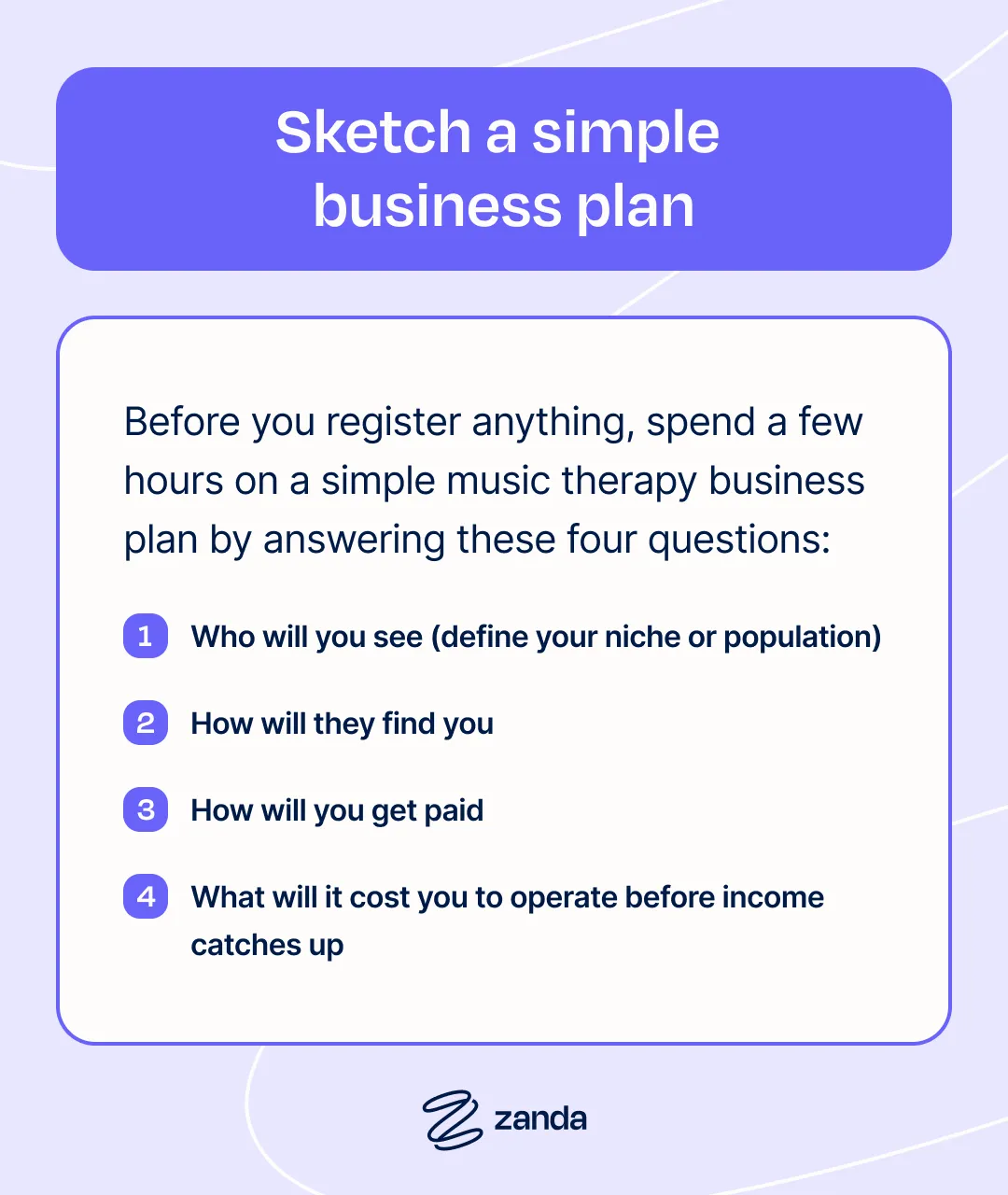
Before you register anything, spend a few hours on a simple music therapy business plan by answering these four questions:
- Who will you see (define your niche or population)
- How will they find you
- How will you get paid
- What will it cost you to operate before income catches up
Therapists who skip this step tend to make it up as they go, which usually means underpricing early on and realizing six months in that the numbers don’t work. A single page covering your niche, your first three referral sources, your target session rate, and your break-even client count gives you something concrete to check yourself against three and six months in.
This is also where you decide what kind of practice you’re actually building. Starting a music therapy private practice from scratch looks different from stepping away from a facility job with an existing referral base already in place, and being honest about which one you’re doing shapes almost every decision after this.
Before you lock in a launch date, it helps to tally what getting started will actually cost. Instruments and basic equipment (a portable keyboard, hand percussion, adaptive instruments for clients with limited mobility) run anywhere from a few hundred to a few thousand dollars depending on your niche. Add professional indemnity and public liability insurance premiums, AMTA or CBMT membership and credentialing fees, a practice management software subscription, and a basic website, and most therapists spend somewhere in the low thousands before their first paid session. Knowing this number before you start means you’re not caught short three months in.
Step 3: Choose and register your business structure
Most music therapists in private practice operate as sole traders or self-employed individuals, at least starting out, rather than forming a company.
- In the US: choose between a sole proprietorship and an LLC, register your business, and apply for an EIN through the IRS. An LLC adds a layer of liability protection a sole proprietorship doesn’t, which matters more once you’re seeing clients regularly.
- In the UK: decide between operating as a sole trader or forming a limited company. As a sole trader, register with HMRC for Self Assessment and you’ll receive a Unique Taxpayer Reference (UTR) by post. A limited company registers separately with Companies House and comes with its own liability protections, but adds more admin than most solo practitioners need starting out.
- In Australia: decide between a sole trader structure and a company or partnership, then register for an ABN and, if relevant, GST. Open a dedicated business bank account before you take your first client payment.
Structure choice has tax and liability consequences, and warrants a conversation with an accountant or business advisor.
Step 4: Sort insurance, privacy, and compliance
Professional indemnity insurance and public liability insurance aren’t optional extras when you’re the sole operator of your practice. If something goes wrong, that coverage is the only thing standing between a bad session and your entire business.
Privacy, clinical documentation, and background check obligations follow you regardless of country:
- In the US: HIPAA compliance, plus a background check with requirements that vary by state and setting
- In the UK: UK GDPR compliance (including registering with the ICO as a data controller), plus an enhanced DBS check
- In Australia: Privacy Act and health-records requirements, plus a national police check and Working with Children Check (WWCC), often required for NDIS work
Know your scope of practice cold, and keep the AMTA or CBMT competency and ethics standards close at hand. This is what protects both you and the people you’re working with.
Step 5: Decide how you’ll get paid
Your funding model shapes almost every other decision in this guide, so get clear on it early.
In the US, there’s no blanket insurance coverage for music therapy. Reimbursement is case-by-case: some private insurers will cover it with pre-approval, some state Medicaid waiver programs include music therapy, and Medicare pathways are limited and specific. A lot of MT-BCs start out entirely self-pay, or build a caseload through school and facility contracts, specifically to avoid the overhead of insurance paneling while they get established. If you do go the insurance route later, you’ll need to get familiar with the relevant CPT codes for billing.
In the UK, there’s no single dominant funding scheme, and private practice runs mostly on self-pay and referral-based work. Private health insurance rarely covers music therapy the way it covers physiotherapy, so most independent therapists build a caseload from a mix of self-funding families, schools, and charities.
For pediatric work specifically, an Education, Health and Care Plan (EHCP) can include music therapy as specified provision, funded through the local authority rather than the NHS, which makes understanding EHCP processes worth the time if that’s part of your caseload.
In Australia, the NDIS is the dominant funding stream for music therapy, followed by private pay. You’ll work with participants who are self-managed, plan-managed, or agency-managed, each with different administrative requirements on your end.
Look into becoming an NDIS registered provider and understand current NDIS pricing (the PAPL guide has the specifics; rates change, so don’t rely on a number you saw six months ago). Funding was reviewed recently and confirmed to continue, with updated pricing and an ongoing evidence review still in progress, so check current NDIS rules rather than assuming last year’s structure still applies.
Step 6: Set up service delivery and your space
Music therapy doesn’t require a fixed clinic, and a lot of successful private practices don’t have one.
Decide whether you’re working from a clinic space, delivering in-home or community-based sessions, or running telehealth. Mobile and home-visit practice is common across aged care, schools, and disability services, which means your logistics planning (instrument transport, scheduling drive time, what fits in your car) matters as much as your clinical planning.
For a mobile caseload, instrument choice becomes a practical decision as much as a clinical one. A compact keyboard, a ukulele instead of a full guitar, hand percussion that survives being packed and unpacked daily. These hold up better than anything fragile or oversized once you’re loading and unloading a car several times a day. Many mobile therapists keep a core kit that covers most session types rather than carrying their full instrument collection to every visit, adding specialized pieces only when a specific client’s goals call for them.
Step 7: Set your rates and manage the finances
Rate-setting depends heavily on your funding model. NDIS-funded work in Australia is capped by NDIS price limits, so your rate isn’t fully yours to set. Private-pay work, in both Australia and the US, lets you set the price yourself. Check those rates against your business plan every few months and adjust as your bookings fill in.
You’ll want a system to track cash flow, invoicing, and bookkeeping early on. Usually you won’t need to hire an admin person right away. Zanda is built to handle invoice collection, payment tracking, follow-ups, and revenue reporting in one platform, covering most of what a solo practitioner needs without adding headcount.
Step 8: Choose the software to run your practice
This is where a lot of new practice owners underestimate the workload. Scheduling, clinical notes, billing and claiming, telehealth delivery, intake forms, and outcome measurement all need a home, and doing it manually eats hours you’d rather spend with clients.
A practice management platform built for allied health should cover:
- Scheduling and calendar management
- Clinical documentation and notes
- Billing, invoicing, and claiming
- Telehealth delivery
- Intake and consent forms
- Outcome measurement, so you can actually demonstrate client progress over time
- AI assistance for notes, which cuts down the after-hours admin that eats into evenings
This is the infrastructure Zanda was built around: a single platform handling scheduling, documentation, claiming, and outcome measures so music therapists spend their time on sessions instead of chasing paperwork across five different tools. Plus, BizzyAI is built in to make transcribing and writing notes far faster than doing everything manually.
When choosing your software, also beware of any platforms that don’t have external certifications including ISO27001, HIPAA and GDPR. These validate that the software, and the business behind the software, operates in ways that will keep your client data secure and private.
Step 9: Find clients and market your practice
Don’t spend on paid advertising right off the bat. Focus on building your referral network instead. Referrers can include GPs and other allied health professionals, NDIS support coordinators and Local Area Coordinators (LACs) in Australia, and schools or aged care facilities, especially ones you’ve worked with before going solo.
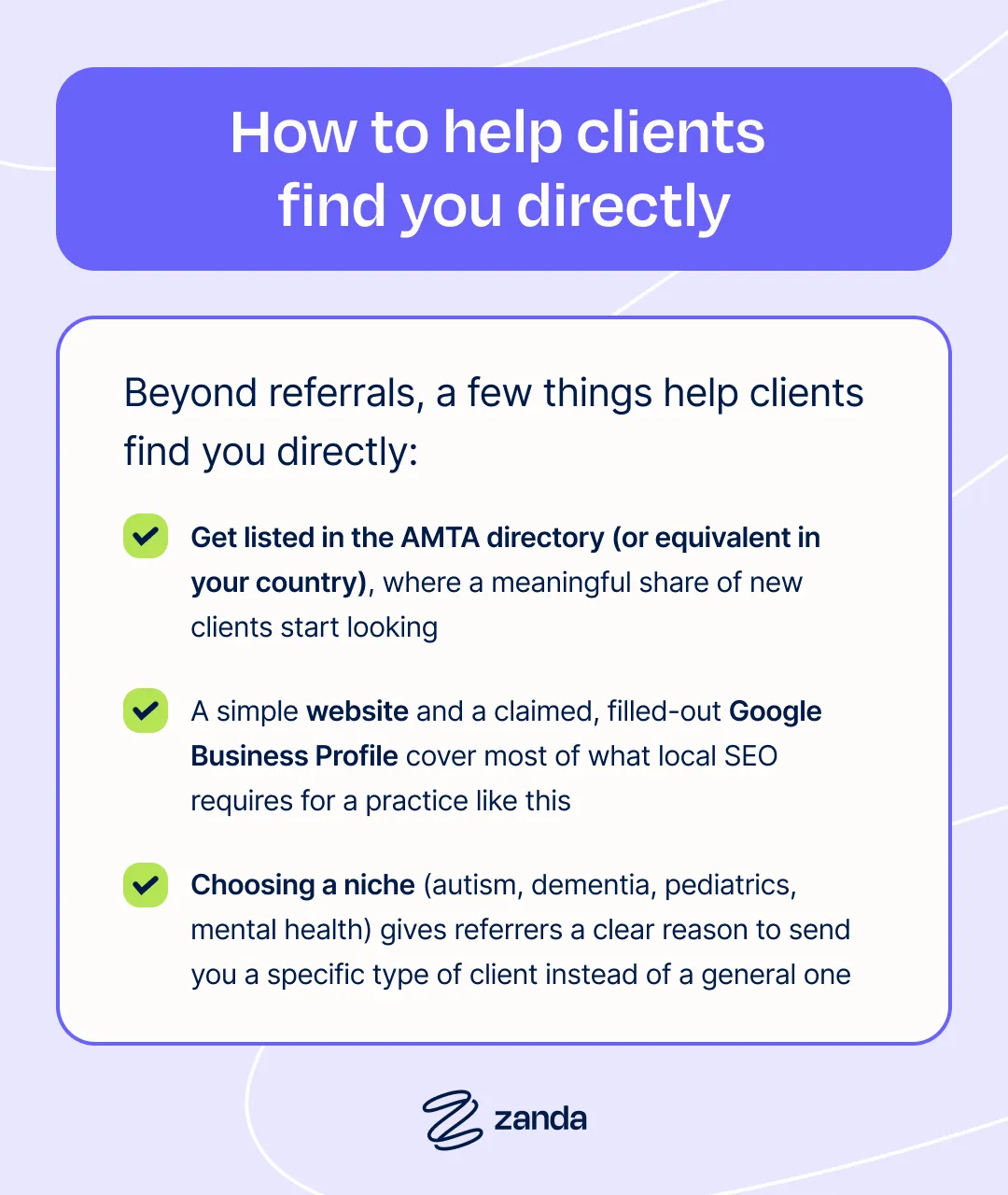
Beyond referrals, a few things help clients find you directly:
- Get listed in the AMTA directory (or the equivalent in your country), where a meaningful share of new clients start looking
- A simple website and a claimed, filled-out Google Business Profile cover most of what local SEO requires for a practice like this
- Choosing a niche (autism, dementia, pediatrics, mental health) gives referrers a clear reason to send you a specific type of client instead of a general one
A handful of strong outcomes with the right referrers, a pediatrician, a memory care director, or a school counselor all tend to generate more consistent bookings over a year than any amount of paid social spend, since the referral carries built-in trust an ad can’t replicate.
Step 10: Build referral relationships and plan for growth
Referrals from other allied health professionals work differently than the ones above, since they build over months of repeat contact instead of a single listing or web search. A physical therapist, occupational therapist, or speech pathologist who trusts your work will keep sending referrals long after your first meeting with them, so these relationships pay off more when you treat them as ongoing rather than a one-time introduction.
Growth also looks different depending on the practice you want to run. Some music therapists take on subcontract work with agencies or schools alongside their own caseload. Others eventually bring on additional RMTs or MT-BCs and build group programs, turning a solo practice into a small team. Neither path is more legitimate than the other; it comes down to what you actually want to run.
Step 11: Stay compliant and keep your registration current
Getting registered and credentialed isn’t a one-time task. AMTA requires ongoing CPD in Australia, and CBMT requires CMTE recertification in the US, both on defined cycles you need to track. Re-registration deadlines sneak up faster than expected once you’re busy running a practice.
For Australian practitioners specifically, NDIS rules and pricing shift more often than most other funding schemes, so building a habit of checking current guidance (rather than assuming last year’s rules still apply) protects both your compliance and your revenue.
Putting it all together
None of these steps depend on the others being perfect first. Most therapists work through qualifications, structure, and insurance in parallel with their business plan, then layer in funding, software, and marketing once the fundamentals are locked down. If you take one thing from this guide on how to start a music therapy practice, let it be this: the therapists who get to a steady caseload fastest are the ones who treat the business side with the same seriousness as the clinical side, not as an afterthought to be figured out later.
Your new music therapy practice is waiting
Starting a music therapy practice isn’t complicated. As the steps above show, it’s a series of manageable tasks, and none of them requires a business degree. What it does take is intentionality: treating the business side of your practice with the same care you bring to your clinical work.
So if you’re a passionate music therapist, let that passion carry you through the setup. Every registration, insurance policy, and system you put in place brings you one step closer to the clients whose lives will be better because you decided to do this. Music therapy changes lives, and a well-run practice is what lets you keep delivering it, week after week, on your own terms.
Pick your first step and take it today. Your future clients will be glad you did.
FAQ
Do I need to be a registered or board-certified music therapist to start a practice?
Yes. An RMT credential through AMTA in Australia, or MT-BC certification through CBMT in the US, is required before you can practice credibly and access funding streams for music therapy services.
Can music therapy be funded by the NDIS, and do I need to register as a provider?
Yes, the NDIS is the dominant funding source for music therapy in Australia. You can work with self-managed and plan-managed participants without provider registration, though registration opens up agency-managed participants and comes with its own requirements.
Is music therapy covered by insurance, and how do I get reimbursed?
There’s no blanket coverage in the US. Reimbursement depends on the individual insurer, state Medicaid waiver programs, or limited Medicare pathways, which is why many therapists start with self-pay or facility contracts.
How much can a music therapist earn or charge in private practice?
This varies widely by location, funding model, and niche. NDIS-funded rates are capped by current price limits, while private-pay rates are set by the therapist based on local market and experience.
Can I run a music therapy practice from home, mobile, or via telehealth?
Yes. Many music therapists run in-home, community-based, or telehealth practices rather than a fixed clinic, and NDIS funding in Australia supports flexible delivery formats including group sessions.
What software do music therapists use to manage their practice?
Most use practice management software covering scheduling, clinical documentation, billing and claiming, telehealth, and outcome measurement, since handling these separately becomes unmanageable once a caseload grows.
How long does it take to set up a music therapy practice?
Timelines vary, but between registration, insurance, business setup, and building a referral base, most therapists spend two to four months on getting to a steady caseload in a self-sustaining practice. But taking the first steps and getting to a point where a music therapist sees their first client in their own practice can also be very fast.