
What Is Music Therapy?

When US Congresswoman Gabby Giffords survived a gunshot wound to the head that took away her ability to speak, music therapy was able to bring her words back through singing. Her music therapist started with “Happy Birthday,” singing the line and leaving the last word for Giffords to fill in the name of her husband. She continued using melody and rhythm to reroute language through undamaged parts of her brain until sentences she couldn’t say became sentences she could sing, and eventually say again.
That’s music therapy in practice: rhythm and melody reach parts of the brain that speech alone sometimes can’t touch after an injury like that, and a therapist trained to use that connection deliberately, session by session, helped her find her way back to words she’d lost.
Most people picture music therapy as someone strumming a guitar at a bedside or a patient putting on headphones to relax, which isn’t wrong exactly, but it misses the assessment behind the session, the goals set specific to that person, and the therapist tracking whether any of it is working the way any other allied health treatment plan would. This guide gets into what actually happens in a music therapy session, who it tends to help most and why, and what separates a credentialed therapist from a well-meaning musician in the room.
What is music therapy?
Music therapy is the clinical, evidence-based use of music (played, sung, written, or listened to) within a structured therapeutic relationship. It’s delivered by a qualified, credentialed therapist to address physical, emotional, cognitive, and social goals built around the specific person receiving care.
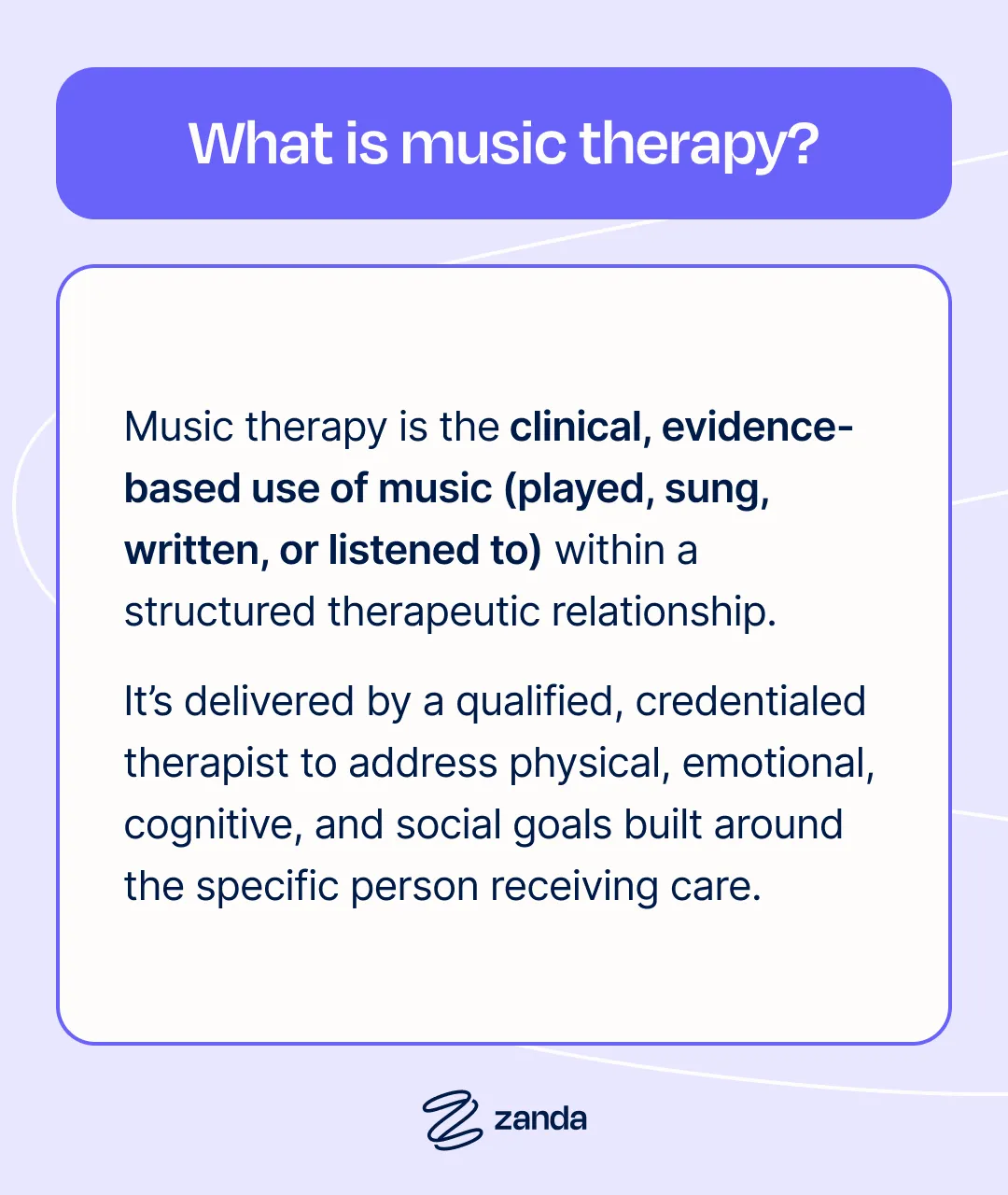
The therapeutic relationship is doing a lot of work in that definition. Music therapy involves a therapist assessing a person, setting goals specific to their situation, and using music as the mechanism to reach those goals, not simply music playing in the background near someone who happens to have a health condition. Two people with the same diagnosis can walk into music therapy and leave with completely different session plans, because the plan was built around them, not the diagnosis. You don’t need to read music, play an instrument, or carry any musical background at all to benefit from it.
How does music therapy work?
So, what does a music therapist do on a daily basis? Assessments, planning, delivering interventions, and tracking progress cover the bulk of a music therapist’s work.
A session follows a clinical arc even when it doesn’t look clinical from the outside. It starts with an assessment: the therapist learns the person’s history, needs, and what they hope to work toward, whether that’s motor function after a stroke, emotional regulation for a child with autism, or pain management during a hospital stay. From there, the therapist sets goals specific to that person and builds interventions designed to reach them, which might mean playing an instrument to work on fine motor control, writing a song to process grief, or listening to and reflecting on music chosen for its emotional weight. Progress gets reviewed on a regular basis, and the plan shifts as the person does.
The music itself is the vehicle, not the destination. The therapeutic relationship, the assessment, and the goal-setting built around the person are what separate a session from someone playing a well-loved song in the background at home.
What happens in a music therapy session
Sessions typically run 30 to 60 minutes and happen weekly or every two weeks, though a hospital or NICU session might be shorter and more frequent depending on the setting and the person’s needs. Some clients work one-on-one with a therapist, especially where the goals are personal (grief processing, speech recovery after a stroke), while others meet in small groups, common in schools, aged care, and disability services, where the social dynamic of making music together becomes part of the intervention itself.
A single session might move through several beats inside that clinical arc: a check-in, an instrument-based warm-up, a focused intervention tied to that day’s goal, and a closing reflection, though the shape flexes depending on what the person needs that day. Length, frequency, and format follow the same logic as everything else in music therapy, built around the person rather than a fixed template.
Types of music therapy: active and receptive approaches
Music therapy techniques split broadly into two categories, active (also called expressive) and receptive, and a therapist typically draws from both depending on what a session calls for.
Active methods involve the client making music directly:
- Improvisation: spontaneous music-making with no wrong notes, often used to explore emotion or build a sense of agency
- Instrument playing: structured or free play on percussion, keys, or other accessible instruments
- Singing and vocal work: used for breath support, emotional expression, and social connection
- Songwriting and lyric analysis: writing original lyrics or unpacking the meaning in existing songs to process experience
- Music and movement: pairing rhythm with physical movement for motor or coordination goals
Receptive methods rely on listening rather than making music directly:
- Music listening and reminiscence: using well-loved or era-specific music to trigger memory and connection, common in dementia care
- Guided Imagery and Music (GIM): a structured receptive listening technique combining music with guided imagery for deeper emotional exploration
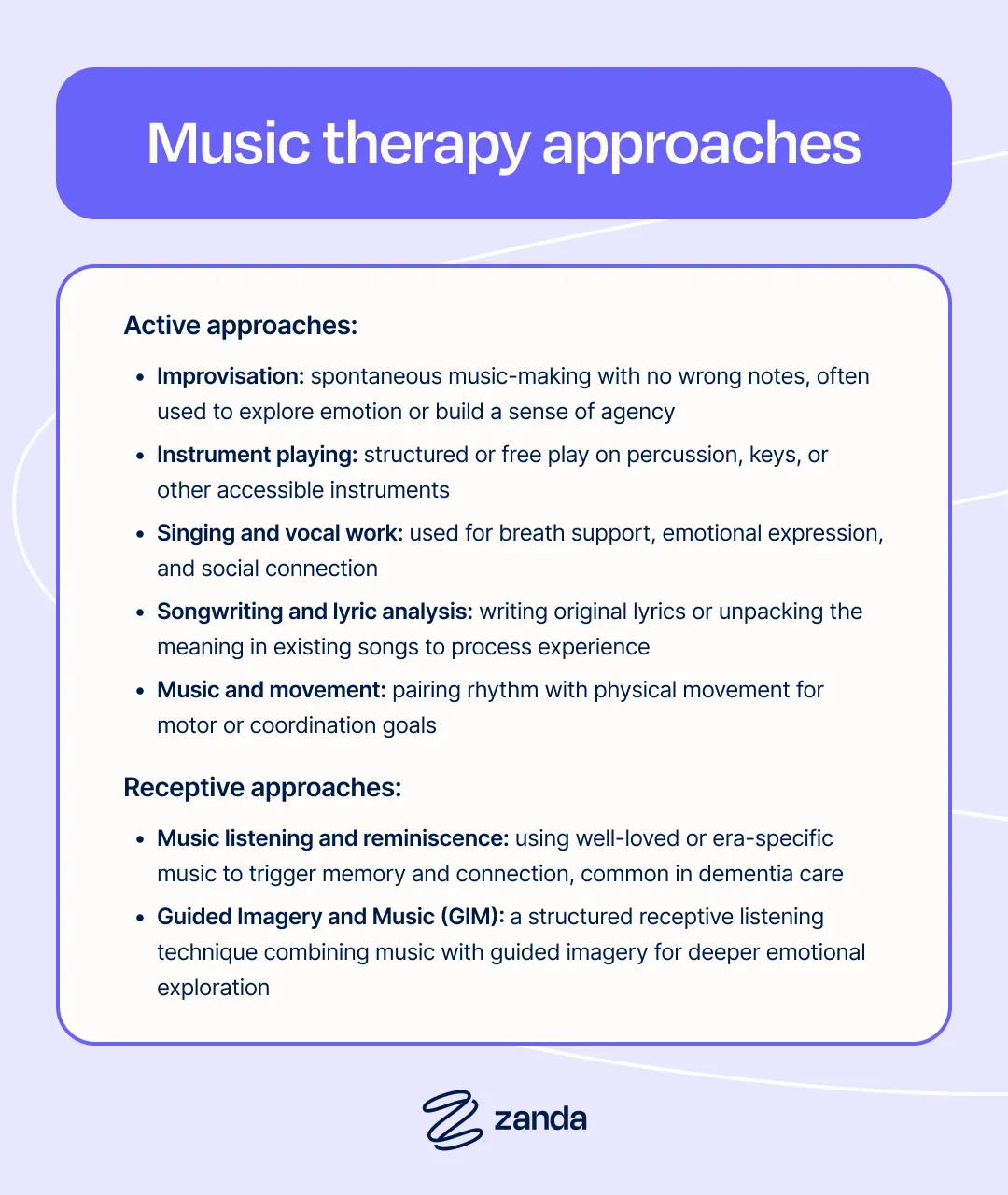
A therapist chooses between and combines these types of music therapy based on the goals set during assessment, which is part of why a session can look completely different from one client to the next even within the same diagnosis.
Music therapy benefits, by population
People of all ages benefit from music therapy, and none of them need a musical background to do it. The populations below each represent a body of practice, and in several cases a topic deep enough for its own article, but the throughline stays the same: music therapy meets people where a purely verbal or purely physical intervention sometimes can’t.
Children and autism, or other developmental needs. Music therapy supports communication, social interaction, and self-expression in children who may find musical engagement more accessible than verbal engagement.
Mental health. For anxiety, depression, and stress, music therapy offers a structured outlet for emotional expression that doesn’t rely on talking about the feeling directly.
Dementia and older adults. Familiar music reaches memory and mood in ways that can persist even as other cognitive functions decline, supporting connection and quality of life for people with dementia and the families caring for them.
Neurologic rehabilitation. After a stroke or acquired brain injury, rhythm-based interventions support motor retraining and speech recovery as part of a broader rehabilitation plan.
Pain, hospital, NICU, and palliative care. In neonatal intensive care, gentle interventions built around the infant’s specific responses support regulation and family bonding. In palliative care, music therapy supports comfort, self-expression, and quality of life at end of life.
Where do music therapists work?
Music therapists work across hospitals and NICUs, schools, aged care facilities, rehabilitation settings, and community and disability services, and increasingly, private practice. That last setting is where a growing number of therapists are building independent careers, running their own caseloads instead of working exclusively inside a larger institution, which shifts the conversation from how music therapy works clinically to how someone actually builds a caseload and a business around it.
Is music therapy evidence-based?
Yes, music therapy is an established, research-supported allied health profession, backed by decades of clinical study and named among complementary approaches by bodies including the NIH’s National Center for Complementary and Integrative Health. At the same time, the evidence base is stronger for some applications, like effects on pain perception, mood, and motor rehabilitation, than others, and NCCIH itself notes that research into several specific applications is still preliminary and would benefit from larger, more rigorous studies.
A profession built on assessment, goals built around the person, and a solid evidence base doesn’t need to overclaim to be credible, and the overclaiming, ironically, tends to be what erodes trust instead of building it.
That tension between clinical evidence and policy pressure played out publicly in Australia at the end of 2024, when the National Disability Insurance Scheme (NDIS) moved to strip music and art therapy from a funded support category without consulting the industry, a decision that triggered petitions and public backlash from Registered Music Therapists across the country. An independent review followed, led by health economist Dr. Stephen Duckett AM, and his report landed in September 2025 confirming what practitioners had argued from the start: art and music therapy can produce measurable, beneficial outcomes when delivered by a qualified therapist.
The NDIS supported all of the recommendations, including a new national price limit of $156.16 an hour that took effect in November 2025. This is a useful case study in what happens when evidence and access collide with policy, and it’s exactly the kind of scrutiny an evidence-based profession should be able to hold up under.
What music therapy is not
A few things get lumped in with music therapy that don’t belong there, and clearing this up matters for anyone trying to figure out what they’re actually looking for.
Listening to music on your own to unwind counts as self-care, not treatment, since there’s no assessment, no credentialed therapist, and no clinical goal built around a specific person behind it.
Music education and lessons aren’t music therapy either, even when a student experiences meaningful emotional benefit from learning an instrument. The goal in a lesson is skill acquisition, learning to play, not a clinical outcome tied to a health or developmental need.
Sound healing and sound baths get confused with music therapy most often, and the confusion makes sense given the overlapping vocabulary. But sound healing isn’t delivered by a credentialed therapist, doesn’t involve a clinical assessment, and isn’t grounded in the same evidence base. The differentiator across all three is consistent: a qualified therapist, a goal built around the person, and research behind the approach.
Who is qualified to provide music therapy?
Credentialing varies by country, and it helps to know the terms before looking for a provider.
United States: A board-certified music therapist (MT-BC), credentialed through the Certification Board for Music Therapists and aligned with the American Music Therapy Association (AMTA US).
United Kingdom: A music therapist registered with the Health and Care Professions Council (HCPC), the statutory regulator for the profession, with the British Association for Music Therapy (BAMT) serving as the professional body.
Australia: A Registered Music Therapist (RMT), registered with the Australian Music Therapy Association (AMTA), typically through an AMTA-accredited master’s degree at the University of Melbourne or Western Sydney University, or an assessed equivalent qualification.
Thinking about becoming a music therapist?
If you’re a musician or allied health professional turning this over, the credentialing path above is your starting point. Few careers ask you to hold both a musical ear and a clinical eye at once, watching in real time as a chord progression opens up a stroke patient’s speech or a familiar melody pulls a dementia patient back into a conversation with their family. Get credentialed, then choose your setting: working inside a hospital or aged care facility under an existing clinical team, or building a private caseload of your own. Either path starts the same way, with a degree that treats musicianship and clinical judgment as equally serious skills. Not many jobs let you watch the thing you love doing become the thing that heals someone. Music therapy does.
FAQ
Do you need to be musical to do music therapy?
No, clients don’t need any musical ability or background to benefit from music therapy. Music therapy is built around the person’s goals, not their musical background, and most interventions ask for no instrument skill or singing ability at all. For practitioners, most accredited programs expect a base level of musicianship coming in, since delivering an intervention safely means being fluent enough on an instrument or voice to adapt in the moment.
What happens in a music therapy session?
A session typically follows assessment, goal-setting specific to the person, a designed music-based intervention (active or receptive), and ongoing review as needs evolve.
What conditions can music therapy help with?
Music therapy supports autism and other developmental needs, mental health conditions like anxiety and depression, dementia, neurological rehabilitation after stroke or brain injury, and pain or comfort in hospital, NICU, and palliative care settings.
Is music therapy backed by science?
Yes. It’s a research-supported profession named among complementary approaches by bodies including NCCIH, though the strength of evidence varies by application, and some areas of research are still developing.
How is music therapy different from just listening to music?
Listening to music independently is self-care. Music therapy adds a credentialed therapist, a clinical assessment, and goals built around the person, none of which are present when someone puts on a playlist alone.
How do I find a qualified music therapist?
In the US, look for MT-BC credentials aligned with the American Music Therapy Association. In the UK, confirm HCPC registration. In Australia, search the AMTA directory for a Registered Music Therapist (RMT).
Is music therapy covered by the NDIS?
Yes, but check current regulations, as they may change. After the NDIS’ 2024 attempt to remove funding sparked industry-wide pushback, an independent review confirmed music therapy remains available under the NDIS when it’s linked to a participant’s goals and delivered by a Registered Music Therapist, with updated pricing of $156.16 an hour that took effect in November 2025.