
How to Get Your First 10 Clients in Private Practice

You’ve built up clinical confidence working under someone else’s roof, and maybe even have a client or two who ask for you by name. At some point you start wondering if it’s time to start your own practice. But how do you get your first clients in private practice? It’s true that this can feel like the hardest part of starting your own private practice, but every practitioner who’s ever started out on their own has been exactly where you are now, and they all made it through.
Let’s focus on getting those first 10 clients, and then the rest tends to start falling into place.
How do you know you’re ready?
The first 10 clients ask more of you than any 10 after them, simply because you don’t have a reputation or a referral pipeline built yet. That’s where everyone starts, but it shifts once you’ve got a history of sessions and outcomes behind you. Every client you help proves to that client you know what you’re doing, and it proves the same thing to you, which is how conviction actually gets built: by racking up evidence that you’re good at this.
The first decision that matters is whether to leave your current role completely and build a caseload from day one, or keep steadier ground under you while you grow on the side. Going all in forces fast, focused action, since your income needs replacing. Easing in gives you room to build at a natural pace. Pick the one that is right for your life now.
Damien Adler, Co-Founder of Zanda, built his own practice from the ground up and ran it for over a decade before selling it, and wrote the best-selling 9 Secrets of Successful Health Practices along the way. He’s talked candidly about what those first 10 clients actually took. This is what he recommends.
1. Act as if
You’ve probably heard of “fake it till you make it.” This is a version of that. It’s showing up as if you already have a full caseload today: get ready, go to your office (or open your laptop), be prepared to answer the phone or an email, and be ready to take a booking at the last minute. Showing up “as if” means you’re ready the moment that first client calls, and it starts wiring you into the identity of a private practice owner before you’ve got the caseload to prove it.
Damien tells the story of his own opening day like this:
“I remember thinking the phones weren’t going to ring themselves, and there was a real question in my head about whether I should just be sitting in an empty office. At 9 a.m. on the day we opened, the phone rang. Someone had heard about us and wanted to book. If I hadn’t been sitting there to answer it, we would have lost our very first client before we’d even started.”
That mindset carries past opening day too. Every process you’d eventually need with a full caseload (intake forms, a cancellation policy, consent paperwork) is worth having ready before you need it, not scrambled together after the first call comes in. And no, you don’t need a fully built website before you open your doors. A one-page site with your name, what you help with, and a way to book is plenty until you’ve got the caseload to justify more.
2. Know what you offer, and know how to say it
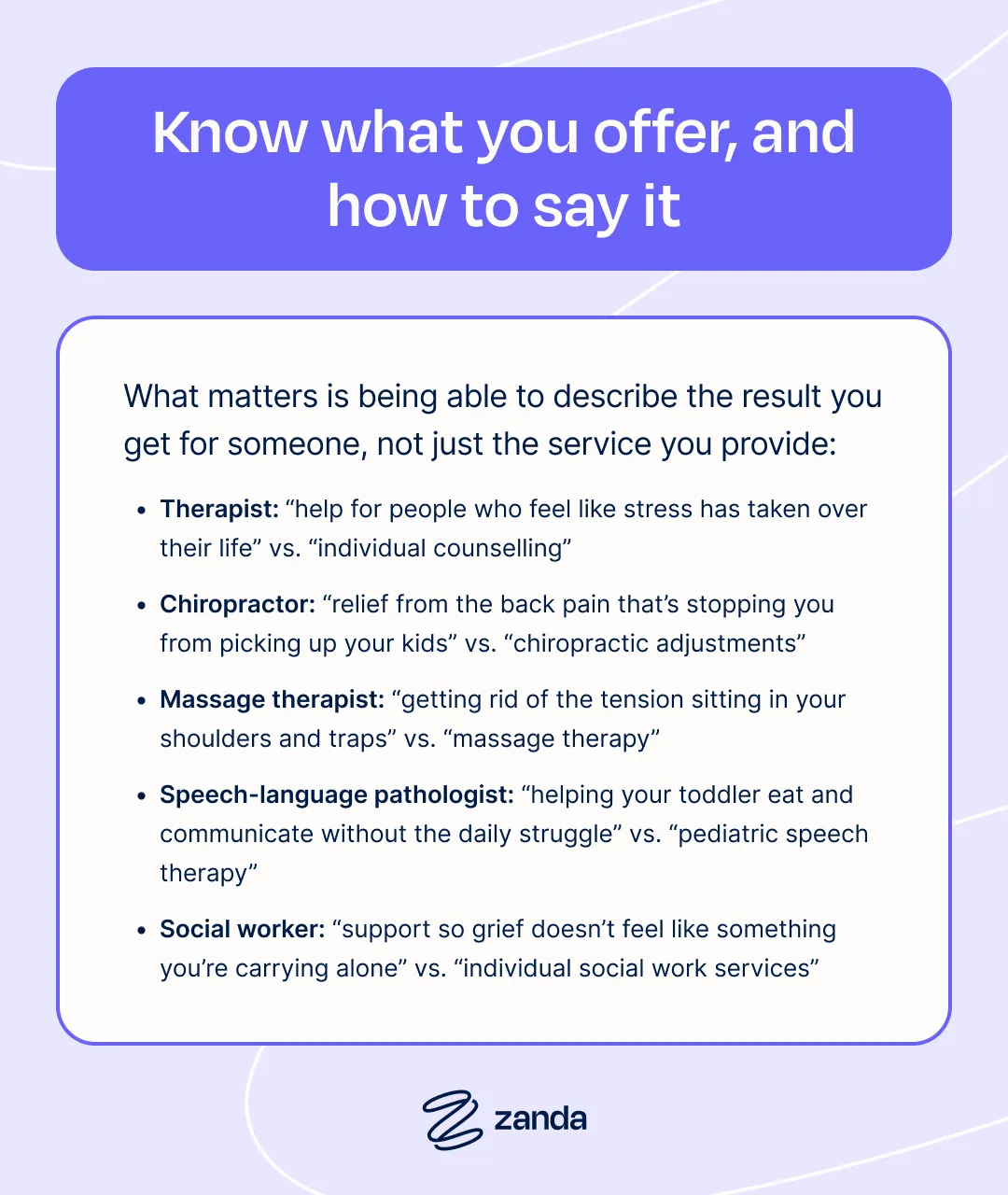
Finding your niche in private practice isn’t something you need to have figured out on day one. Plenty of practitioners start out with a very general direction, and narrow their focus years later, once they’ve seen enough clients to know what they’re actually good at and what they enjoy most. What matters from the beginning is being able to describe the result you get for someone, not just the service you provide. That’s your unique selling point.
A client searching “therapist near me” gets a dozen results that all read the same: individual counseling, evidence-based approach, accepting new clients. Scroll through massage therapists nearby and it’s the same wall of “deep tissue, sports massage, relaxation.” Nobody’s differentiating on the page, so nobody’s differentiating in the client’s head either. The one who breaks that pattern is the one who gets remembered. The exercise is the same across every specialty, just the language changes:
- Therapist: “help for people who feel like stress has taken over their life” instead of “individual counseling”
- Chiropractor: “relief from the back pain that’s stopping you from picking up your kids” instead of “chiropractic adjustments”
- Massage therapist: “getting rid of the tension sitting in your shoulders and traps” instead of “massage therapy”
- Speech-language pathologist: “helping your toddler eat and communicate without the daily struggle” instead of “pediatric speech therapy”
- Social worker: “support so grief doesn’t feel like something you’re carrying alone” instead of “individual social work services”
The clearer you are on the result you create, the easier it is to have an answer ready the moment someone asks, whether that’s another practice sizing you up as a referral or someone at a barbecue asking what you do for work. Get this language locked before you need it, because you never know which version of that question turns into your next client.
3. Set up a practice management system
You need somewhere for a client to land: a booking link, an intake form, a way to hold their information that isn’t a notebook or a stack of sticky notes. This is the piece people skip because it feels like admin, but it could be the difference between someone booking on the spot and someone deciding to “think about it” because the process felt clunky. And you still don’t need a website to make this work. A booking link does the job a homepage would.
Damien recommends getting a practice management system with a client portal. Clients book their own appointment, fill out intake paperwork before they walk in, and get reminders without you chasing anyone down. You get a home for notes, invoicing, and scheduling that scales with you from client one to client 100. The Zanda Starter Plan is built for this stage, because it includes 1000 appointments and is priced for someone just starting out so you don’t have to pay for capacity that you don’t need yet.
4. Leverage the referral sources you already have
Introduction letters to doctors and GPs (general practitioners) and your existing referral network are one of the best tools you can use for getting your first clients. Keep it short: who you are, what you specialise in, how to refer. One page, not four.
Visits or emails to colleagues, including ones outside your own industry, are also recommended. A psychologist opening a practice might reach out to the children’s dentist down the street, not just other psychologists, because parents managing one kind of appointment are often managing several.
Brochures in the waiting rooms of adjacent practices: the PT down the hall, the massage therapist two doors down, the chiropractor whose clients might need exactly what you do.
Local Facebook groups where your ideal client is already asking “does anyone know a good [specialty] near me?” Answer that question in public and you’ve just referred yourself.
5. Take whatever comes through the door
Your first clients aren’t the time for you to be selective. They’re about building the skill, confidence, and track record that eventually allows you to be selective. Take the clients you believe you can help, even when they look nothing like the caseload you pictured when you drew up your business plan.
A nutritionist might feel most drawn to working with competitive athletes, but her first 10 clients end up being an overwhelmed mother trying to get dinner on the table without a nightly negotiation, a high-achieving executive whose travel schedule has wrecked his eating habits, and a retiree managing a new diabetes diagnosis.
A therapist might have a particular interest in supporting career transitions, but her first 10 clients turn out to be a couple navigating a rough patch in their relationship, a college student dealing with anxiety for the first time, and someone processing a recent loss. Every one of them is a chance to build skill, refine how she works with people, and start earning the kind of word-of-mouth that eventually brings the caseload she imagined.
6. Don’t burn the bridge with your current employer
Have the open conversation early, before you have a firm exit date. Tell your employer what’s on your mind, ideally months out rather than weeks. Ask directly what leaving well could look like: notice period, how existing clients get handled, whether any of them are free to follow you if they choose to.
This is how you end up receiving overflow referrals down the line, or become the specialist a former colleague thinks of first when their books are full. Damien has seen both sides of this conversation, as the one leaving and as the one being told:
“We had people come to us and say they were thinking about starting their own practice, and we were supportive of that. You have different conversations when someone’s honest with you early. We let people take some clients with them if that’s what made sense. There’s no reason for anyone to leave with bad blood over it.”
The people you were straight with on the way out are often the same ones sending you work a year later. Damien says it plainly: “Your competitors are also your colleagues.”
The obvious way not to do any of this
Here’s the version that gets people in trouble: go into a role planning to build a caseload just so you can leave with it, poaching clients quietly on your way out the door. It puts you in a legal gray area and a moral one that’s murkier still, risking the exact relationships (with your employer, with the referrers who trusted you) that step 6 is asking you to protect. If clients want to follow you when you leave, that’s a different thing entirely, and it happens more naturally than people expect when you’ve done everything else on this list honestly.
As Damien puts it: “Don’t do things that make your soul feel sticky.”
How to build a caseload that outlasts the first 10
What matters in the end isn’t the 10 clients you saw. It’s the practitioner you turned into while seeing them. The practitioner who acted like the practice was real before anyone else believed it, who could say in one sentence what made them worth referring to, who took the unglamorous case and did right by it anyway, who left their last job with the door held open instead of slammed shut. Client 11 shows up because a GP remembered you, a former colleague trusted you, or a client told a friend. Build the first 10 the right way and you’ve already done the hardest part.
FAQ
How long does it take to build a full caseload?
Timelines vary by specialty and location, but many practitioners find it takes somewhere between 6 and 18 months to go from zero clients to a full, steady caseload. Referral relationships, niche clarity, and how consistently you’re showing up all speed that timeline up or slow it down.
Do I need a website to start a private practice?
Not necessarily. A one-page site with your name, what you help with, and a way to contact or book you is enough to start.
Should I quit my job before starting a private practice?
There’s no universally right answer. Leaving completely forces fast, focused action since you need to replace that income right away. Easing in while you’re still employed gives you more room to build at a natural pace. The right call depends on your financial runway and risk tolerance.
Is it legal to take clients when I leave a practice?
It depends on your employment contract, your state or country’s regulations, and whether you signed a non-compete or non-solicitation agreement. The safest path is the one Damien describes in step 6: have an honest, early conversation with your employer about what leaving well looks like, rather than quietly building a caseload with the intention of leaving with it. Check your contract and consult an employment lawyer if you’re unsure what you agreed to.