
How to Increase Private Practice Revenue Without Working More Hours

If you want to know how to increase private practice revenue this year without adding more hours, this is where to start. Damien Adler, co-founder of Zanda and a former private practice owner, doesn’t think a practitioner needs to be fully booked before they start thinking about how to make more money in private practice.
“It starts with defining what you want your practice to be or what you want your life to be like,” he says. “You don’t need to wait for [the practice] to be fully maxed out.”
Cassandra Gavel, founder of GBY Therapy, a multi-location practice that’s grown into group programs, supervision, and on-demand products, watches for a different signal entirely. For her, the signal to grow was when she started to feel too comfortable in her day to day.
Between the two of them, six moves stand out as the ones that grow allied health private practice revenue without working more hours: pricing, hiring, groups, products, contracts, and the leaks most practices don’t know they have.
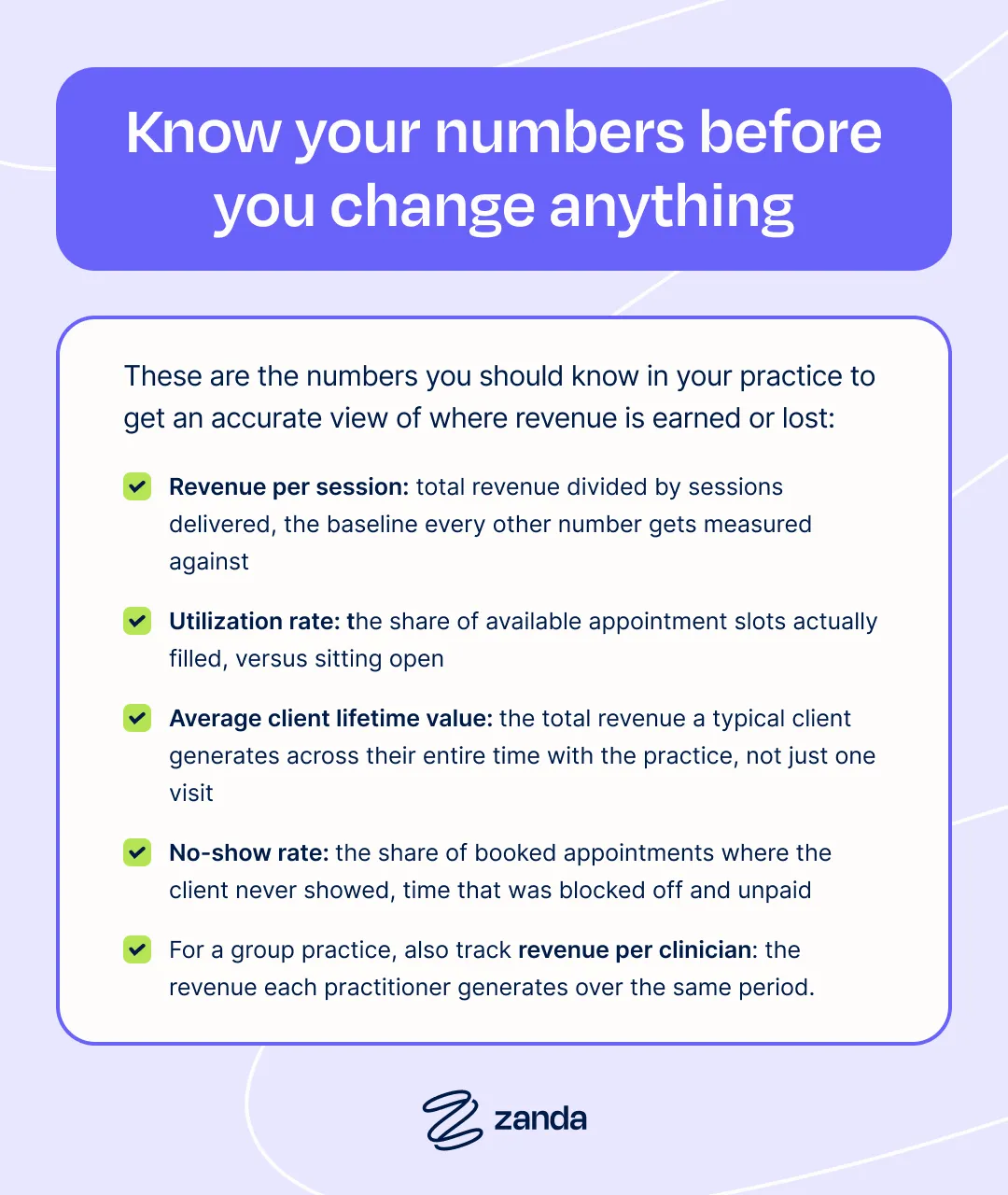
Know your numbers before you change anything
These are the numbers you should know in your practice to get an accurate view of where revenue is earned or lost:
- Revenue per session: total revenue divided by sessions delivered, the baseline every other number gets measured against.
- Utilization rate: the share of available appointment slots actually filled, versus sitting open.
- Average client lifetime value: the total revenue a typical client generates across their entire time with the practice, not just one visit.
- No-show rate: the share of booked appointments where the client never showed, time that was blocked off and unpaid.
- For a group practice, also track revenue per clinician: the revenue each practitioner generates over the same period.
Include the time spent writing notes after each session, and you may find the real hourly rate is meaningfully lower than the booking fee suggests. Or look at lifetime value by client type, and one segment might turn out to be responsible for most of the churn, quietly costing more in turnover. Either way, the number points to which lever below is worth pulling first.
Most practice management platforms, Zanda included, surface this reporting without a spreadsheet built from scratch, and a closer look at what to track and why is worth a read on its own.
Raise your rates first
Rate increases sit at the bottom of the effort scale and the top of the impact scale, which is exactly why Damien leads with them. “Raise your rates first. That’s the lowest hanging fruit.”
Damien often sees practitioners considering a rate increase run through the same worries: will clients be able to afford it, will the practice suddenly look expensive next to competitors, will referrals slow down?
Those concerns are reasonable, and Damien had them too. What he’s learned from actually raising rates, repeatedly, across years of running a practice, is that the outcome rarely matches the fear.
“Try it and see what happens… [your fears] typically don’t happen,” he says. And even in the version where it does cost some volume, the outcome can still favor the practitioner. “Even if it does, you’ve now got the same amount of revenue and 20% more time. That outcome, even if that is what happens, is still good.”
Pricing also does quiet work on perception that most practitioners don’t account for. “The more you charge, the more implied quality there is. People may infer that you’re the best.” Corporate clients feel this even less acutely, since price sensitivity tends to drop once trust and the relationship are already established.
Plus, the clients who leave at a higher price point are often the ones costing the most time relative to what they paid, so it ends up being a win-win.
What a rate increase actually buys back
If you want to know how to increase your private practice revenue, you need to know how to price your health services. The relationship between a rate increase and how much caseload it can afford to lose isn’t intuitive, so it helps to see it laid out:
| Rate increase | Caseload you can lose and still maintain revenue |
|---|---|
| 10% | ~9% |
| 20% | ~17% |
| 30% | ~23% |
This table is for illustrative purposes only, and should be confirmed against the numbers in your business. It assumes unchanged session length and service mix, and does not calculate profit or total working hours.
If lost sessions stay within these limits, a practitioner keeps the large majority of their caseload, earns the same or more, and gets time back on top of it.
Telling existing clients about a rate change requires thinking about timing, notice periods, and whether current clients get grandfathered in. Give clients advance written notice of the new fee and start date, and explain any arrangements for existing bookings. See more detail about how to raise your rates in private practice.
Stop losing revenue to pricing leakage, no-shows, and unpaid invoices
Revenue leakage tends to hide inside systems a practice already has running, not in a shortage of demand. Damien’s own practice found this in its concession (discount) pricing, where a temporary discount quietly became permanent. “We discovered a lot of leakage in our practice. We didn’t for a long time actually check whether people still met the eligibility criteria. They might have been unemployed temporarily for three months, but two years later, they’re still getting concession treatments.”
It’s a personal call to even offer discounts or a sliding scale at all, and tightening eligibility isn’t a statement about values in either direction.
The fix, once made, paid off without costing the practice its integrity. “When we tightened it up, we definitely saw a revenue increase without any unfairness to clients,” Damien said.
No-shows and unpaid invoices drain a practice through the same mechanism. Deposits, an enforced cancellation policy, and automated appointment reminders close a meaningful share of that gap before it ever turns into a balance someone has to chase down after the fact. Review outstanding balances regularly and automate payment reminders where appropriate. For the specifics on structuring this, see cancellation fees for no-shows.
Hire another practitioner
Growth through hiring often only works when it’s driven by shared values instead of simply adding people to absorb overflow.
Cassandra’s hiring process runs almost entirely on relationships she’s already built through supervision or consulting work.
She says, “I wasn’t open hiring. I only work with clinicians that I’m familiar with and I know how they work. You have to really trust who’s nurturing your values and your vision for the company.”
She compares it to choosing childcare: “Are you going to look at just someone on the street, or are you going to make sure that you’re finding someone that’s going to be nurturing and caring, as close to what you would be, when you’re not around.”
Damien has watched this tradeoff play out from both sides. Hiring for values costs speed early on, but it saves the churn that comes from filling seats without checking for fit. “In some ways it’s a slower way of building because you can just get bums on seats if you don’t really care about that alignment of values, but then you tend to end up with more turnover and lack of harmony within the practice.”
Shared values don’t require a shared specialty, either. Cassandra’s team includes clinicians who work exclusively with addiction, exclusively with children, exclusively with eating disorders, all operating inside the same set of values while covering different ground clinically. To protect your own hours, budget for hiring and supervision time, check the margin after practitioner and overhead costs, and delegate routine administration. For a fuller walkthrough of the setup, see how to start a group practice.
Launch a group program without overbooking or underfilling it
Groups let a practitioner serve more people without trading more of their own hours one for one. Cassandra started small and tested before scaling, filling her first groups (virtual, low-lift, low-risk) almost entirely through her existing referral network instead of paid marketing.
“I decided I would start small, and we started with just offering the virtual groups. The first few rounds of those groups were coming purely from clinicians saying I actually have clients that would really love to be a part of this.”
It didn’t work right away, and the early inconsistency is what eventually forced a redesign rather than a retreat. “Did it work initially? No, absolutely not. We’ve had periods of having them really full and then we’ve had other periods of not having anyone in the group.”
The eventual fix targeted the structure, not the marketing. “That’s when we had the open intake introduced, meaning that people can register for it, they don’t pay anything, and once we have a minimum of three people that are enrolled in it, then we start.”
Closed groups run on the opposite principle: payment collected upfront protects the group’s momentum from mid-program drop-off instead of leaving it exposed the way the early open groups were.
Create passive income streams from what you already know
On-demand and packaged content turn a practitioner’s expertise into something clients can access outside a session, and the idea for Cassandra’s version came straight from client behavior rather than a gap she went looking for.
She explained her thought process: “I’m seeing that they’re being booked in at midnight, two in the morning, four in the morning… when people are really dealing with a lot of thoughts and life situations, they’re going to the internet and trying to look for support. So why don’t I have something there.”
The first version shipped rough, on purpose, which is the part practitioners tend to skip when they’re waiting for an idea to feel ready. “The first one we did, it was really, really rough… it’s not going to be perfect, but the content is there.” Her team runs on a simple motto for exactly this reason: progress, not perfection. These products take time to create, market, and maintain, but can earn revenue from repeated sales without another live session each time.
The purchase terms remove a different kind of pressure, the fear of locking a client into a version that becomes outdated. “Once it has been purchased, anytime we update it, it belongs to that client forever, so they have access to it even when we do our updates.”
The same instinct carried into corporate and government training, built on skills Cassandra had already developed in a previous government role, and across nearly all of it, referrals did more work than any ad spend could have. “Ultimately my personal experience has been, if you’re giving good quality information, support and experience, they’re going to tell at least one person.”
How to win corporate and government contracts as a health practitioner
“You should aim to charge corporations and government bodies way more,” Damien says.
Organizations negotiate from a budget instead of a paycheck, and that changes the price sensitivity dynamic entirely. The rate that would make an individual client hesitate might barely register against an organizational line item.
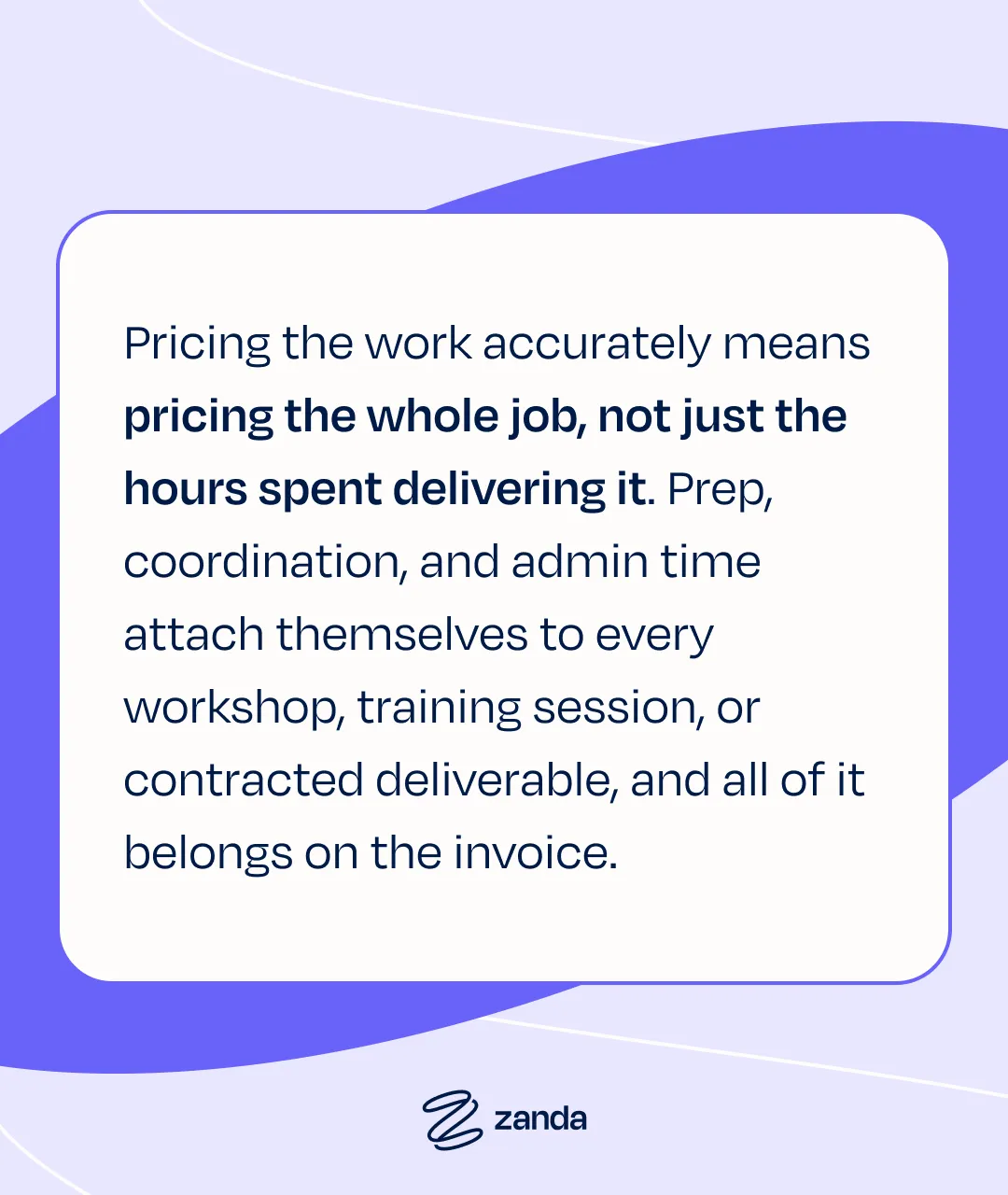
Pricing the work accurately means pricing the whole job, not just the hours spent delivering it. Prep, coordination, and admin time attach themselves to every workshop, training session, or contracted deliverable, and all of it belongs on the invoice. Start with organizations in your existing network and propose a clearly scoped workshop that addresses a need they’ve identified. Reuse suitable training materials to reduce preparation time for repeat bookings.
Not every opportunity with a budget attached is worth chasing. Some contracts cost more in time than they return in revenue, and Damien’s take on those is blunt. “There are third parties, insurance companies, that bid to enter this tender competition. Get rid of all the stuff that is just not worthwhile financially.”
Increase practice revenue without more clients by reclaiming your time
Every hour spent on notes, rescheduling, or paperwork is an hour that isn’t going toward client care or, just as often, isn’t going toward the practitioner’s own time off. Reclaiming that time is frequently the fastest way to increase effective revenue per hour without touching a single price or adding a single session.
BizzyAI: Scribe cuts down the time spent writing and formatting clinical notes once a session ends. Online forms move intake and paperwork out of appointment time entirely. A client portal that lets people book, pay, and get reminders without a phone call removes another slice of admin that was never billable to begin with.
Zanda brings scheduling, billing, note-taking, online forms, and reporting into one platform, built by practitioners, for practitioners, so a growing practice isn’t stitching together five different tools to manage it all. That matters even more once a practice adds associates or a second location, since Zanda handles multiple practitioners and multiple locations from the same account instead of forcing a separate setup for each one. It comes with a 12-month money-back guarantee and no lock-in contracts, and practices can try it free for 14 days to see what it actually reclaims.
Growth starts with clarity
You don’t need to do everything at once to increase private practice profitability this year. Take a step back to get clear on what a practice actually does well, then experiment deliberately outside that comfort zone rather than chasing every option on the table.
“It’s important to find where your roots are and invest in that,” Cassandra says. “If something doesn’t align with us and doesn’t align with our ethos, then it’s okay for it not to be us. We can refer to our colleagues that do that very well.”
Remember that you can always try something new and pivot. As Damien puts it, “You can revisit it. It’s not fixed.”