
Should You Charge for No-Shows?

No-shows are an inconvenience for any healthcare practice–but more than that, they represent a challenge to the sustainability of the business. When a client fails to attend a scheduled session, it creates a ripple effect. A loss of revenue, a disruption to schedules, and the loss of that time slot for another client in need of care.
The financial impact is substantial. The Medical Group Management Association (MGMA) reported no-show rates of nearly 7% in single specialty practices in 2023, a figure that translates to tens of thousands of dollars in lost annual revenue.
Yet, many practice owners fear that charging a fee for no-shows and late cancellations will drive away clients.
In this article, we’ll explore how a clearly communicated cancellation policy can protect your practice and your clients–valuing your time as a therapist and supporting continuity of care.
The value of a cancellation policy for health practices
Implementing a cancellation policy is an important operational decision. To determine if it aligns with your practice’s values, consider these pros and cons.
Pros
- Financial protection: Cancellation fees can help cover the service, staff, rent, and utility costs incurred during the missed appointment.
- Operational efficiency: No-shows create inefficiencies, disrupting scheduling flow and wasting time and resources that could be allocated to other clients.
- Industry standard: Charging for late cancellations is standard practice across many industries, particularly in healthcare.
- Valuing expertise: It reinforces the value of your time and expertise.
- Improved client commitment: A cancellation policy encourages clients to be more diligent in attending appointments or providing timely notice.
- Practice professionalism: Well-defined policies demonstrate competence, fostering trust and setting clear boundaries for the client-therapist relationship.
Cons
- Client retention: There is a risk that clients who frequently miss appointments may seek services elsewhere.
- Genuine emergencies: On occasion, clients may experience genuine emergencies or sudden financial issues, and charging them a cancellation fee may add to their already bad day. Each situation requires consideration. A rigid policy may not account for unique, one-off events where offering flexibility could preserve a client relationship.
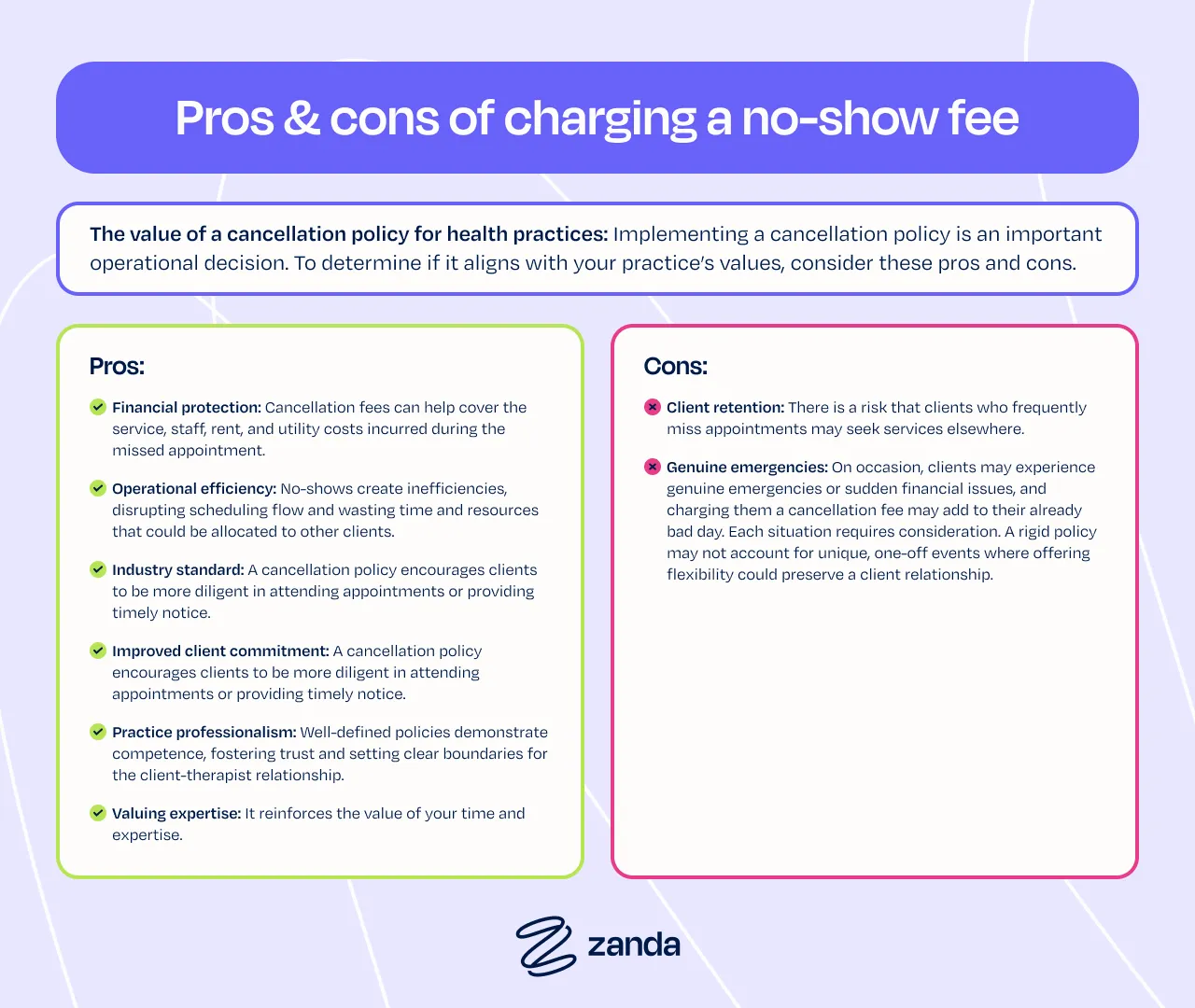
It’s clear from the number of pros in these lists that it’s likely wise to charge a no-show or late cancellation fee. The key to implementing it? Clarity and built-in flexibility–such as giving team members the ability to waive the fee for a first-time occurrence or a verifiable emergency.
Ultimately, clients who no-show eliminate any opportunity to offer that slot to others on a waiting list. A professional cancellation policy is a fundamental tool for efficient practice management, allowing you to protect your schedule and ensure your time is spent providing care.
How to implement a cancellation policy for health practices
A successful cancellation policy is both clearly defined and consistently enforced. These best practices will help you protect your time while maintaining positive client relationships.
1. Define a notice period
Establish a timeframe for required notice of a cancellation–typically 24 to 48 hours in advance of an appointment. This sets clear expectations for clients, and gives your practice time to fill open slots. Ensure that your cancellation notice period is clearly stated on your intake forms and all communications.
2. Provide explicit fee notification
Clients must be made aware of potential cancellation fees before the appointment, including the fee amount and the conditions under which it will be charged. Communication is the cornerstone of a fair and enforceable policy.
3. Build discretion for emergencies into your cancellation policy for health practices
An overly rigid policy can damage client relationships.
Empower your staff to waive fees for genuine emergencies. This flexibility demonstrates empathy and good faith, preserving trust while still upholding the policy for routine cases.
4. Send multi-channel appointment reminders
Automated SMS and email reminders are proven to reduce no-shows. A reminder sent 48 hours prior allows for advance notice, while a second reminder 24 hours before serves as a final confirmation.
5. Make practice management easy with Zanda
Zanda is designed to help you minimize no-shows and improve client relationships with:
- Automated reminders: Reduce forgetfulness and no-shows with configurable SMS and email alerts.
- Online booking: Allow clients to manage their own appointments and cancellations 24/7, providing the advance notice you need.
- Waitlist management: Quickly fill last-minute cancellations with a few clicks, ensuring your calendar remains full.
- Integration with Stripe: Collect payment details seamlessly with intake forms, and process no-show fees without the need for additional reminders.
Three approaches to a cancellation policy for health practices
Developing the right policy for your practice requires balancing financial protection with good client relations. Here are three approaches to consider.
1. The first-time waiver
This approach acknowledges that emergencies happen while establishing boundaries for the future. It builds goodwill by offering a one-time exemption.
A clear notice in your waiting area or in email communications could state:
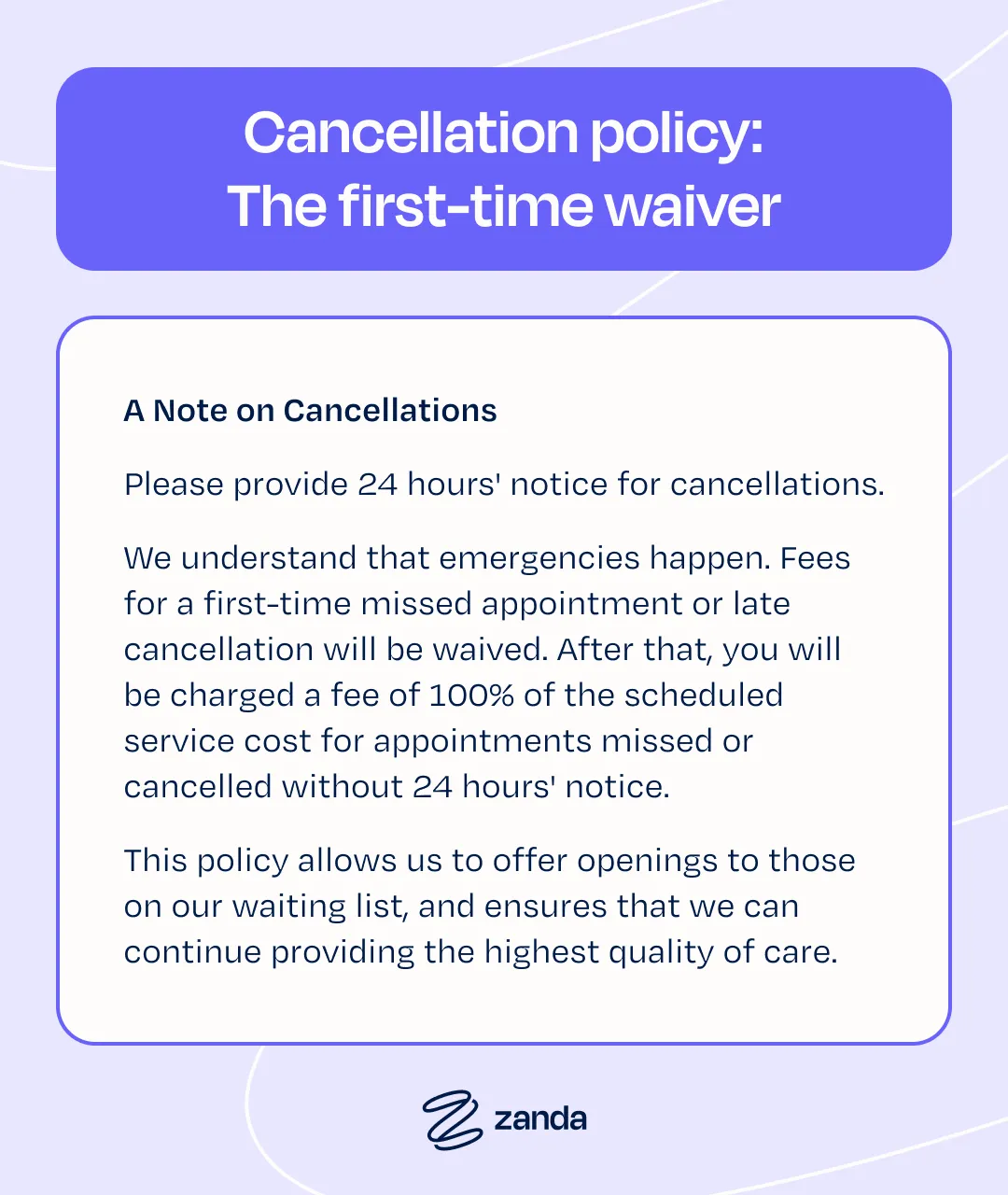
A note on cancellations
Please provide 24 hours’ notice for cancellations.
We understand that emergencies happen. Fees for a first-time missed appointment or late cancellation will be waived. After that, you will be charged a fee of 100% of the scheduled service cost for appointments missed or cancelled without 24 hours’ notice.
This policy allows us to offer openings to those on our waiting list and ensures that we can continue providing the highest quality of care.
2. The full-fee policy
This model leaves no room for ambiguity. It’s a standard practice that protects your business’s revenue and operational efficiency.
A direct, professional notice is key:
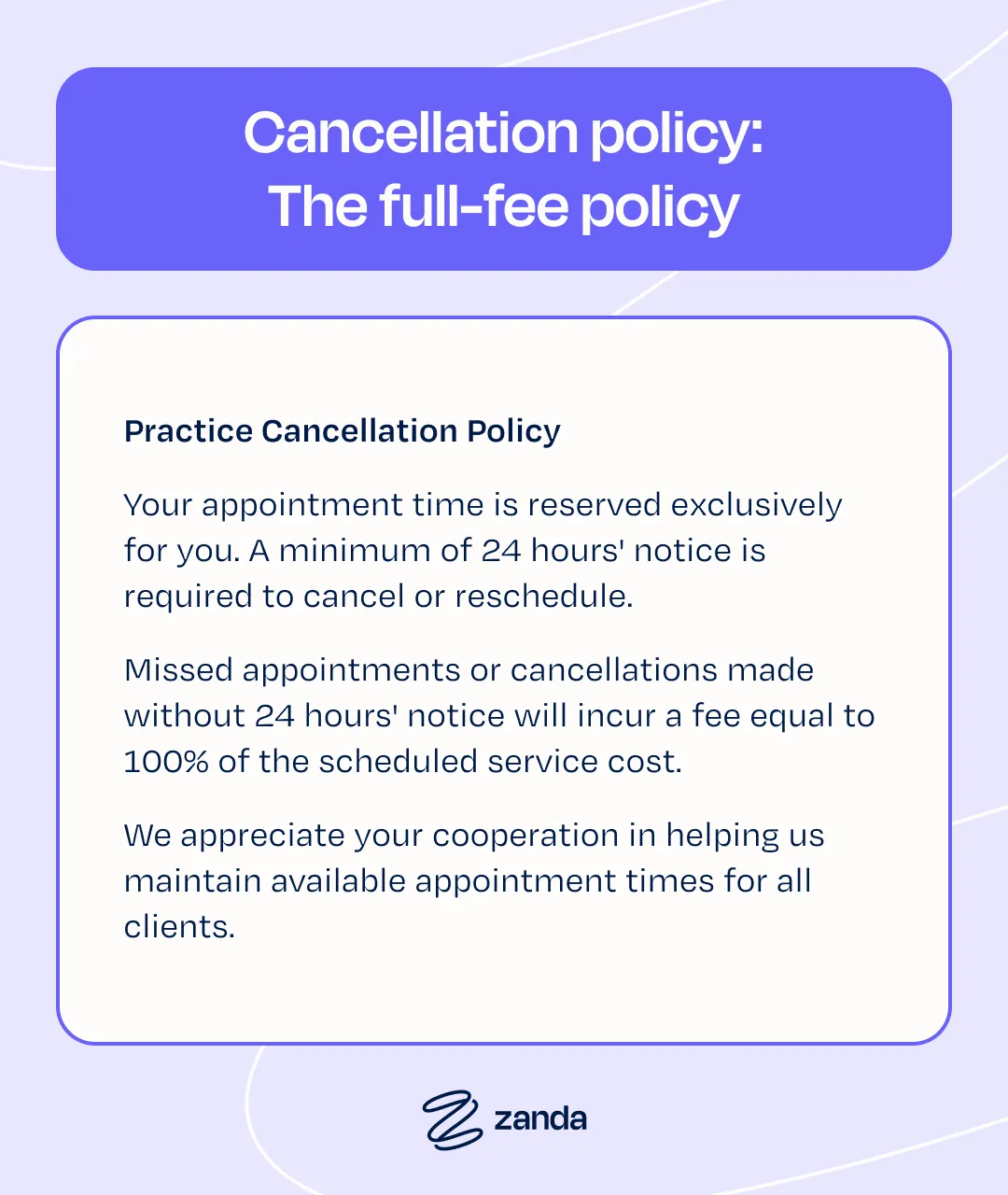
Practice cancellation policy
Your appointment time is reserved exclusively for you. A minimum of 24 hours’ notice is required to cancel or reschedule.
Missed appointments or cancellations made without 24 hours’ notice will incur a fee equal to 100% of the scheduled service cost.
We appreciate your cooperation in helping us maintain available appointment times for all clients.
3. The 50% policy
A 50% no-show fee represents a compromise, sharing the financial impact of missed appointments between the practice and the client. It demonstrates empathy while still ensuring a portion of your costs are covered.
Here’s a cancellation policy template for this approach:
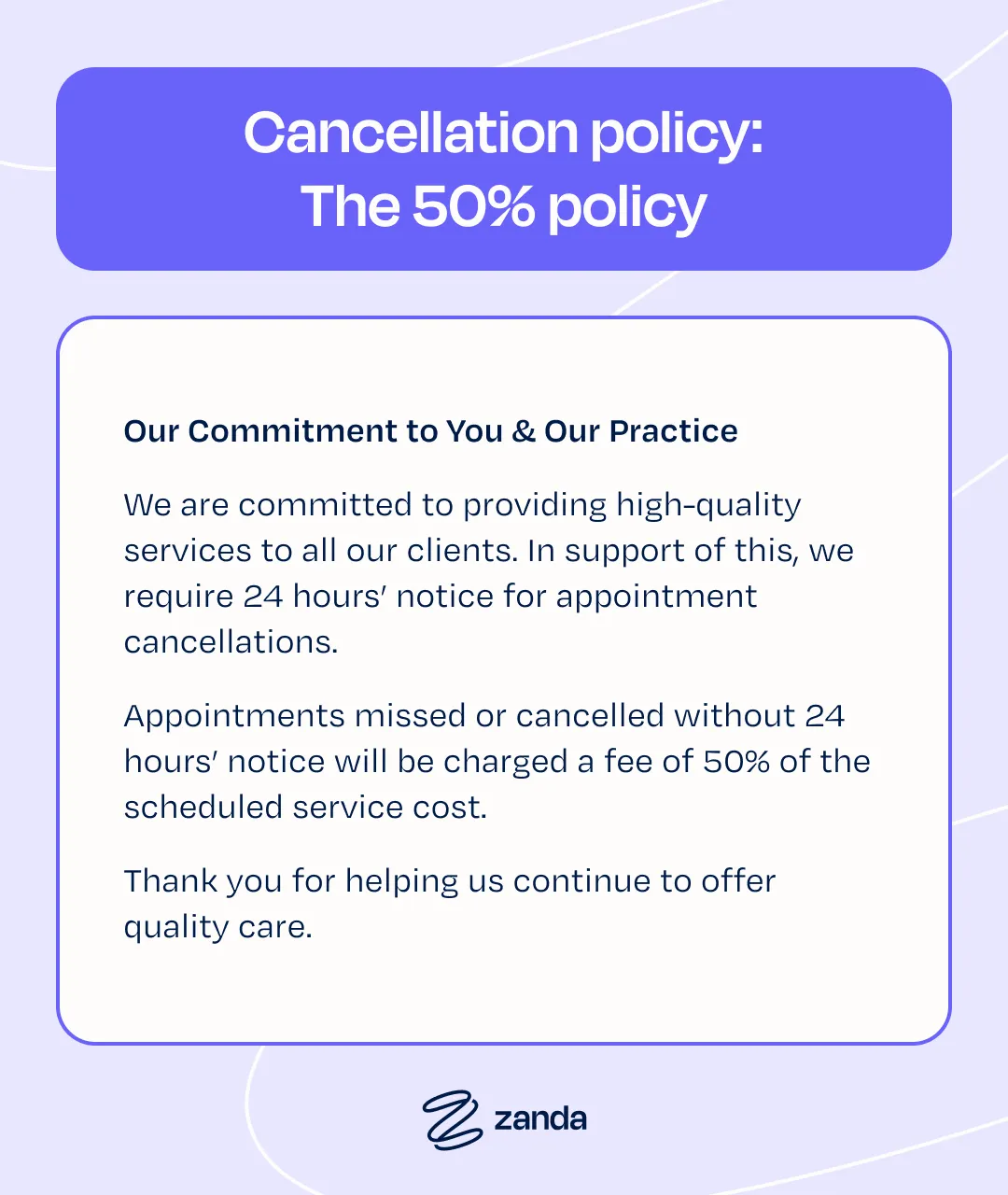
Our commitment to you & our practice
We are committed to providing high-quality services to all our clients. In support of this, we require 24 hours’ notice for appointment cancellations.
Appointments missed or cancelled without 24 hours’ notice will be charged a fee of 50% of the scheduled service cost.
Thank you for helping us continue to offer quality care.
Implementing your policy
Whichever framework you choose, clarity and consistency should be non-negotiable. Communicate your policy through multiple channels–intake forms, reminders, and visible signage in the practice–to ensure clients are never surprised by an unexpected fee.
A well-defined cancellation policy is a critical component of a sustainable private practice. It protects your financial health and allows you to continue providing care to the clients who rely on you.
Your practice, our priority
Implementing a no-show policy is about improving attendance, supporting continuity of care, and safeguarding the business you’ve built.
The right practice management software supports client relationships with clear lines of communication, automated reminders, a waitlist, and seamless online booking and payments.
Ready to spend less time managing scheduling gaps?
Experience Zanda with a 14-day free trial–no credit card required.