
6 Metrics to Track in Your Allied Health Clinic

If you’re serious about the sustainability of your allied health clinic, you have to keep in mind that you’re running a business. Monitoring the pulse of your clinic requires more than casual observation; it calls for a structured approach through tracking essential metrics.
Your Key Performance Indicators (KPIs) are at the heart of this process. These KPIs act like a spotlight on your clinic’s performance, showing how well you’re doing towards achieving specific goals and where you need to improve.
In this article, we’ll dive into healthcare KPIs, why monitoring them is essential for growth, and some top clinic metrics to focus on.
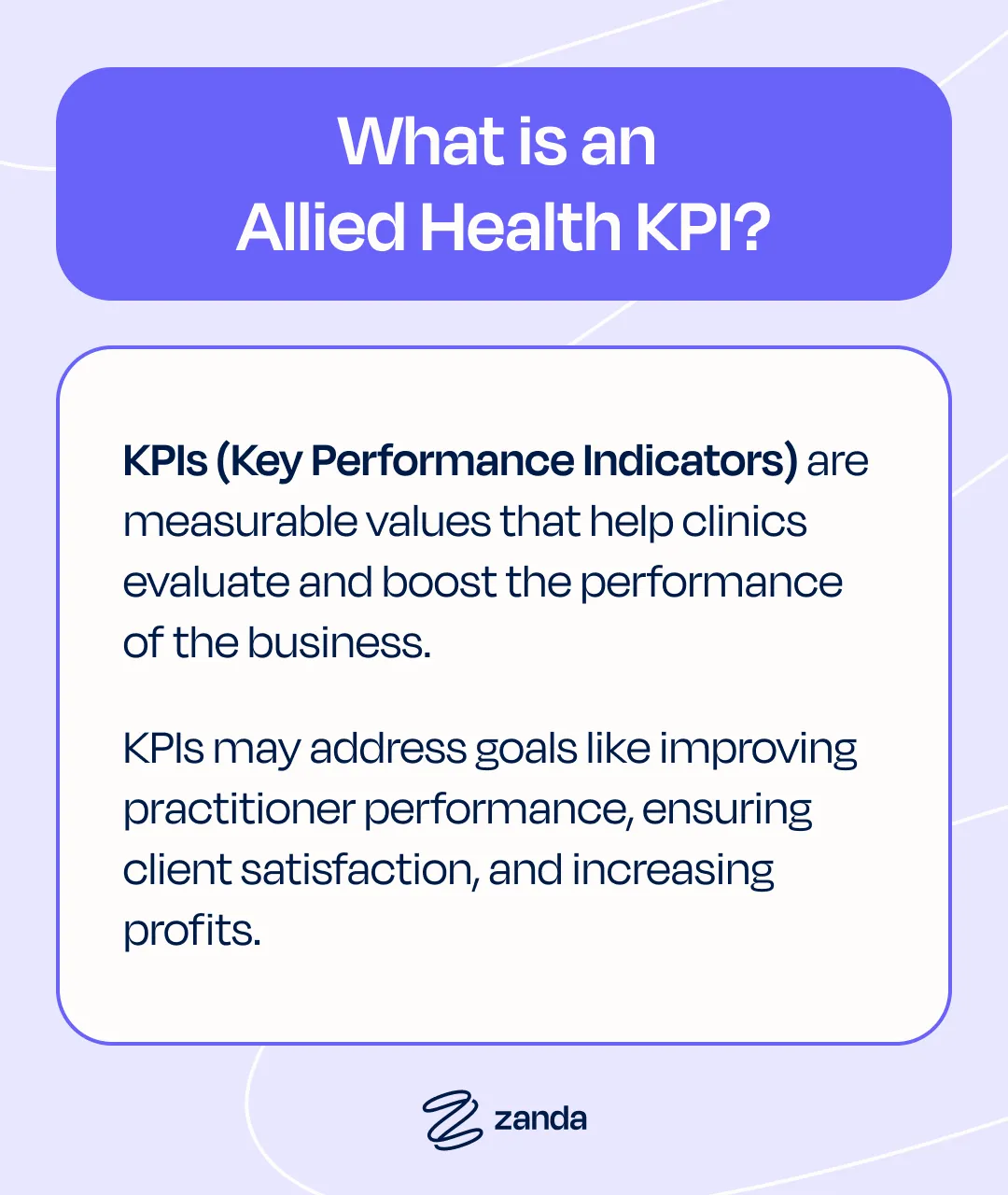
What is an allied health KPI?
Allied health clinics collect a lot of data, but KPIs focus on the measures that matter most. They help you see how the clinic is performing at a glance, and show whether things are moving in the right direction for your clients, your team, and the business.
A metric is simply a raw data point.
It tells you what’s happening: how many cancellations you had this week, how many new clients booked, or how many invoices are still outstanding. Metrics are useful, but they don’t tell you whether you’re actually reaching your goals.
A KPI (Key Performance Indicator) goes a step further.
A KPI is a metric connected to a strategic objective. It measures whether you’re moving closer to the kind of clinic you want to build, whether that’s a clinic with stronger outcomes, better retention, improved cash flow, or more stable growth.
Put simply: All KPIs are metrics, but not all metrics are KPIs.
This distinction matters because clinics often track many numbers, but only a handful help you make decisions. KPIs cut through the noise and highlight the indicators that move your clinic forward.
Metrics vs KPIs in allied health
Every allied health clinic tracks day-to-day healthcare operations metrics such as bookings, cancellations, and admin time. These metrics give you a quick read on how the clinic is operating.
But your healthcare KPI metrics are the ones connected to your goals. These might include improving client retention, increasing average sessions per client, or keeping aged receivables under control. Your KPI metrics are the numbers you check often, share with your team, and use to guide improvement.
Metrics vs KPIs (allied health examples)
| Metric (raw data point) | KPI (strategic, goal-aligned) |
|---|---|
| Number of new client bookings this month | Grow new bookings by 15% year-on-year |
| No-show rate | Reduce no-shows to under 8% within 6 months |
| Average sessions per client | Increase average sessions from 4 → 5 by year-end |
| Aged receivables balance | Keep 90% of accounts within 30-day terms |
| Percentage of telehealth appointments | Reach 25% telehealth utilization as part of hybrid care strategy |
| Client satisfaction score | Maintain a rating of 4.5/5 or higher |
Why is monitoring KPIs important?
Monitoring KPIs gives you a clear picture of how your clinic is performing. Instead of relying on guesswork, you see what’s working, what needs attention, and where changes can make a meaningful difference. This helps you support clients more effectively and run your clinic with confidence.
KPIs also guide the operational side of your practice. They highlight the behind-the-scenes activity that keeps everything moving, from scheduling to billing to team capacity. When you understand these patterns, you can make decisions that keep your clinic running smoothly.
KPIs support better resource allocation
Your rooms, your team, and your time are limited. Tracking practitioner utilization, session volume, and admin time helps you see where resources are stretched and where you have room to move. With that insight, you can balance workloads and protect your team’s energy.
KPIs improve scheduling efficiency
KPIs reveal the “why” behind chaotic schedules. They can help you understand gaps or explain why the day feels busier than expected. These insights make it easier to adjust reminders, refine your schedule, and create a steadier flow for clients.
KPIs strengthen billing and cash flow
Cash flow underpins every part of your practice. KPIs like aged receivables, paid versus outstanding invoices, and average payment times reveal where payments slow down. With clearer visibility, you can act sooner and keep revenue steady.
KPIs improve client engagement
Clients move through your clinic in stages, and KPIs help you understand that journey. Tracking referrals, conversions, attendance, and treatment completion highlights where clients pause or discontinue treatment. Even small improvements in these areas can strengthen outcomes and engagement.
KPIs help manage costs
Costs can build up quietly. KPIs that track room usage, staffing efficiency, or the cost per appointment show you where simple changes could create meaningful savings. These insights support sustainable growth without cutting corners.
Framework for establishing a metrics-driven clinic
To build a metrics-driven clinic, you need a simple structure that keeps your goals clear and your data meaningful. This framework helps you choose the right measures, review them consistently, and turn insights into practical action.
Step 1: Define your strategic goals
Start with what matters most to your clinic. Are you trying to grow, improve efficiency, or strengthen client outcomes? Clear goals help you decide which numbers are worth paying attention to and which ones are just noise.
Step 2: Select the right KPIs
Choose KPIs and operational metrics that connect directly to your goals. If you’re focused on growth, track new bookings or conversion rates. If efficiency is the priority, measure utilization, cancellations, or cost per appointment. Keep your list tight and relevant.
Step 3: Set baselines and targets
Know where you’re starting before you try to improve. Establish a baseline for each KPI, then set realistic targets. These targets guide your decisions and help you understand whether your changes are working.
Step 4: Collect data and report regularly
Make reporting a routine. Whether you review KPIs weekly or monthly, stay consistent. Regular reporting keeps trends visible and prevents issues from flying under the radar.
Step 5: Review insights and take action
Use your KPIs to make informed improvements. Adjust your schedule, streamline processes, or support your team based on what the data shows. Tracking numbers only matters when it helps you improve.
So, now that we know what KPIs are and how to use them, let’s look at some of the top metrics to focus on.
KPI #1: Attendance rates
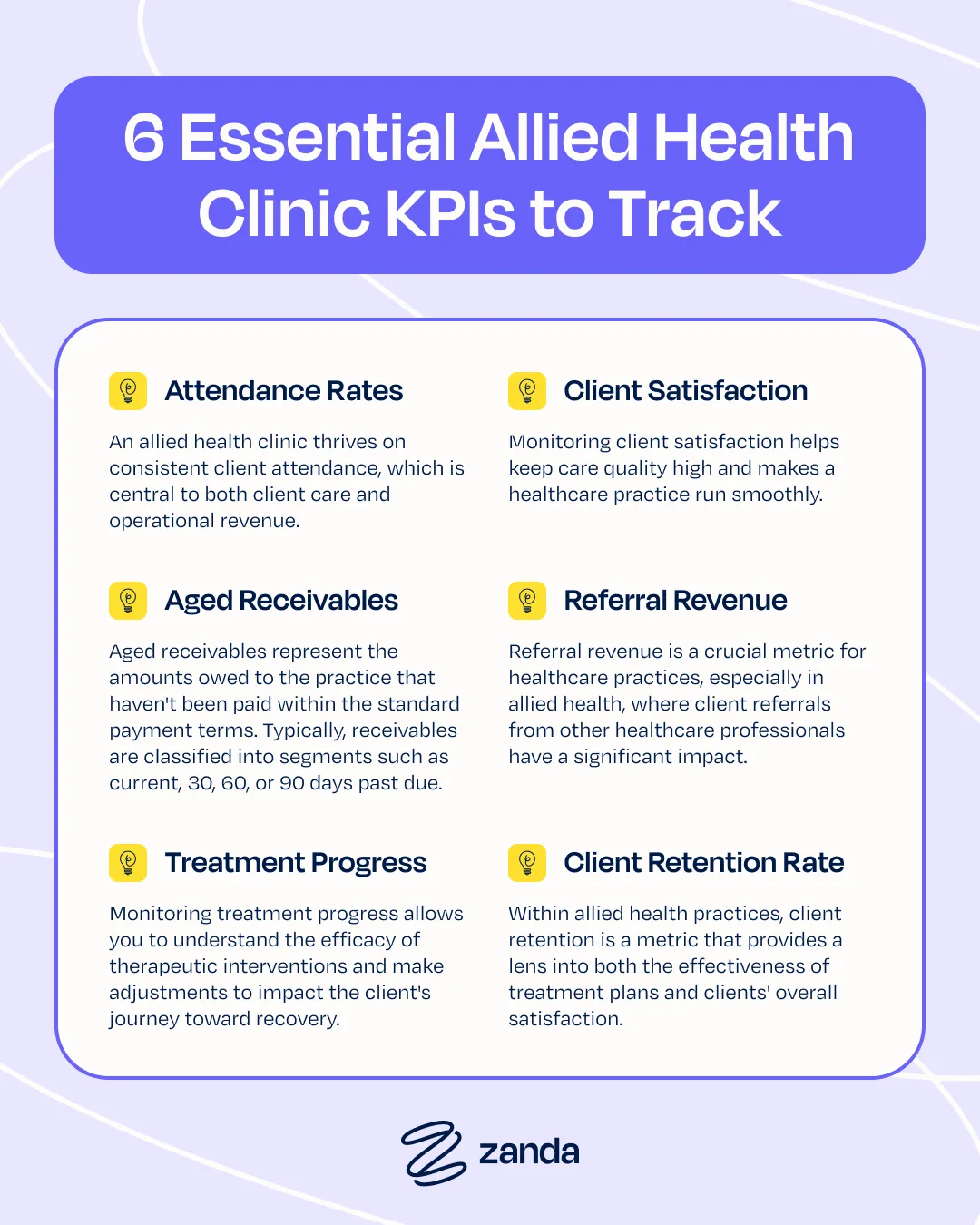
An allied health clinic thrives on consistent client attendance, which is central to both client care and operational revenue.
Consider tracking:
- Attendance rates: The ratio of scheduled appointments to actual attendance. A higher attendance rate indicates strong engagement between practitioners and clients, whereas a lower rate might signal issues that merit further investigation.
- No-shows and late cancellations: No-shows and late cancellations are detrimental to a healthcare practice’s operational efficiency and revenue generation. These metrics reflect potential revenue loss and could indicate underlying problems in client engagement or administrative processes.
What does the data tell us?
Attendance rates help to understand the client journey and where your practice may have gaps.
- Before the initial appointment: If no-shows or late cancellations are prevalent before the first appointment, it may point to issues in admin processes during intake, such as miscommunication, unmet expectations or negative interactions.
- After appointments have begun: If attendance issues occur after the initial consultation, it might reflect engagement problems with practitioners. For instance, practitioners may not have reinforced the importance of consistent attendance or didn’t enforce no-show fees in the past.
What action can you take?
When you understand these metrics, you can identify potential issues to address, whether from administrative processes or practitioner interactions. Then, you can take practical steps to enhance practice operations and client engagement.
Additional considerations: Digging deeper into the data, for instance, evaluating no-shows between first consultations and subsequent appointments, can further illuminate problem areas.
KPI #2: Aged receivables
While various financial metrics deserve attention, aged receivables are a critical indicator of a practice’s financial health. This is because maintaining a steady cash flow is not just about profitability but a requirement for sustainable practice operations.
Aged receivables represent the amounts owed to the practice that haven’t been paid within the standard payment terms. Typically, these receivables are classified into segments such as current, 30, 60, or 90 days past due.
What does the data tell us?
Monitoring the growth of aged receivables provides a clear picture of a clinic’s cash position. It also hints at potential collection issues, ensuring that the practice has a realistic understanding of its financial health.
An escalating trend in aged receivables can lead to a strain on the practice’s ability to operate. The lag in collections hinders the practice’s ability to meet its operational expenses, even if it appears profitable on paper. The cash position, unlike profit, reflects the actual funds available, making it a more accurate indicator of a practice’s financial health.
What action can you take?
Use practice management software like Zanda to simplify billing and facilitate quicker payments, improving cash flow. The software streamlines the invoicing process, allows you to send reminders to clients for outstanding invoices, and provides an easy-to-use platform for online payments, streamlining the revenue collection process.
KPI #3: Treatment progress
Monitoring treatment progress allows you to understand the efficacy of therapeutic interventions and make adjustments to impact the client’s journey toward recovery.
A well-structured approach to tracking treatment progress using standardised outcome measures is essential for a healthcare practice aiming to deliver superior care. Here, practice management software with features like online forms becomes an invaluable asset, facilitating seamless data collection directly from clients.
What does the data tell us?
Data collected from standard measures helps quantify the effectiveness of treatment and identify necessary changes.
Using practice management software simplifies collecting data through online forms, making the process easier and more accurate. This aids in quickly adjusting treatment plans to better meet client needs and improve health outcomes.
What action can you take?
The insights garnered from the data empower healthcare practitioners to:
- Refine treatment plans: Based on the progress data, treatment plans can be adjusted to better cater to client needs, ensuring they are on the fastest route to recovery.
- Enhance communication: Sharing progress data with clients fosters a transparent provider-client relationship, ensuring clients are well-informed and involved in their treatment.
- Allocate resources: Understanding which treatments yield better results allows for thoughtful allocation of resources, improving the overall operational efficiency of the practice.
- Build referral networks: Positive results are a strong testament to the quality of care provided, which can help build a referral network, further fueling the practice’s growth.
KPI #4: Client satisfaction
Monitoring client satisfaction helps keep care quality high and makes a healthcare practice run smoothly.
By using practice management software to gather feedback as part of your practice’s routine, you can work to improve client satisfaction, boosting your practice’s reputation and financial health.
Methods for collecting feedback include:
- Post-appointment surveys: Ask for feedback immediately after an appointment to capture a client’s experience while it’s fresh in their mind.
- Email surveys: Send a survey link in a follow-up email or at the bottom of invoice emails.
- SMS surveys: A survey link sent via SMS caters to clients who prefer mobile communication.
- Pre- and post-session ratings: Ask clients to rate how they feel before and after a session.
What does the data tell us?
A practice management system like Zanda helps collect client feedback seamlessly. It reduces the administrative burden, allowing practices to focus more on implementing feedback to enhance client care and operational excellence.
What action can you take?
To facilitate the acquisition of feedback from clients, you can use your practice management software for much of the heavy lifting:
- Post-appointment surveys: When appropriate, ask for feedback immediately after an appointment. Use a simple rating system and a comment section for actionable insights.
- Embed survey links in appointment reminders, invoices, or post-appointment communication: Integrating a survey link within appointment reminders or invoice emails can provide multiple touchpoints for clients to share feedback.
- Bulk email campaigns: Conducting periodic bulk email campaigns to collect feedback can provide a broader understanding of client satisfaction.
Leveraging practice management software simplifies the process, ensuring that client feedback is collected and acted upon, laying the groundwork for a thriving practice responsive to its clients’ needs.
KPI #5: Referral revenue
Referral revenue is a crucial metric for healthcare practices, especially in allied health, where client referrals from other healthcare professionals have a significant impact.
Referral revenue is more than just a financial metric; it reflects a practice’s reputation and professional relationships within the healthcare community.
When you evaluate referral revenue, you can gauge the effectiveness of your referral relationships and develop strategies to strengthen them. Zanda provides healthcare practices with insight into revenue generated per referrer, aiding better decision-making when fostering referral relationships.
What does the data tell us?
Referral revenue is the income generated from clients referred to your practice by other healthcare professionals or agencies. Monitoring this metric is essential for several reasons:
- New client acquisition: Understanding how effective referrals are in bringing new clients.
- Revenue stream: It’s a direct indicator of a significant revenue stream for the practice.
- Referral relationship value: Provides insights into the effectiveness of relationships with referring entities.
- Revenue per referrer: Understanding the revenue generated from each referrer is vital in identifying which referral relationships are most beneficial. Zanda offers a feature where practices can view the amount invoiced in connection to a specific referral source. This analysis can help in:
- Identifying high-value referrers: Acknowledge and make relationships with referrers who contribute significantly to your practice’s revenue a priority.
- Targeted marketing: Allocate resources efficiently to enhance referral relationships.
- Performance assessment: Evaluate service performance using referral rates and subsequent revenue.
What action can you take?
Knowing where to focus your efforts allows you to implement strategies to improve referrer relationships.
This could include:
- Regular communication: Maintain regular contact with referrers, update them on client progress, acknowledge their referrals, and write referral feedback letters.
- Educational events: Host seminars or workshops to inform referrers about your services and how they benefit clients.
- Thank you notes: Simple gestures, like sending thank you messages to referrers, can go a long way toward nurturing referral relationships.
KPI #6: Client retention rate
Within allied health practices, client retention is a metric that provides a lens into both the effectiveness of treatment plans and clients’ overall satisfaction. It’s gauged by the number of clients who continue to seek services compared to the number of new clients.
By tracking average number of sessions alongside client retention rates, practices can gain invaluable insights into treatment efficacy and client engagement. It also highlights the critical issue of over-treatment and the importance of well-defined treatment plans.
What does the data tell us?
Client retention rates signify:
- Treatment effectiveness: A reasonable retention rate may signify effective treatment plans that address client needs, encouraging continuous engagement.
- Client satisfaction: Retained clients are often satisfied; their continued patronage is a vote of confidence in the practice’s services.
- Financial sustainability: Client retention translates into a steady revenue stream, which is more cost-effective than acquiring new clients.
- Professional reputation: High retention rates can enhance a practice’s reputation, making it a preferred choice among referrers and potential clients.
It’s also important to monitor the average number of sessions per client because it:
- Indicates progress: Helps track the progress of treatment plans and assesses their effectiveness over time.
- Identifies over-treatment: Alerts to potential cases of over-treatment, where clients may be kept on for longer than necessary without significant progress.
What action can you take?
By paying attention to client retention rates and average number of sessions, allied health practices can foster a culture of meaningful client engagement and optimal treatment outcomes.
You also have the opportunity to address over-treatment through well-defined treatment plans that can significantly enhance the quality of care, client satisfaction, and the practice’s financial stability.
Challenges and how to overcome them in healthcare operations metrics
Tracking healthcare operations metrics can be powerful, but many clinics face obstacles that make it hard to consistently collect data or act on the insights. Understanding these challenges is the first step toward building a smoother, more reliable process.
Data silos
Information often sits in different systems, spreadsheets, or individual clinicians’ heads. When data isn’t connected, it becomes difficult to get a clear view of how the clinic is performing. Using one system for bookings, billing, notes, and reporting keeps your information in one place and supports more accurate metrics.
Lack of time or capacity
Clinicians and admin teams are already stretched. Without a clear process, metrics can become an extra burden. Designating a “metrics owner” or building reporting into your regular workflow can make the process easier and more sustainable.
Inconsistent definitions across clinicians
People may measure or interpret things differently. What counts as a cancellation? When is a treatment plan considered complete? Standardizing your definitions helps everyone speak the same language and ensures your reports reflect what’s actually happening.
Resistance to change
Shifting to a metrics-driven approach can feel uncomfortable at first. A culture of “measure, learn, improve” helps your team see metrics as tools for support, not judgment. When the focus is on better systems and smoother days, people tend to embrace the process more openly.
Lack of action after reporting
Collecting data without taking action is one of the most common challenges. Building regular review sessions into your schedule, even it’s it’s just 15 minutes on a Monday morning, creates space to reflect on trends and decide what to do next. The goal is to turn insights into improvements.
Using software to support your metrics
Practice management software with strong reporting and analytics features makes the entire process easier. When your data lives in one system, you can track trends, spot gaps, and make changes with confidence. It also reduces the manual work that often gets in the way of consistent reporting.
Becoming a metrics-driven allied health clinic enables better client care and operational efficiency. If you’d like a simpler way to track your clinic’s metrics, Zanda has a Practice Dashboard and built-in reports that can help. Start a free trial to see how Zanda makes practice management easy.