
How to Build a Sustainable Private Practice

Damien Adler, co-founder of Zanda and a registered psychologist, started a successful group psychology practice in 2007 and sold it 16 years later after growing it into the kind of business that could run without him.
His own practice grew during one of the toughest years of his life, the kind of year that sinks most businesses built around one person. It grew because he’d already done the work of building a sustainable private practice long before the crisis showed up. That’s the payoff of treating sustainability as something you design for early: the practice doesn’t just hold on when life gets in the way, it keeps moving forward while you’re not looking.
This article is the written companion to the Beyond Productivity: How to Build a Sustainable Practice webinar with Damien and Zanda Chief Buzz Officer Jessica Gibson.
The efficiency trap: why building a sustainable private practice takes more than automation
Typing faster doesn’t make a practice able to survive an illness, a funding cut, or a slow month. A practitioner books more sessions in the time they saved and calls that growth, without ever asking whether the practice could keep running if they couldn’t show up tomorrow.
Damien has watched this play out often enough to name it precisely: “That can actually sometimes distract from that kind of long-term sustainability. And so you’re efficient, but you’re still stuck.”
Efficiency gains show up immediately, in a shorter to-do list or a calendar with more breathing room, while sustainability only proves itself when something goes wrong, which is exactly why, as Damien puts it, “we can be highly efficient and still not strategic. And that is the trap.”
The rocking chair test
Picture yourself decades from now, retired, looking back on the practice and the life it built. What would you want to feel proud of?
Damien calls this finding your North Star, the thing that makes every other decision easier because you can measure a choice against it instead of guessing. It’s also why “sustainable” here means more than the business generating revenue. It means the practice supports the life its owner wants, not just the schedule that happens to be full this week.
The year Damien’s practice ran without him or his wife
Damien co-founded Zanda while running a group psychology practice with his wife, Bec. Around the start of the pandemic, Bec became seriously ill from something unrelated to COVID. She’s since made a full recovery, but at the time, no one knew how long that would take. At the same time, Damien needed to step back from the practice to focus on Zanda, whose customers were navigating their own disruption. Two pressures, from two different directions, landing at once, and by any normal measure, the practice should have struggled to keep the lights on.
It didn’t. The practice grew, stayed in strong enough shape to sell later, and the team members who stepped up during that stretch stayed in their roles for years afterward.
Jessica, Chief Buzz Officer at Zanda, has interviewed enough practitioners to know why that outcome is the exception rather than the rule: “The biggest risk that we see is when your brand is dependent entirely on one person, or one thing.”
Private practice key-person risk is exactly what Damien and Bec had already solved for before it ever showed up. It’s the only reason two owners could step back from day-to-day operations at the same time and the business kept moving.
Why the practice grew instead of falling apart
Two things made that possible. Referrals had always gone to the practice itself and its philosophy of care, not to Damien or Bec by name, so their absence didn’t interrupt the flow of new clients. (If you’re still building those referral relationships, this guide on how to build referral relationships is a good place to start.)
“People were referring to the practice and saying the practice provides this range of treatment with this philosophy,” Damien explains.
And the team had systematized admin knowledge instead of keeping it in one person’s head, so they could step in and keep things running without either owner available to fill the gaps.
Damien traces both back to the same underlying design choice: “When a practice is built with sustainability in mind, [it] has multiple pillars holding it up… When one of those things does happen, the business can continue on. In fact, the practice grew over that time.”
The four pillars of a sustainable private practice
Damien points to four pillars that were already in place before the crisis hit:
- Consistent profit rather than just revenue
- Clinicians supported by admin processes so they could focus on care
- The right people in the right roles instead of everyone doing everything
- Regular evaluation of how the practice was actually performing
When it comes to hiring the right people, Damien is clear: “Recruiting based on values is the single best thing that you can do.”

He’s just as direct about what happens without the first one. Growing without checking the underlying economics can look impressive on paper while quietly running on underpaid practitioners, which he calls a vanity metric, not growth that holds up.
Sustainability also means refusing to compete on price
The same fragility shows up in pricing, and a private practice pricing strategy built around undercutting competitors is its own version of a single point of failure. Damien has seen tenders (the formal bidding process organizations use to select a service provider, often for government or corporate contracts) structured to invite the cheapest possible bidders. In one case, the requirement dropped from a registered psychologist to anyone with a basic counselling degree.
Rather than compete on those terms, his practice walked away from the bid entirely, and the pattern that followed became predictable: “For about six months it would go quiet… and then over time, all that work would start coming back,” because, as Damien puts it, “you get what you pay for.”
Jessica has watched practitioners learn the same lesson the hard way: “When you undercharge, or when you compare yourself to another practitioner… it can really hurt you in the end.” A practitioner she interviewed proved the opposite could also hold. She raised her rates above a competitor’s in the same town, expecting to lose business, and started getting more calls instead.
What sustainability looks like in practice
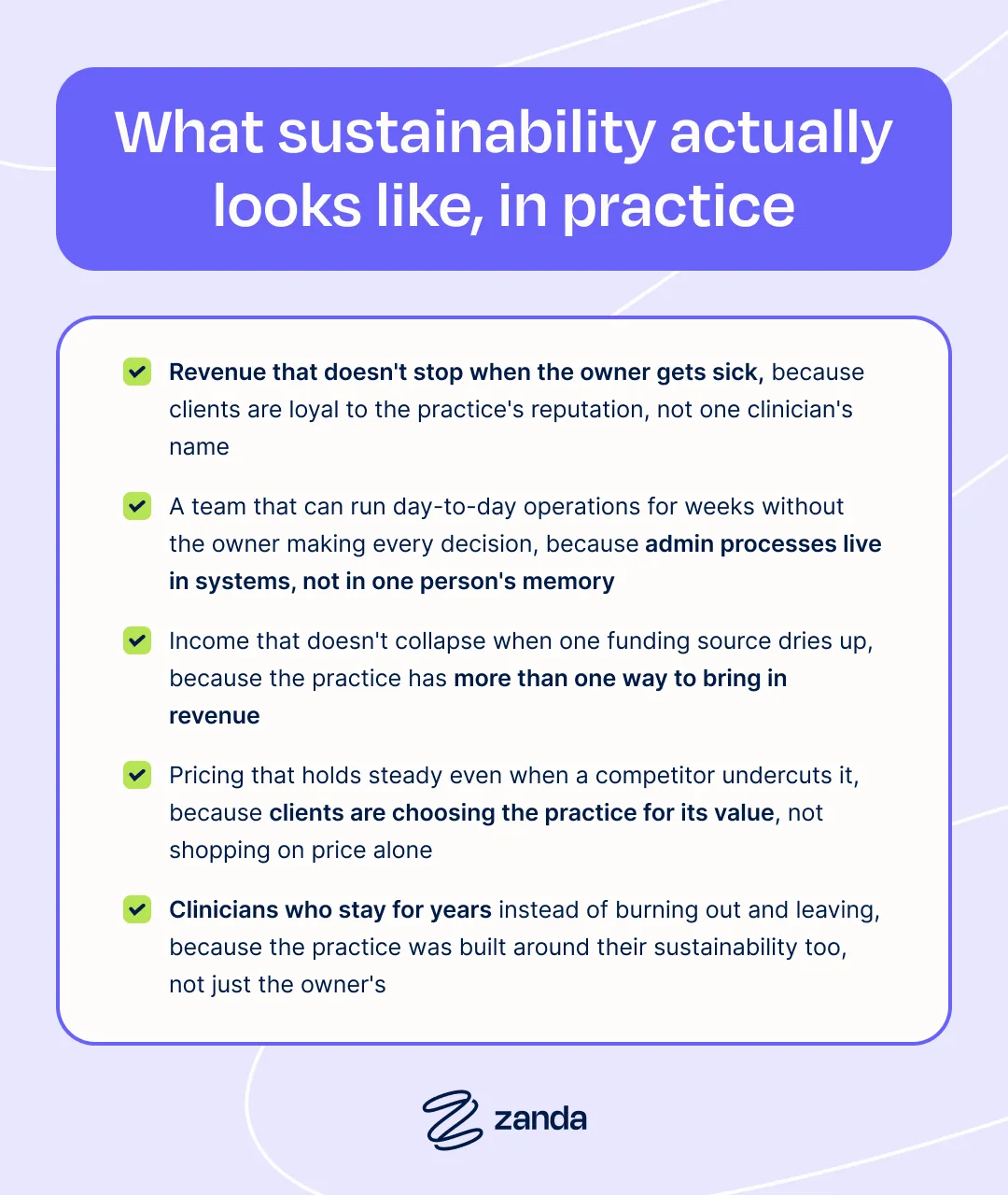
- Revenue that doesn’t stop when the owner gets sick, because clients are loyal to the practice’s reputation rather than one clinician’s name
- A team that can run day-to-day operations for weeks without the owner making every decision, because admin processes live in systems
- Income that doesn’t collapse when one funding source dries up, because the work of diversifying practice income was done before it was needed
- Pricing that holds steady even when a competitor undercuts it, because clients are choosing the practice for its value and not shopping on price alone
- Clinicians who stay for years instead of burning out and leaving, because the practice was built around their sustainability too
How to step back from your practice without it falling apart
For practitioners who are fully booked and can’t imagine stepping back, the first move is smaller than you’d think.
“Just go two months ahead if you have to. Block out whatever, your Friday afternoons, to start with, and then slowly build out the time that you’re working on the business,” Damien suggests.
If you’re wondering how to step back from your practice without blowing up the calendar overnight, this is the answer: a protected block of time, held every week, where the shift from reactive to sustainable actually starts. Building a sustainable private practice is less about one big overhaul and more about protecting small pieces of time until the system around you can hold its own.
A practice that survives its owner stepping away is a practice someone built on purpose. Someone systematized the admin, built the referral pipeline, and set up income streams that don’t depend on any one person showing up every day. That’s the infrastructure Zanda is built to make easier: appointment scheduling, clinical notes, billing, and client communication that live in one system, so sustainability doesn’t rest entirely on your shoulders.
FAQ
What’s the difference between an efficient practice and a sustainable one?
An efficient practice does more with less time. A sustainable private practice keeps functioning, and keeps generating revenue, even when something disrupts it: illness, a funding change, a competitor, a slow season. A practice can be highly efficient and still not sustainable if everything still depends on one person or one income source.
How do I diversify income without spreading myself too thin?
Treat new revenue streams the way Damien treated corporate work: an insurance policy running quietly in the background, not a second full-time job. Build the relationships and infrastructure so you could scale it up quickly if needed, without making it the primary focus while your core service is still working.
How do I know if my practice has too much key-person risk?
Ask what happens to referrals, revenue, and day-to-day operations if you were out for a month. If referrals dry up because clients came for you specifically rather than the practice’s reputation, if no one else knows how the admin systems actually work, or if revenue depends on a single funding source or contract, that’s key-person risk showing up in three different places at once. It’s not an emergency, but it does require building the systems and the brand recognition before you need them.
How much should I rely on referrals tied to my own name versus my practice’s brand?
Some personal reputation is normal and useful, especially early on. The risk shows up when it’s the only thing carrying the practice. Shifting marketing and client-facing language toward the practice’s mission and standards, rather than one practitioner’s name, is what let Damien’s practice keep growing when he and his wife had to step back.