
DASS-21 Scoring and Interpretation: The Complete Guide for Mental Health Practitioners

DASS-21 scoring and interpretation is something most mental health practitioners pick up on the fly: handed a form by a supervisor, shown a severity table once, then left to develop whatever system they’ll use for the next decade. Ask ten clinicians how they track client progress and you’ll get ten different answers.
The DASS-21 is one of the few outcome measures most mental health practitioners actually agree on. It’s free, it covers three distress domains simultaneously, and it gives you a number you can point to when a client asks “am I actually getting better?” or a funder asks “why does this person still need sessions?” This guide covers what the DASS-21 measures, how to use the DASS-21 in clinical practice correctly, where it falls short, and how to administer it efficiently.
What is the DASS-21?
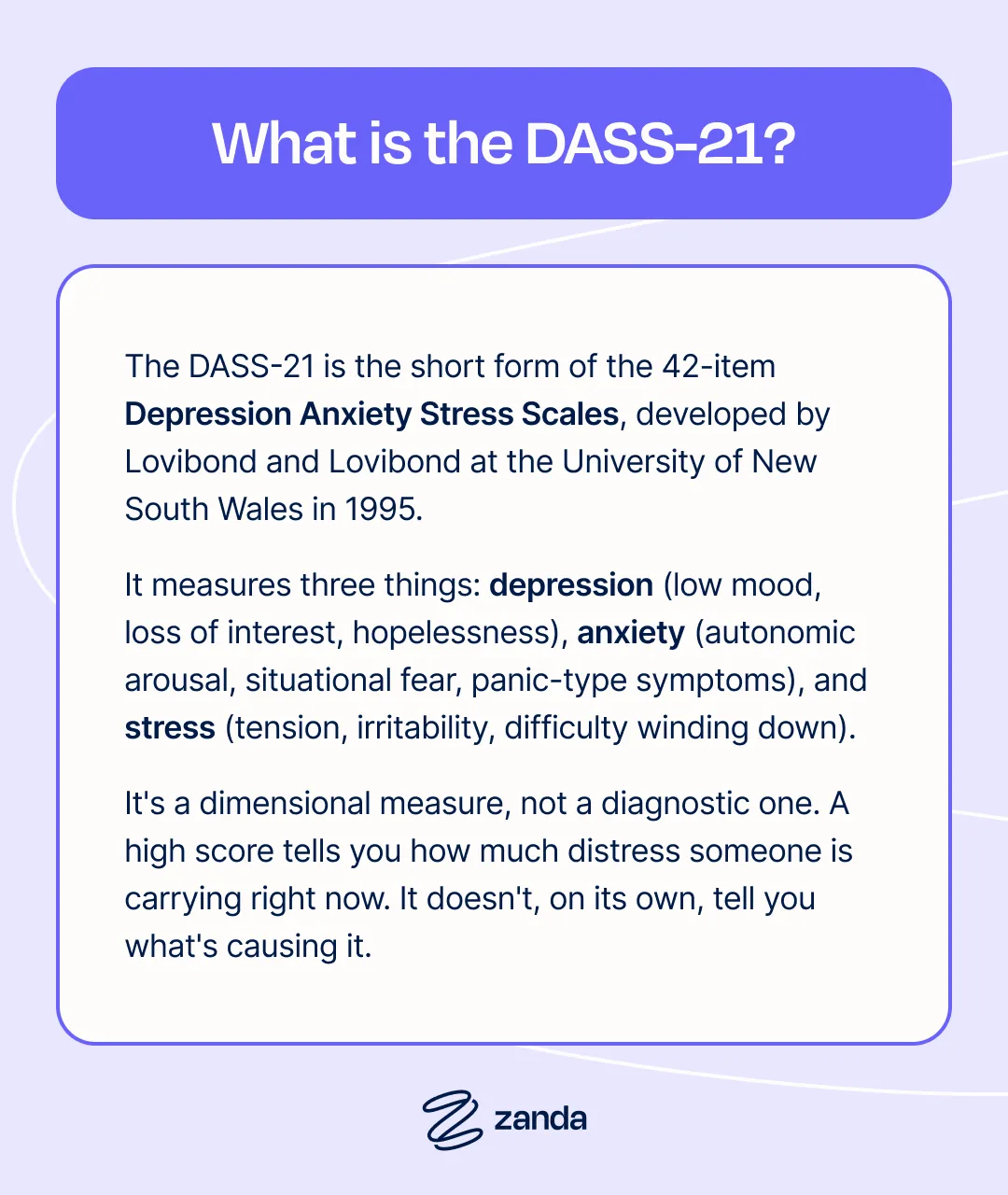
The DASS-21 is the short form of the 42-item Depression Anxiety Stress Scales, developed by Lovibond and Lovibond at the University of New South Wales in 1995. It measures three things: depression (low mood, loss of interest, hopelessness), anxiety (autonomic arousal, situational fear, panic-type symptoms), and stress (tension, irritability, difficulty winding down).
It’s a dimensional measure, not a diagnostic one. A high score tells you how much distress someone is carrying right now. It doesn’t, on its own, tell you what’s causing it.
When to use the DASS-21
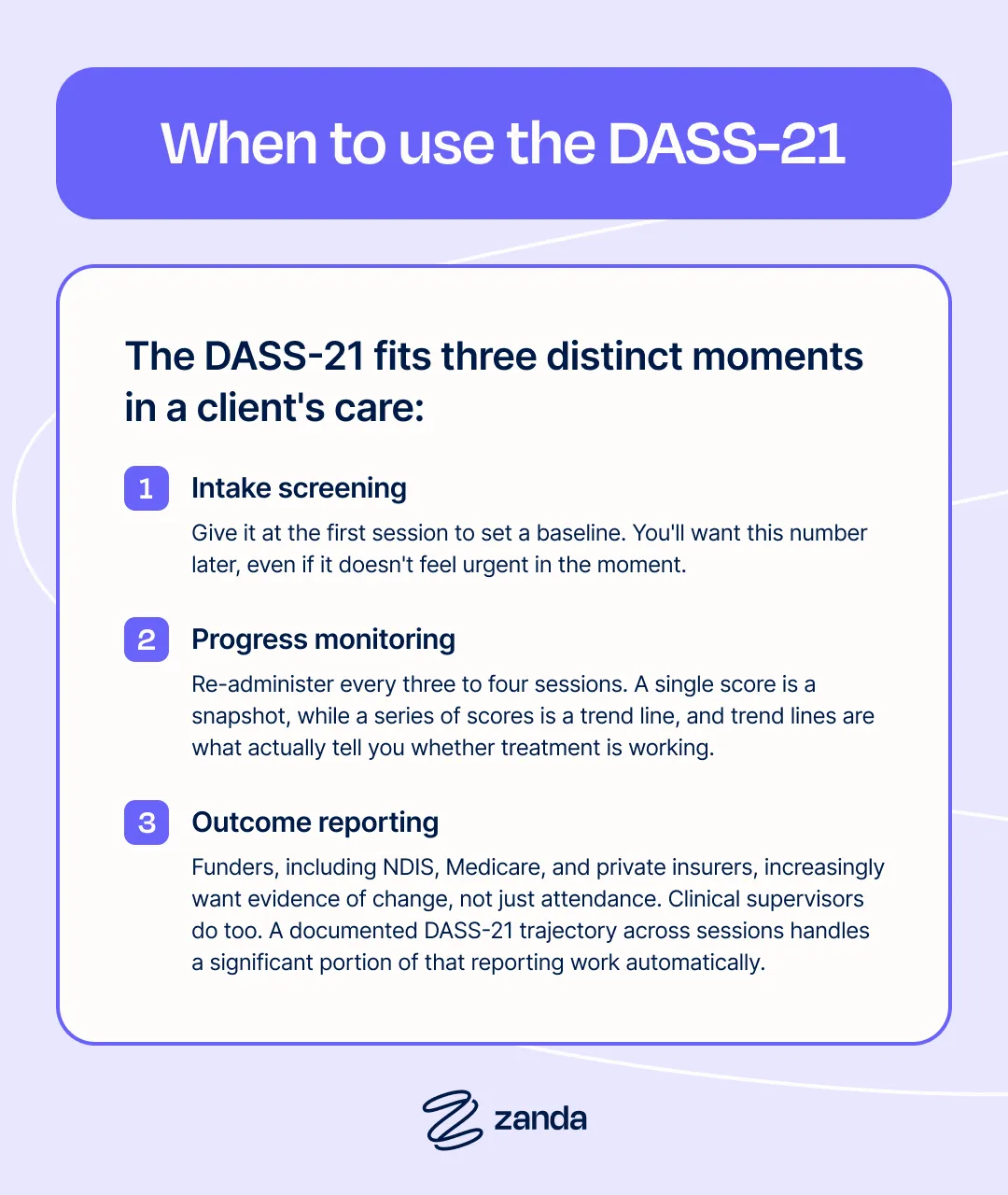
The DASS-21 fits three distinct moments in a client’s care.
Intake screening. Give it at the first session to set a baseline. You’ll want this number later, even if it doesn’t feel urgent in the moment.
Progress monitoring. Re-administer every three to four sessions. A single score is a snapshot, while a series of scores is a trend line, and trend lines are what actually tell you whether treatment is working.
Outcome reporting. Funders, including NDIS, Medicare, and private insurers, increasingly want evidence of change, not just attendance. Clinical supervisors do too. A documented DASS-21 trajectory across sessions handles a significant portion of that reporting work automatically.
Most practitioners know they should be doing all three. The reason many aren’t comes down to one thing: manual scoring breaks the habit before it forms.
How to administer the DASS-21
Administering the DASS-21 takes five to ten minutes and works as a self-report measure, validated for ages 17 and up. A youth version, the DASS-Y, exists for younger clients; a shorter DASS-10 also circulates, though the 21-item version remains the standard.
The two most common delivery formats are handing the form to clients in the waiting room before a session, or sending an electronic version through a client portal so it’s already complete when they walk in. Either works for initial intake; the portal option is considerably more practical for between-session progress monitoring. When giving instructions, keep them simple: ask the client to rate how much each statement applied to them over the past week, on a scale from 0 (did not apply at all) to 3 (applied very much, or most of the time).
DASS-21 scoring
DASS-21 scoring runs in three steps.
Step 1: Sum the items for each subscale. The 21 items split evenly across three subscales, seven items each.
| Subscale | Item numbers |
|---|---|
| Depression | 3, 5, 10, 13, 16, 17, 21 |
| Anxiety | 2, 4, 7, 9, 15, 19, 20 |
| Stress | 1, 6, 8, 11, 12, 14, 18 |
Step 2: Multiply each subscale total by 2. Because the DASS-21 is the short form of the original 42-item version, scores need to double to align with the DASS-42 severity ranges. A raw depression subscale total of 10 becomes 20.
Step 3: Compare each doubled score against the DASS-21 cutoffs below.
DASS-21 interpretation and severity ratings
| Severity | Depression | Anxiety | Stress |
|---|---|---|---|
| Normal | 0–9 | 0–7 | 0–14 |
| Mild | 10–13 | 8–9 | 15–18 |
| Moderate | 14–20 | 10–14 | 19–25 |
| Severe | 21–27 | 15–19 | 26–33 |
| Extremely severe | 28+ | 20+ | 34+ |
A mild or normal score doesn’t mean a client’s struggles aren’t real. It means distress, as the DASS-21 measures it, hasn’t reached a clinically elevated level this week. A moderate or severe score is worth raising directly with the client: ask what’s been happening, whether the score matches how they’d describe their week, and whether the current treatment plan needs to shift.
A jump from moderate to severe between sessions deserves a conversation about safety and escalation. Think of the score as a prompt for a clinical conversation, not a substitute for one.
Small fluctuations within a band aren’t necessarily clinically significant. A shift of a few points can reflect a rough week rather than a real change in trajectory. A movement of one full severity band is more likely to reflect meaningful change. If the score moves but the band stays the same, note it and watch it.
DASS-21 scoring example: a step-by-step walkthrough
Take a client named Sarah completing the DASS-21 at intake. Her raw item scores break down like this:
Depression items (3, 5, 10, 13, 16, 17, 21): 1, 2, 1, 2, 1, 2, 1 → raw total 10
Anxiety items (2, 4, 7, 9, 15, 19, 20): 0, 1, 1, 0, 1, 1, 0 → raw total 4
Stress items (1, 6, 8, 11, 12, 14, 18): 2, 2, 1, 2, 2, 1, 2 → raw total 12
Double each subscale total: depression becomes 20, anxiety becomes 8, stress becomes 24.
Against the severity table, Sarah lands at moderate depression (14–20), normal anxiety (just short of mild at 8), and severe stress (climbing toward extremely severe at 24). That pattern, elevated stress running well ahead of depression and anxiety, often points toward a current external pressure (a job, a relationship, a deadline) rather than a longer-running mood disorder, and it’s worth asking Sarah directly what’s been happening in the last week.
Using DASS-21 scores in session
Scoring the DASS-21 is the easy part. What trips practitioners up more often is what to do with the number once you have it.
When a score lands in the moderate or severe range, the instinct is sometimes to deliver it as a verdict: “you’re scoring severely on stress this week.” That framing can shut down a conversation before it starts. A more useful approach is to bring the score in as shared data: “You scored higher on stress this week than last session. Does that track with how things actually felt?” That question invites the client to confirm, complicate, or push back on what the measure shows, which is usually where the clinical conversation gets most useful.
For clients new to outcome measures, normalizing the score as part of how you work together matters. A rising score doesn’t mean treatment is failing, and a falling score isn’t permission to coast. These scores are simply information to help inform the next best treatment step.
A few situations that specifically warrant a direct conversation:
- A stress subscale running high relative to depression and anxiety (often situational, worth exploring what’s driving it)
- A score that shifts sharply in either direction between sessions (check what was happening that week before drawing clinical conclusions)
- Any score in the severe or extremely severe range on any subscale (review safety and check whether the current care plan is calibrated to the level of distress the client is actually carrying)
The DASS-21 as an outcome measure for funder reporting
For NDIS participants, Medicare-rebated psychology clients, and clients covered by private health insurers, outcome documentation has moved from expected to increasingly required. The DASS-21 as an outcome measure gives you exactly what funders and clinical supervisors typically ask for: a standardized, validated tool applied at multiple time points, with documented change across those points.
What this looks like in practice:
- An intake score establishes baseline distress across all three subscales
- Re-administration every three to four sessions produces a documented trend
- A final or review-point score shows the degree of clinical change against that baseline
- For NDIS plans specifically, a documented trajectory supports both progress reporting and requests for continued funding where progress is slow but the clinical picture is complex
One instrument covering depression, anxiety, and stress, applied consistently across sessions, also reduces the reporting burden considerably. Funders don’t need a narrative explanation of improvement when a trend line across eight sessions shows a depression score moving from moderate to mild, anxiety holding stable, and stress dropping from severe to normal range. The DASS-21 makes that case on its own.
Clinical considerations and limitations
The DASS-21 is a screening tool, not a diagnostic one. A high score flags distress. It doesn’t confirm a disorder, and it shouldn’t substitute for a structured clinical interview.
A few other limits worth keeping in mind: translated and culturally adapted versions exist, but normative cutoffs were developed primarily in Western, English-speaking populations, so interpreting scores from other cultural contexts warrants caution. The measure also has known limitations with severe presentations involving dissociation or psychosis, where self-report may not track well with actual symptom severity. Because all three subscales draw from overlapping symptom domains (irritability appears in both anxiety and stress, for instance), a borderline difference between two subscale scores is worth noting but not overinterpreting.
Use DASS-21 scoring and interpretation as one input alongside clinical judgment, not as the final word.
Common challenges with manual DASS-21 administration
When practitioners score the DASS-21 by hand or in a non-automated format, three friction points tend to appear consistently.
Time cost. Hand-scoring seven items per subscale, across three subscales, every few sessions, across a full caseload adds up fast. A busy practice can easily spend several hours a week on DASS-21 tallying alone.
Transcription errors. Tallying under time pressure almost inevitably produces occasional miscounts, and a miscount on a measure used for treatment decisions or funder reporting isn’t a small problem.
Lost visibility over time. When scores live on paper or in scattered PDFs, spotting a meaningful trend (anxiety climbing steadily over six sessions while depression holds flat) takes real effort. The pattern sits buried in a stack of forms, when it needs to be visible at a glance.
Automating DASS-21 scoring with Zanda Scored Forms
This is exactly the kind of repetitive, error-prone task a good practice management system should handle for you. Zanda’s Scored Forms automate the full DASS-21 workflow: send the form to a client via SMS or email ahead of a session, scores calculate automatically the moment the client submits, and subscale totals and severity ratings land directly in the client’s record without any manual tallying.
If DASS-21 completion is part of new client onboarding, you can configure that as an automation. For clients who want visibility into their own progress, you can give them access through the Client Portal too.
Re-sending the same form across sessions builds a running history automatically. Using Zanda’s Client Progress Reports, you can track score changes over time: depression dropping steadily over eight weeks, anxiety holding flat, stress spiking around a known life event. That’s the kind of pattern that’s actually useful in session and in a funder outcome report, and it becomes visible without any extra work on your end.
The DASS-21 is one of many form templates available in Zanda, though the system also allows practices to build custom forms, with or without scoring.
See full setup instructions for Scored Forms
Frequently asked questions
Is the DASS-21 free to use?
Yes. The DASS-21 is freely available for clinical and research use, without licensing fees. It’s already set up and ready to use in Zanda.
Can the DASS-21 diagnose depression or anxiety?
No. It screens for and measures symptom severity. A diagnosis requires a full clinical assessment, typically against criteria in the DSM-5 or ICD-11.
How is the DASS-21 different from the DASS-42?
The DASS-21 is the short form, with seven items per subscale instead of fourteen. Scores get doubled during scoring specifically to make them comparable to the original 42-item version’s severity ranges.
How often should I re-administer the DASS-21?
Every three to four sessions works well for most caseloads: often enough to catch meaningful change without over-administering.
What’s the difference between the DASS-21 and the PHQ-9 or GAD-7?
The PHQ-9 and GAD-7 each measure a single domain (depression and anxiety respectively) and are widely used in primary care. The DASS-21 covers three domains at once and is more common in psychology and allied mental health practice. Some practitioners use both, depending on what a funder or referral pathway requires.
| DASS-21 | PHQ-9 | GAD-7 | |
|---|---|---|---|
| Measures | Depression, anxiety, stress | Depression only | Anxiety only |
| Item count | 21 | 9 | 7 |
| Time to complete | 5–10 minutes | 2–3 minutes | 2–3 minutes |
| Typical setting | Psychology, allied mental health | Primary care, general practice | Primary care, general practice |
| Best for | Tracking multiple distress domains over time | Quick depression screening | Quick anxiety screening |
This article is provided for general informational purposes and does not constitute clinical or legal advice. Practitioners should use their own clinical judgment and consult relevant professional guidelines when administering and interpreting psychological measures.