
Voicemail Scripts for Private Practice: Examples for Therapists and Medical Offices

Ever thought about the fact that your voicemail is often the first thing a new client hears from your practice? Someone deciding whether to book. A client rescheduling after hours. A GP leaving referral details. Most will hit your voicemail at some point, and like it or not, what they hear shapes what they think of you.
Yet voicemail is one of those things that’s easy to overlook. You set it up once when the phone system was installed, and never really think about it again.
The thing is, a good voicemail script does a lot of work for you. It reassures callers they’ve reached the right place. It gets you the information you need to call them back. And for mental health, allied health clinics and medical practices, it keeps you compliant with privacy rules like HIPAA.
In this article, we’ll walk you through what to include in your voicemail script, with eight copy-paste examples you can adapt for therapists, health clinics, medical offices, group practices, and after-hours scenarios.
Why you need a therapist voicemail script
Most therapy practices can’t answer the phone all day. When you’re in session, on lunch, or when someone calls after hours, calls go to voicemail. That means for a good chunk of the day, your voicemail is doing the talking for you.
A scripted voicemail, that’s thoughtful rather than something you’ve recorded off-the-cuff, helps you handle those calls consistently. It also saves you the awkwardness of re-recording the same message every few months when something changes.
3 benefits of having a professional voicemail
Whether you have an established client base or you’re looking to grow your practice, a professional voicemail is an essential tool to help elevate the image of your practice. Even when you’re not available to respond to a call, you want clients to experience a personal touch, rather than having a robotic voice on the other end of the line.
Beyond the obvious, the benefits of having a professional voicemail script for private practice include:
- You make new clients feel comfortable. A lot of people feel nervous calling a therapist or medical practice for the first time. A warm, clear voicemail tells them they’re in the right place and that someone will get back to them soon.
- You cut down on wrong numbers and repeat questions. When your voicemail identifies your practice and states your hours, callers who’ve dialled the wrong number hang up, and callers with simple questions (like “are you open today?”) often get their answer without needing a call back.
- You stop playing phone tag. Ask for a name, number, and reason for the call in your message, and you’ll have what you need to respond properly the first time. No back-and-forth, no chasing.
What to include in a HIPAA-compliant voicemail script
The Health Insurance Portability and Accountability Act (HIPAA) permits mental health providers to leave voicemail messages for clients, but it places limits on what those messages can contain. Your outgoing voicemail should follow the same standard.
Here’s what to include in your voicemail:
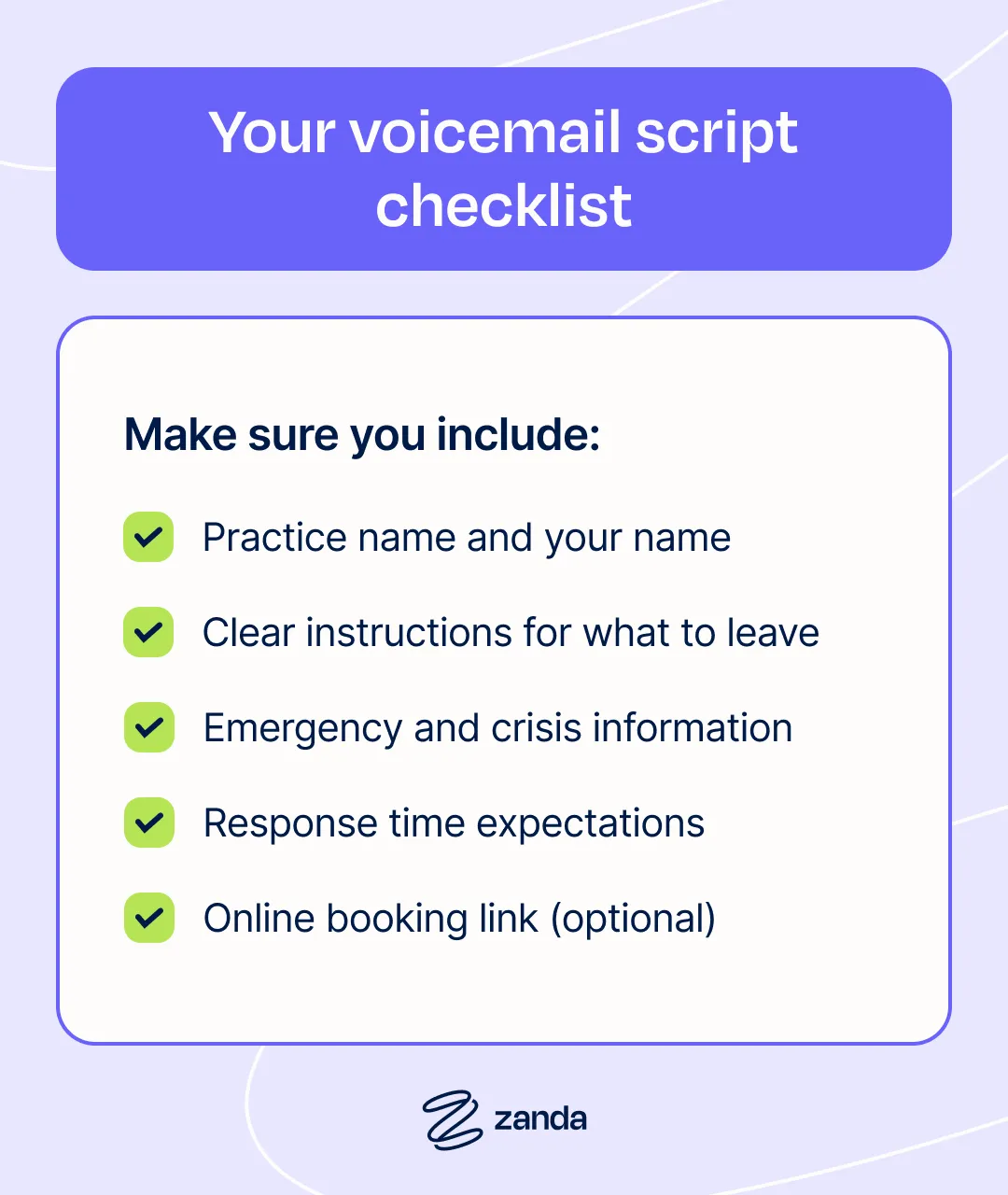
Greetings and practice identification
Open with the name of your practice, and your own name if you’re a solo practitioner. This is the single most important element of the script. That way, a caller who’s reached the wrong number knows straight away and can hang up, and a caller who’s reached the right place has the reassurance they need before leaving their details.
Clear instructions for callers
Tell callers exactly what details to leave in their message. Ask for their name, a callback number, and a brief reason for the call. If you ask, you’re more likely to get it. If you don’t, you’ll spend half your callbacks trying to work out who the person is and what they wanted.
Emergency and crisis information
If you’re a mental health practice, this is not optional. Direct callers to emergency services and to a crisis line.
- In the US, that’s 911 for emergencies and 988 (call or text) for the Suicide and Crisis Lifeline.
- In Canada, that’s 911 for emergencies and 988 (call or text) for the Suicide Crisis Helpline. In Quebec, callers can also reach 1-866-APPELLE (277-3553) or text 53 53 53.
- In Australia, that’s 000 for emergencies, Lifeline on 13 11 14, or 13YARN on 13 92 76 for First Nations callers.
- In the UK, that’s 999 for emergencies and Samaritans on 116 123.
- In New Zealand, that’s 111 for emergencies and 1737 for the national helpline (call or text).
Important Note From Our Legal Eagles: We know you know this, but we need to say it anyway. The information in this template is general in nature and is not legal advice. Consider checking with your professional association for guidance on the emergency numbers in your region.
Response time expectations
Tell callers when they can expect to hear back. This is the single thing that stops people from calling you three times in a row. Be realistic. If you usually take 2 business days, say 2 business days. Don’t promise same-day callbacks you can’t keep.
A typical line might be: “We aim to return all calls within 2 business days. If you haven’t heard from us by then, please call again.”
Instructions on how callers can book online (optional)
If your practice uses a Client Portal for online scheduling, your voicemail is a useful place to mention it. Some callers would rather book directly than wait for a callback, especially for routine appointments. Giving them that option can convert an unanswered call into a confirmed appointment without any extra effort.
Essential tips for writing the ideal voicemail script for private practice
What’s the secret to writing the ideal voicemail script? You’ve got the elements. Here’s how to actually put it together.
Step #1: Write an actual script
Don’t try to wing it. Plenty of people hit record, trip over their words on attempt number 12, and end up with something that sounds flustered. A 2-minute planning exercise saves you all of that.
Write down what you want to say, read it aloud, and adjust until it sounds natural. Read it like you’re talking to one person, not an audience. If a sentence feels clunky on paper, it’ll feel worse recorded.
A few practical things to get right before you record:
- Keep it under 30 seconds. Longer than that and callers stop listening before you’ve covered the important information.
- Front-load your practice name. Callers who’ve dialled the wrong number will hang up within the first few seconds.
- Don’t bury the instruction to leave a message. If you save “please leave your name and number” until the end, some callers will already have hung up by then.
- Date any temporary changes. If your hours change for a holiday, say so explicitly. “Our office will be closed from December 23 to January 2” is better than “we’re closed for the holidays”, because a caller hearing that message in February will worry they’re outdated.
Step #2: Sit down and record it (or hire a voice actor)
Once you’ve got your script, find a quiet room and record it. A few things that make a real difference:
- Sit up straight and smile when you speak. It sounds silly, but both come through in your voice. Callers can hear a slumped, distracted recording, and they can hear a warm one, too.
- Have a glass of water on hand. Dry mouth makes for uneven audio.
- Take a breath before you start. And pause for half a second before the first word. It sounds more natural than launching straight in.
- Do a few takes. You’ll almost never nail it on the first try. Record three or four and pick the best one.
If recording your own voice feels awkward (and it does for a lot of people), you can hire a voice actor instead. It’s cheaper and faster than you’d expect.
Freelancer.com is one option. Post a short brief with your script, budget, and the accent or tone you want, pick from the applicants, and you’ll usually have a finished recording within a few days. Fiverr and Voices.com work the same way.
For most practices, this is overkill. But if you’ve recorded your own voicemail six times and still don’t like how it sounds, it’s worth considering.
Voicemail script examples for mental health and private practice professionals
Here are eight voicemail scripts you can copy and adapt for your practice. Each one uses brackets to mark the bits you’ll need to fill in yourself. Pick the one closest to your situation and tweak from there.
A quick note on tone before you start: aim for warm but professional. A voicemail that’s too casual can undermine trust, but one that’s too stiff can feel cold, especially for mental health callers who may already be nervous about reaching out.
1. Therapist voicemail script (with crisis line)
Best for solo therapists and counselors in mental health practice. Includes the crisis line reference that’s essential for this field.
“Hi, you’ve reached [your name] at [practice name]. I’m not able to take your call right now, but please leave your name, number, and a brief message, and I’ll get back to you within [2 business days].
If you’re experiencing a mental health emergency, please call 911 or go to your nearest emergency department. For immediate crisis support, you can also call or text 988 to reach the Suicide and Crisis Lifeline.
Thanks for calling, and I’ll be in touch soon.”
2. Confidential voicemail greeting example
Use this if you want to emphasise privacy, for situations where callers are likely to share sensitive details. A short note about confidentiality can help nervous first-time callers feel safer leaving a message.
“You’ve reached [practice name]. Your call is confidential, and messages are only accessed by our clinical team.
Please leave your name, a callback number, and a brief reason for your call. We’ll return your call within [1 business day].
If this is an emergency, please hang up and dial [911 / 000 / 999 / 111] or contact [crisis line number].“
3. Medical office voicemail script
For GP clinics, family practices, and general medical offices. Straightforward, informative, and focused on triage.
“Thank you for calling [practice name]. We’re sorry we can’t take your call right now. Our office hours are [Monday to Friday, 8am to 5pm].
Please leave your name, phone number, and a brief message. We’ll return your call within [1 business day].
If you need a follow-up appointment, please use our online portal at [website]. If your call is urgent and can’t wait, please contact [after-hours service or emergency department]. For life-threatening emergencies, hang up and dial [911 / 000].“
4. Medical assistant voicemail script
For medical assistants, receptionists, or practice admin staff handling a shared line.
“You’ve reached the reception team at [practice name]. We’re either on another call or away from the desk.
Please leave your name, phone number, and a brief outline of what you’re calling about, whether that’s booking an appointment, a billing question, or a prescription query. We’ll call you back within [1 business day].
For urgent medical concerns, please contact [after-hours service]. For emergencies, hang up and dial [911 / 000].“
5. Counselor and allied health voicemail script
For counselors, physiotherapists, occupational therapists, podiatrists, speech pathologists, and other allied health professionals.
“Hi, you’ve reached [your name], [profession] at [practice name]. I’m with a client at the moment, so please leave your name, phone number, and a brief message, and I’ll return your call within [2 business days].
If you’re booking a new appointment, you can also book online at [website].
Thanks for calling, and I look forward to speaking to you soon.”
6. After-hours voicemail message
Switch to this script outside business hours. It sets clear expectations about when callers will hear back.
“Thank you for calling [practice name]. You’ve reached us outside our regular hours.
Our office is open [Monday to Friday, 9am to 5pm]. If you’d like to book or reschedule an appointment, please leave your name and number, or book online at [website], and we’ll get back to you by the next business day.
If this is a medical emergency, please hang up and dial [911 / 000]. For mental health crisis support, call or text [988 / Lifeline number].“
7. Group practice voicemail with menu
For multi-practitioner clinics, where callers need to reach a specific therapist or team member.
“Thanks for calling [practice name]. For the fastest response, please listen to the following options:
- Press 1 to leave a private message for [practitioner 1]
- Press 2 to leave a private message for [practitioner 2]
- Press 3 for billing and administration
- Press 0 to leave a general message
All messages are confidential and will be returned within [1 business day]. If this is an emergency, please hang up and dial [911 / 000].“
8. Holiday or vacation voicemail
Use this when your practice is closed for a specific period. Always include the exact dates so the message doesn’t sound outdated if someone hears it later.
“Hi, you’ve reached [your name] at [practice name]. Our practice is closed from [December 23] through [January 2]. We’ll be returning calls and emails from [January 3].
If you need to book or reschedule an appointment during this time, you can do so online at [website].
If this is an emergency, please hang up and dial [911 / 000]. For urgent mental health support, call or text [988].”
A key tip is to manage your callers’ expectations by being clear and honest about your response times. Of course, it’s also vital to set aside time every day to respond to your voice messages. And try to keep your messages as short as possible, while still providing all the necessary details required.
When a voicemail isn’t the answer
Voicemail is the default, but it isn’t always the best or only option. A good voicemail script handles missed calls well, but a great setup can reduce the number of missed calls in the first place.
Here are three alternatives worth considering.
Hire a virtual receptionist or answering service. If your practice gets enough call volume that voicemail feels like a bottleneck, a virtual receptionist can answer during business hours for a fraction of the cost of an in-house hire. They take messages, book appointments, and escalate anything urgent. Zanda has some virtual assistant partners that focus on healthcare reception.
Add online booking options. A lot of the calls that hit your voicemail are routine: someone wanting to book, reschedule, or check availability. If those callers can self-serve through an online booking page, you cut your voicemail volume significantly. Zanda’s practice management software includes a Client Portal that lets clients book 24/7 without needing to reach your team at all. Pair it with automated SMS appointment reminders, and you’ll reduce both missed calls and no-shows.
Offer SMS or a contact form as an alternative. Some clients prefer not to leave voicemails, especially for sensitive topics. Giving them a text or form option (mentioned in your voicemail greeting) can recover calls that would otherwise go unreturned.
None of these replace a good voicemail script. But combined, they can meaningfully reduce how often your voicemail needs to do the work for you.
As you can see, a good voicemail script is a small thing that does a lot of work for you. Write it once, record it well, review it every six months, and you’ll spend less time on phone tag and more on the clients you’re actually seeing.
FAQs
How long should a voicemail greeting be?
Aim for 20 to 40 seconds. That’s enough time to identify yourself and your practice, direct callers in an emergency, ask for the details you need, and give your callback window. If it’s much longer, callers tend to stop listening before you’ve covered the important information.
Should a voicemail include emergency numbers?
Yes, and for mental health practices, this isn’t optional. Every outgoing message should direct callers to local emergency services and a crisis line.
For allied health and general medical practices, a crisis line isn’t required, but directing callers to their nearest emergency department or urgent care is good practice. A caller in distress who reaches your voicemail needs to know where to turn.
What information shouldn’t be asked for in a healthcare voicemail?
Don’t ask callers to leave diagnosis details, medication names, insurance information, or any other protected health data. HIPAA treats voicemail as an unsecured channel, so if you ask someone to confirm they’re being treated for depression or to name a specific medication, you’ve introduced a problem. Ask only for a name, a callback number, and a preferred time.
How often should I update my voicemail script?
At least every six months, and any time something changes: your office hours, your callback window, a practitioner leaving a group practice, a new online booking link. An outdated message that references the wrong hours or a staff member who left a year ago doesn’t just confuse callers; it makes your practice look like it isn’t paying attention.