
How to Start a Group Practice: The Complete Guide to Scaling Your Clinic

Your waitlist is two months long and this week you turned away three referrals. That’s when the thought arrives: I could help more people if there were two of me.
This may be a sign you’re ready to start a group practice.
But what does going from one to two (and beyond) really look like in practice? You’ll need to think about hiring, finances, and managing a calendar with multiple names on it. You’ll be a clinician and a boss who enables good clinicians to do their best work. You’ll have to market the business, not just yourself.
This guide walks through setting up a group practice, and covers what most guides skip: what to do when someone leaves, how billing works across a team, and how to build something that still runs well on the days you’re not there.
How to start a group practice: your roadmap from solo to group
Transitioning from solo to group practice can be a smooth process when the steps happen in order. If you hire a clinician before you’ve determined how people get paid, or bring on a second OT before you know your break even number, you may end up doing more work in the long run.
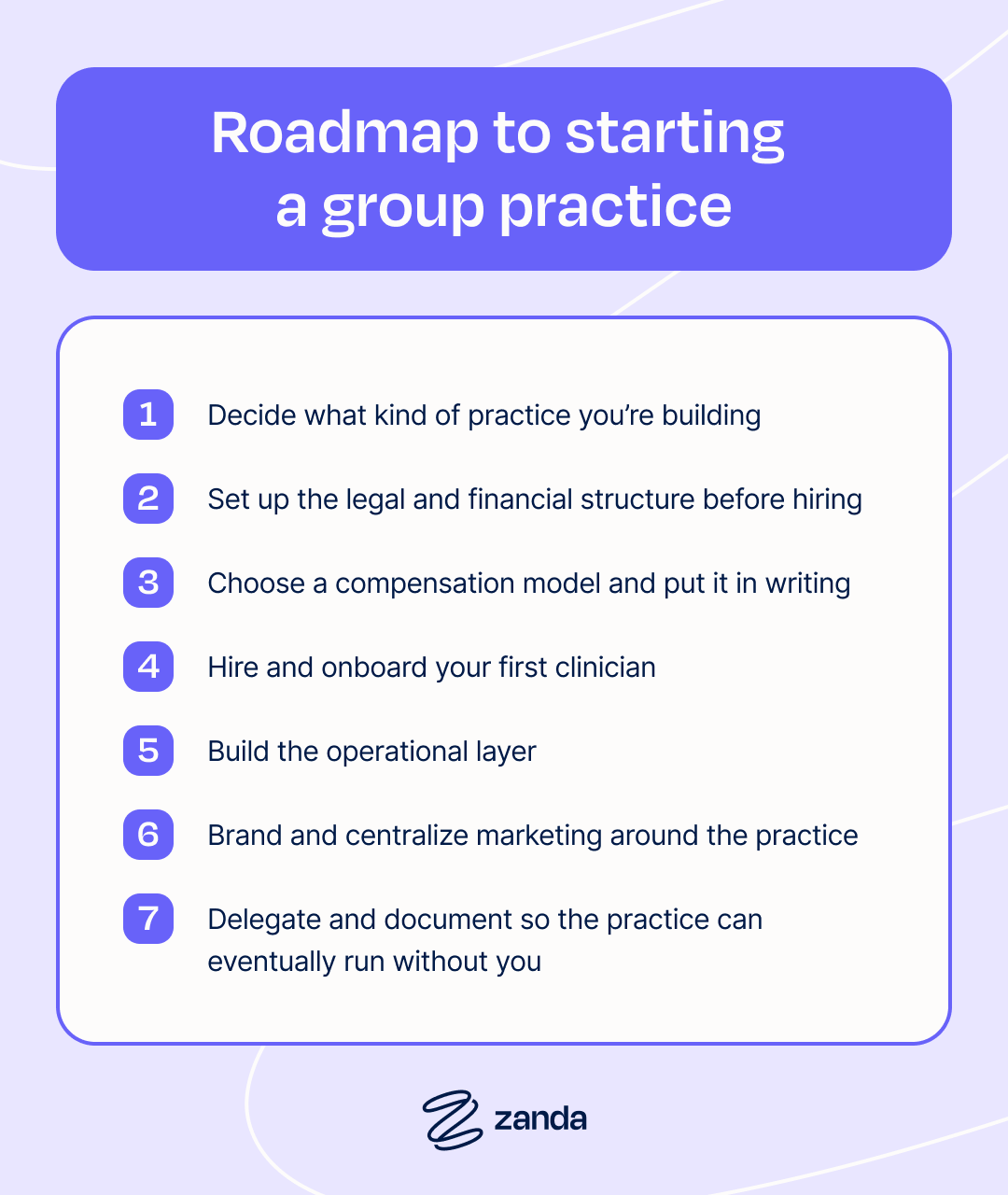
Here’s the sequence to follow:
- Decide what kind of practice you’re building (multidisciplinary or specialized), because it shapes everything downstream.
- Set up the legal and financial structure before you hire.
- Choose a compensation model and put it in writing.
- Hire and onboard your first clinician, with classification, credentialing, and supervision determined in advance.
- Build the operational layer: shared space, scheduling, and group practice management software.
- Rebrand and centralize marketing around the practice rather than your name.
- Delegate and document so the practice can eventually run without you.
Steps 1 to 3 happen before you hire anyone. Steps 4 and 5 cover your first 90 days with staff. Steps 6 and 7 take you through the rest of year one.
Strategic planning: build your foundation for scale
Three decisions come before your first hire: what kind of practice you’re building, how it’s structured legally and financially, and how you’ll pay the people you bring in.
Define your vision: multidisciplinary clinic or specialized group?
Most group practices take one of two shapes: a multidisciplinary clinic spanning several professions, or a specialized group built around one. The choice has consequences for your staffing, your space, and the referral networks you build.
A multidisciplinary clinic (think OTs, physical therapists, and speech pathologists all under one roof) lets you take on more complex cases and refer clients internally. A child with a developmental delay might see the OT on Tuesday and the speech pathologist on Thursday. For referrers, a clinic like this is an easier send than a solo practitioner. The trade-off is coordination overhead: separate insurance panel applications, different scope-of-practice boundaries, and documentation standards that don’t always line up across disciplines.
A specialized group (say, trauma-informed psychologists, or a multidisciplinary chronic pain team) is easier to market and often builds a stronger clinical reputation, but limits your referral base to presenting issues within that specialty.
There’s no right answer. Your location, your existing referral relationships, and your willingness to take on coordination work determine the right group practice business model for you. The point is to decide before you write the first job description, because “what kind of practice do we want to be” is harder to answer after you’ve hired three people with different expectations.
Choose a legal structure for your group practice
The most common shift when transitioning from solo to group practice is moving from a sole proprietorship to a limited liability company (LLC) or, for licensed health professionals in the US, a professional limited liability company (PLLC).
Most practitioners do this for liability separation. If a clinician on your team faces a malpractice claim, the LLC structure can protect your personal assets from it. This isn’t guaranteed if the business is mismanaged, but it’s better protection than operating as a sole trader.
In Australia, incorporating as a proprietary limited company (Pty Ltd) achieves something similar, and in the UK a private limited company (Ltd) does the same. The right group practice legal structure is jurisdiction-specific, so get advice from a healthcare accountant or solicitor before you decide. Ask them specifically:
- What structure minimizes my personal exposure if a clinician is sued?
- What gives me the most flexibility if I want to bring in a co-owner in five years?
Set up the right financial structure: the break-even math
Before you post your first job ad, work out the break-even point for each new hire.
To calculate this number, take the clinician’s compensation (salary or percentage split, plus employer costs like payroll tax and retirement), add a proportional share of rent, software, and admin costs, then divide by a realistic sessions-per-week figure.
When you put numbers to it: a physical therapist seeing 25 patients per week at an average of $160 per patient generates $4,000 per week (amounts vary significantly by market). If your all-in cost for that position is $2,600, your margin is $1,400 per clinician before practice overhead.
Your first hire rarely starts at full capacity, so build in a ramp period to manage expectations. It’s normal for a new clinician to take three months to fill their caseload. If your model only works at 90% capacity from day one, take another look at your numbers.
Decide on compensation models: salary, percentage split, and tiered
How you pay your clinicians shapes your practice culture. There are three main compensation models, and the right one depends on your growth stage and risk tolerance.
| Model | How it works | Best suited to | Who carries the risk |
|---|---|---|---|
| Flat salary | Fixed pay regardless of caseload | Predictable, high-volume referral flow | The owner |
| Percentage split (e.g. 60/40) | Clinician keeps a set share of fees billed | Fluctuating caseloads in psychology and counseling | Shared evenly |
| Tiered split | Share rises with seniority or volume | Rewarding retention and productivity | Shifts toward the clinician over time |
Flat salaries give clinicians stability and make it easier to ask them to take on non-clinical work like training, supervision, or admin coverage. But the risk sits entirely with you. If a clinician has a slow month, your costs don’t change. Salaries work best when your referral flow is predictable and high-volume. There’s a motivational trade-off too, since pay isn’t linked to effort, so clinicians may have less reason over time to put in extra hours.
A percentage split, often around 60/40 or 65/35 in favor of the clinician, distributes risk more evenly. When the clinician is busy, you both earn well; when they’re slow, you both feel it. This model is common in psychology and counseling group practices, where caseloads fluctuate more than in a physiotherapy clinic with a steady post-surgical referral base.
Tiered arrangements increase the clinician’s percentage as their volume or seniority grows. A new-graduate occupational therapist might start at 55/45 and move to a higher share after 18 months or once they hit a weekly session threshold. This rewards retention and productivity without committing you to a fixed salary-increase schedule.
Whichever model you choose, put it in writing before the first day of work. Be clear about what happens to unbilled sessions, whether the split treats group sessions differently from individual ones, and how cancellations are handled, including who bears the cost of a late cancellation where no fee is collected.
People and culture: grow your clinical team
Your first hire sets the pattern for every hire after it, so get classification, credentialing, and exit terms right from the start.
Contractor vs. employee: what classification means for therapists and allied health clinicians
Classification matters in a group practice because it affects tax obligations, entitlements, and, in some jurisdictions, liability for retirement or pension contributions.
| Jurisdiction | Governing framework | The question that decides it |
|---|---|---|
| US | IRS multi-factor test (1099 vs W-2) | How much control you have over hours, equipment, and delivery |
| Australia | Fair Work Act and recent contractor amendments | The real nature of the engagement, not the label on the contract |
| UK | HMRC IR35 framework | Whether it’s genuine contracting or disguised employment |
In the US, the IRS uses a multi-factor test to determine whether a worker is an independent contractor (1099) or an employee (W-2). If you set the clinician’s hours, provide their equipment, and direct how they deliver services, the IRS may reclassify them as an employee regardless of what your contract says. Misclassification carries penalties: back taxes, interest, and sometimes fines.
In Australia, the Fair Work Act and recent contractor-related amendments have tightened the rules. Therapists and allied health practitioners operating as contractors may still be entitled to certain protections depending on the nature of the engagement.
In the UK, the IR35 framework determines whether a contractor arrangement is genuine or disguised employment. Speech and language therapists and physiotherapists working through their own limited companies may fall inside or outside IR35 depending on their working arrangements. Whatever the jurisdiction, get advice from a healthcare employment specialist before you structure contractor arrangements.
Onboarding done right for every new hire
Before a new clinician sees their first patient, you want them to:
- Sign their contract
- Complete any mandatory compliance training (privacy, consent, reporting)
- Receive their login credentials
- Attend at least one orientation session
A written onboarding checklist in your Practice Operations Manual keeps this from falling through the cracks by the time you hire clinicians three and four.
Credentialing, compliance, and clinical supervision for new clinicians
Every clinician you hire needs to carry their own professional indemnity insurance. Don’t assume it transfers from their previous role, and ask to see the certificate before they start.
In the US, each new clinician also needs to be credentialed with the insurance panels your practice participates in. Credentialing can take 60 to 120 days, so if your new psychologist starts on August 1, begin the paperwork in May.
Supervision is a cost many new owners miss. If you hire a counselor still working toward full registration (PACFA or ACA in Australia, state licensure in the US), you’re part of their credentialing pathway, which means a set number of supervision hours you’re obligated to provide. Those hours come out of your own billable time, so account for them in your schedule and your cost model before you hire.
When a clinician leaves
A clinician’s departure is one of the most stressful things that happens in a group practice, and how well you handle it is largely decided before you hire anyone.
Your employment contract needs to answer three things up front:
- Whether a departing clinician can contact your patients directly
- Whether active patients stay with the practice
- What happens to clinical notes and system access
The handover carries clinical risk too. A patient in active trauma treatment shouldn’t get a rushed three-day handoff because nobody planned for the resignation. Build the contract for it: a notice period long enough for a proper clinical handover, a clear clause on post-departure patient contact, and data access that ends on the last day of employment.
If a departing clinician takes a big share of your caseload, that’s lost revenue while the role sits empty. The break-even model you built when you hired them shows how many weeks you can cover the gap before cash flow comes under pressure.
Operations: run a multi-practitioner practice
Running five calendars is not the same as running one calendar five times. Space, scheduling, software, and billing each need a robust system to handle the complexity.
Kimberly Simmons, a virtual assistant who specializes in group practice setups and consultations, says:
“Moving from a solo to a group practice is an exciting step, but it often exposes inefficiencies in the way systems and processes have been set up. One of the most common mistakes I see is practices trying to accommodate each clinician with different compensation models, forms, and booking processes. While this might feel personalized, it quickly becomes difficult to manage and gives each client a different experience of the practice.
The key to a successful group practice is standardization. Your systems, processes, and client journey should be streamlined so that they work consistently across all practitioners. This not only creates a better experience for clients but also makes the business far easier to manage and scale.”
Coordinate shared space across physiotherapists, OTs, and counselors
If you’re starting a group practice in an existing space, you may not need to expand right away. A single consulting room used by two practitioners on different days can double your capacity without doubling your lease.
A physiotherapist who works Monday through Wednesday and a counselor who works Thursday and Friday can share one room with some scheduling coordination and minimal equipment conflict. This hot-desk or room-share model is how many group practices start before they outgrow their first location.
The main challenge is avoiding double-booking. With five practitioners it’s impossible to track by hand, so you need a calendar view that shows room occupancy alongside clinician availability, letting your admin see at a glance whether room two is free at 2 p.m.
Choose group practice management software
The paperwork grows faster than the team does. For a solo physical therapist, a clunky calendar is just an annoyance. But once five physical therapists and an OT share one calendar and the same intake forms, each keeping separate clinical notes, and you need reporting across all of it, it becomes more than a basic setup can handle.
Your practice management software should excel at:
- Role-based access. A junior counselor shouldn’t see the physiotherapist’s clinical notes, and a billing manager doesn’t need clinical records at all. Good permissions let you set each person’s role once and have the software enforce it.
- Centralized intake. A client portal with online booking lets one admin manage appointments for every clinician, with intake forms, consent documents, and cancellation policies sent automatically when a patient books. Reception stops chasing paperwork across five clinicians.
- Reporting. As the team grows, you need revenue per clinician, appointment volume by practitioner and service type, and cancellation rates by clinician or day. If your OT’s Tuesday mornings have a 30% cancellation rate and no one else’s does, that’s a fixable scheduling problem you won’t catch without reporting.
- AI documentation. Notes pile up fast in a group, since every clinician writes them after every session. BizzyAI: Scribe transcribes the live session and drafts the note in your own template, so clinicians stay present with the client instead of typing.
Manage billing across multiple practitioners
In a solo practice, billing is simple: one provider number, one bank account, one set of records. Add four more practitioners and the complexity doesn’t just add up, it multiplies.
Each clinician typically bills under their own provider number for Medicare in Australia, insurance panels in the US, or National Health Service (NHS) contracts in the UK. Your reconciliation process has to match each payment to the right provider, track outstanding claims per clinician, and catch billing errors before they become compliance problems. This is also where you need a plan if a clinician departs: if someone leaves mid-month with claims still outstanding in their name, you need a process for resolving those before their system access is switched off.
Keep billing records per clinician from day one, even with only two team members. Retrofitting a per-clinician structure onto five practitioners’ historic records is far harder than doing it right from the start.
“We’ve found that Zanda is particularly well-suited for group practices because it supports structured workflows and user management. The ability to set different access levels is essential for maintaining confidentiality and reducing admin errors, especially as your team grows.” — Kimberly Simmons
Growth: marketing a brand, not yourself
Once the practice can deliver care without you in every room, the marketing has to follow, which means building a reputation that belongs to the clinic rather than your name.
Rebrand for a multi-clinician practice
Growing into a multi-clinician practice is a real milestone, and your marketing gets to grow with it. The first place that shows is your own name. If your website currently reads “Jane Doe, OT (Pediatric Occupational Therapist)” and you’re bringing on a speech pathologist and a second OT, you’ll soon outgrow it.
A brand name (The Wellness Collective or Riverside Allied Health) gives the whole team something to belong to. Do it deliberately: your domain, Google Business Profile, email signatures, referral letterhead, and social profiles all move together, so you present one clear identity rather than a mix of old and new. The best part is what you’re building underneath it — a reputation that belongs to the clinic, so that as clinicians come and go, the practice keeps its search presence and referral network.
The internal referral loop is where a group practice has an advantage. A child referred for speech therapy may also benefit from an OT assessment, and a trauma-informed psychologist can send a client to a physiotherapist for somatic work. Make these pathways easy to see: put them on your About page, in your general practitioner (GP) referral letter, and in your intake paperwork, named clearly rather than buried in small print. One warm line in a referral letter does more than a brochure ever could: “Our team also includes an occupational therapist and a pediatric physiotherapist if co-assessment would be useful.”
Manage your referral relationships as you grow
When you were solo, every referral came to you. Adding clinicians changes that, and most owners don’t have a plan for it until a primary care doctor calls expecting the original practitioner and gets passed around reception.
The choice is whether a referral belongs to the practice or to a specific clinician. Practice-level referrals keep the work in-house if a clinician moves on. Clinician-level referrals recognize that some referrers trust one practitioner in particular and will follow them if they leave. Most practices settle on a mix: new referrals go to the practice, and established relationships stay with the clinician who built them.
Whatever you decide, document it, communicate it to the team, and make sure your receptionist knows how to handle a call that requests someone by name.
Centralize digital marketing for group practices
When you market the practice rather than a person, a single campaign reaches more of the people you want. A Google Ads campaign pointing at a “Meet the Team” page works harder than one sending people to a single clinician’s bio, because a parent looking for a pediatric OT and someone looking for a therapist both land on a page that fits them.
Review collection pays off more in a group practice too. Five clinicians seeing 20 patients a week generate 100 chances to ask for a review; one clinician seeing 20 generates 20. Set up review request automation once, tie it to appointment completion, and it runs for every clinician automatically.
Leadership and logistics: who runs the practice when it isn’t just you
Stepping back is the biggest shift for many practice owners. This is where you decide what to delegate, who you trust to do the work, and how the practice keeps running when you’re not in the room.
Delegate operations as you grow: practice manager or VA?
Somewhere between your second and fourth clinician, admin starts eating into your clinical time (or your evenings). That’s usually when you’re ready to hand it off, and the decision comes down to a practice manager or a virtual assistant (VA).
“A specialist VA understands the full client journey, from initial enquiry through to ongoing care, and can implement systems that ensure everything runs smoothly behind the scenes. They can manage admin centrally, handle cancellations in line with your policies, and ensure accurate reporting for practitioner invoicing, removing the burden from both the practice owner and individual clinicians.” — Kimberly Simmons
A practice manager, even part-time, gives you back hours for clinical work, business development, and the supervision your team needs from you. A VA costs less and handles the lighter stuff: inbox, scheduling, formatting documents.
Whether it pays off depends on your schedule. Say a part-time manager costs $800 a week and frees you to see eight more patients a week at $200 a session: the freed billings more than clear the wage. If your schedule is already full and delegating frees no billable hours, it may not pay off yet. That changes by the time you reach four or five clinicians, where the focus shifts from freeing your sessions to keeping the whole team’s scheduling, billing, and compliance running smoothly.
Build a practice that can run without you
A practice that runs entirely on your clinical presence, your relationships, and your judgment is hard to sell and hard to step back from. Put the practice on paper and you have the opposite: a clear intake process, a real supervision structure, a team that makes day-to-day calls without you, and financials any manager can read. When your processes are written down, your practice becomes an asset.
The documentation can take years to build, which is why you start in your first year, not your fifth. A new clinician should be able to find the intake checklist, the billing process, and your documentation standards without asking you. That’s what a Practice Operations Manual is for: one place for the processes, templates, and policies that used to live in your head. Once they’re there, scaling a private practice no longer depends on you being in the building, and the practice can run a day, or a week, without you in it.
Run your group practice with Zanda
A group practice has more to manage than a solo one, but the admin doesn’t have to be the hard part. Zanda is built for multi-practitioner practices: each clinician sees only their own patients and notes in their dashboard, while you keep the whole-practice view through reporting. The automations for appointment reminders, review requests, and recall nudges run across the whole team, so you set them up once rather than clinician by clinician.
That frees you up for the work that grows the practice: your clinicians, your referrers, and the patients you started all this for.
Try Zanda free for 14 days, no credit card required.