
AI Consent for Allied Health Practitioners (with Free Templates)

“Try sharing the session notes. You might be surprised how much clients appreciate it. It’s like giving them a mirror for their mind, and it builds trust.” That’s UK-based counselor David Goodman’s advice to other practitioners. “I let my clients know I’m using BizzyAI, and with their consent, I share the notes. It’s not filtered through my lens, it’s just a clear, organized summary of our conversation,” he says. “That’s incredibly powerful.”
That’s the whole shape of good AI consent, really. Tell the client, get the nod, keep going. It doesn’t need to be complicated, and for most practitioners, the entire step involves one sentence added to paperwork they’re already using.
Why is AI consent important?
It helps to know why some practitioners hesitate. Therapists and OTs have been swapping stories on Reddit and in practice forums about clients noticing AI involvement from an oddly phrased reply, a transcription slip, a session note that read differently than usual. It’s become a hot topic in the industry, since trust with clients matters more than almost anything else. But it’s not the whole picture, and it’s not a reason to sit out tools that are changing how practices run day to day.
What is an AI consent form?
An AI consent form is the part of your intake paperwork that tells a client which AI tools touch their data, what those tools do, and what they don’t do. It covers note-taking tools, communication automations, or anything that processes what a client says or writes to you.
What practitioners are actually using AI for right now
Practitioners using BizzyAI are spending an average of 4 minutes per note instead of 14, saving close to 5 hours a week on documentation alone. 71% report being more engaged with clients during sessions, and 62% say they have more time for actual client interaction. AI like this has stopped being a novelty across healthcare and most other industries, and what it’s opening up for clinicians specifically is presence in the room, a better hold on work-life balance, and an administrative load that doesn’t follow them home.
The only question that actually matters
Before deciding what kind of consent a tool needs, ask one thing: does it touch patient data?
If the answer is no (an AI tool drafting your practice newsletter, say, or suggesting social captions) you’re in low-stakes territory. Transparency is still worth it, but it’s not a compliance issue.
If the answer is yes (scribing, transcription, anything processing what a client says or writes to you) that’s where a consent step belongs.
Verbal vs. written AI consent
Not every tool needs the same level of consent. A verbal mention at the start of a session covers low-risk admin tools, things like appointment reminders or scheduling automation, where you simply tell a client what’s running. Anything that records, transcribes, or processes session content, like an AI scribe, is worth putting in writing in your intake paperwork. It’s a small step that covers you and gives clients the transparency they deserve.
What to include in an AI consent form
A solid AI consent paragraph covers four things: which tools you use, what they do, what they don’t do (no AI makes clinical decisions on your behalf), and how a client can opt out. Download our free AI audit template to map out the tools you’re already using, sort which ones touch patient data, and consolidate it all into one practice-wide approach.
A practical checklist
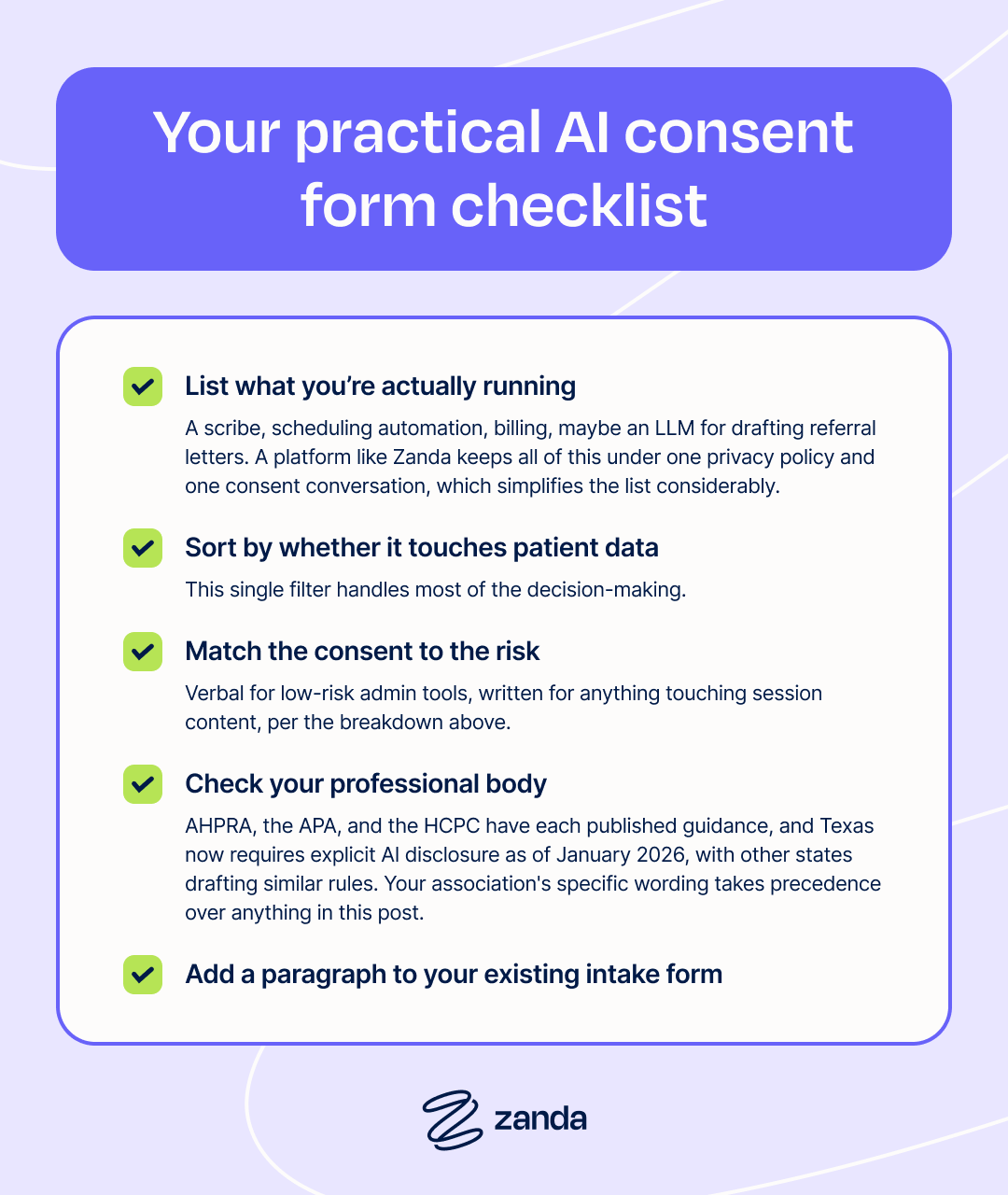
List what you’re actually running. A scribe, scheduling automation, billing, maybe an LLM for drafting referral letters. A platform like Zanda keeps all of this under one privacy policy and one consent conversation, which simplifies the list considerably.
Sort by whether it touches patient data. This single filter handles most of the decision-making.
Match the consent to the risk. Verbal for low-risk admin tools, written for anything touching session content, per the breakdown above.
Check your professional body. AHPRA, the APA, and the HCPC have each published guidance, and Texas now requires explicit AI disclosure as of January 2026, with other states drafting similar rules. Your association’s specific wording takes precedence over anything in this post.
Add a paragraph to your existing intake form.
Free AI consent templates
Australia (Aligned with AHPRA guidance. Consent must be noted in the health record.)
“This practice uses AI tools to assist with clinical documentation and administrative tasks, including session note-taking, appointment reminders, and billing. These tools do not make clinical decisions; all clinical judgment remains with your treating practitioner. Your data is stored securely and is not used to train AI models or shared with third parties. Before using any AI tool that involves your personal health information, we will obtain your consent and note this in your health record. You have the right to decline or withdraw consent at any time without affecting your care.”
United States (Aligned with APA ethical guidance and HIPAA. Note: Texas requires explicit disclosure; check your state.)
“We use AI tools to assist with clinical documentation and practice administration, including session notes, appointment reminders, and billing. These tools do not make clinical decisions, and all judgment about your care remains with your practitioner. Any use of AI in your care will be communicated to you clearly, including the purpose of the tool, how your information is handled, and the associated benefits and risks. Your data is handled in compliance with HIPAA and is never used to train AI models. You may ask questions or opt out of specific uses at any time.”
United Kingdom (Aligned with HCPC standards, NHS England guidance on ambient scribes, and UK GDPR. Implied consent is acceptable for most admin tools; explicit consent is recommended for AI scribing.)
“We use AI tools to support our clinical and administrative work, including note-taking during sessions and tasks such as appointment reminders and billing. You will always be informed before any AI tool is used that involves your personal health information, and you are free to raise any concerns or decline without any impact to your care. AI tools do not make clinical decisions; all decisions about your care are made by your practitioner. Your data is handled in compliance with UK GDPR and is not used to train AI models.”
New Zealand (Aligned with the NZ Privacy Act 2020, Health Information Privacy Code, and ACC/NZ Psychologists Board guidance.)
“We use AI tools to help with clinical note-taking and practice administration, including appointment reminders and billing. These tools do not make clinical decisions; your care remains entirely in the hands of your practitioner. Where AI tools involve your personal health information, we will let you know what’s being used and why, and you can ask questions or opt out at any time without it affecting your care. Your information is stored securely and is never used to train AI models or shared with third parties.”
Watch for shadow AI
Shadow AI is what happens when staff across a practice each adopt their own AI tools independently, one person using a scribe and another testing a different LLM for emails, with no shared policy. It’s how practices end up with inconsistent consent language, tools with different data handling standards, and a compliance gap nobody notices until a client or regulator asks about it.
The fix is establishing one AI policy across the practice rather than letting each person pick their own stack. If you’re building that out from scratch, our Practice Manual has over 100 templates, including AI use policies, so you’re not starting from a blank page.
Where Zanda fits into all of this
Zanda is ISO-27001 certified, independently verified against HIPAA and GDPR, and client data is never used to train AI models or shared with third parties. For practices using BizzyAI, consent capture sits inside the workflow itself, before a session ever starts, so the step happens before it can be missed. Consent is straightforward to set up once you have the right process in place. Don’t let it be the reason you hold off on tools that are changing what’s possible for allied health practitioners.
This post is general information, not legal advice. Requirements vary by jurisdiction and professional body, so check yours directly before finalizing your own consent language.
Frequently asked questions
Do I need patient consent to use AI in my practice?
Yes, for any tool that touches patient data, whether it’s an AI scribe, a transcription tool, or generative AI used for clinical communication. Tools that don’t touch patient data, like an AI tool drafting your newsletter, don’t carry the same obligation, though transparency is still good practice.
Does AI consent need to be in writing?
It depends on the tool. Verbal acknowledgment at the start of a session is generally enough for lower-risk admin tools, like reminders or scheduling automation. Anything that records, transcribes, or processes session content, like an AI scribe, is worth putting in writing in your intake paperwork.
What should an AI consent form include?
Four things: which AI tools you use, what they do, what they don’t do (no AI makes clinical decisions), and how a client can opt out. Download our free AI audit template to work through your own tools and turn the results into that paragraph.
What does good AI consent language look like?
Plain language that names the tool’s purpose, states clearly that clinical judgment stays with the practitioner, confirms data isn’t used to train AI models, and offers an opt-out. See the sample paragraphs above for versions you can adapt directly.
Do therapists have to tell clients they use AI?
Yes, and increasingly it’s a regulatory requirement rather than just good practice. Clients have flagged online that they discovered AI involvement in sessions after the fact, which has pushed professional bodies toward tighter guidance. Telling clients upfront avoids that situation entirely.
Can clients opt out of AI use but still receive care?
Yes. A client can decline AI-assisted note-taking while still using automated appointment reminders, or the reverse. A practice with decent systems can accommodate specific preferences without it affecting care.
What are the AI consent rules for my profession?
It varies by professional body. AHPRA in Australia requires informed consent before any patient data goes into an AI tool, the APA in the US requires disclosure of AI tool purpose and risk, and Texas now mandates explicit patient disclosure as of January 2026. Check your specific association, since requirements can differ even within the same country.
Is using an AI scribe without consent legal?
This depends on your jurisdiction and professional body, but the trend is toward stricter requirements. AHPRA, for example, flags criminal implications for recording a consultation without consent. Always verify your specific obligations rather than assuming a general answer applies.
What’s the difference between AI consent for admin tools vs. clinical tools?
Admin tools (reminders, scheduling, billing) generally only need a verbal mention, since they don’t process clinical content. Clinical tools (scribes, transcription, anything touching session content) need written consent documented in your intake paperwork, since that’s where regulatory scrutiny is highest.