
SOAP Notes for Massage Therapists: A Complete Guide + Templates

SOAP notes provide a clear framework for documenting client sessions. While they’re widely used in healthcare, massage therapists rely on them for specific reasons, including tracking soft-tissue changes, demonstrating treatment rationale, and facilitating communication with other providers when needed.
The challenge? Writing notes that are thorough but efficient. They need to be detailed enough to be clinically useful, yet concise enough not to eat into your hands-on treatment time. Too many therapists get stuck between vague, unhelpful entries or excessive documentation that adds little value but takes away from treatment time.
In this guide, we’ll show you how to write SOAP notes for massage therapy with actionable tips. You’ll learn what to include (and what to skip), how to structure notes for maximum clarity, and where technology can save you time.
Plus, we’ve included a free template to help you standardize your note-taking process.
Why massage therapy SOAP notes matter
SOAP stands for, Subjective, Objective, Assessment, and Plan.
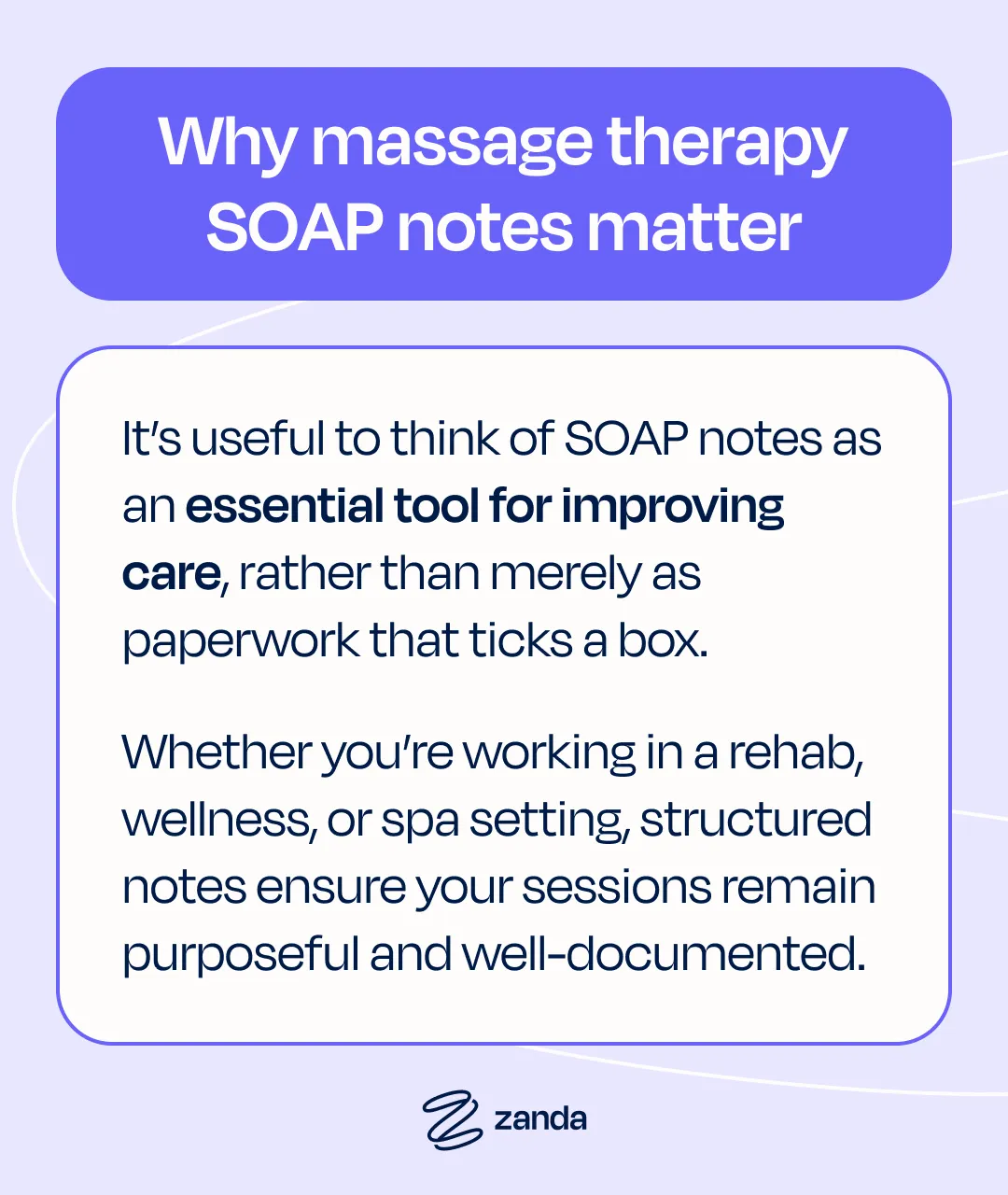
It’s useful to think of SOAP notes as an essential tool for improving care, rather than merely as paperwork that ticks a box. Whether you’re working in a rehab, wellness, or spa setting, structured notes ensure your sessions remain purposeful and well-documented.
Here’s why they matter:
1. Clinical continuity
Well-kept SOAP notes help you track progress over time, recording changes in tension, mobility, or pain patterns.
Without documentation, you’re relying on memory, and clients don’t always remember (or articulate) their history accurately. Clear notes help you adjust treatments based on real data, not guesswork.
2. Team communication
If a client is also seeing a physical therapist, chiropractor, or general practitioner, your notes can provide context for those providers’ treatment plans.
A concise Objective section (e.g., “Reduced scapular guarding after myofascial release”) gives other providers actionable insights. Some insurers also require SOAP notes for reimbursement, and vague descriptions can delay approvals.
3. Legal & billing protection
Documentation helps protect you. If a client questions a charge or claims an injury, your notes serve as the paper trail of what occurred. Clear details (“Client reported 50% reduction in low back pain post-session”) also support billing codes for insurance claims.
When are massage therapy SOAP notes required?
- Insurance billing? Almost always mandatory.
- Clinical referrals (e.g., physical therapy collaboration)? Strongly recommended.
- Cash-based wellness/spa work? Usually not legally required, but still a best practice.
- Even in relaxation massage, noting client preferences (“Avoids deep pressure on calves”) or reactions (“Heat intolerance reported”) will allow you to tailor future sessions to the client’s specific needs.
Although SOAP notes may seem to be about bureaucracy, they’re really a vital component of a system that ensures better, safer, and more effective care.
SOAP note structure overview
SOAP notes follow a simple framework designed to keep treatment documentation focused and actionable.
For massage therapists, each section serves a distinct purpose:
- Subjective (S): The client’s self-report (their own words)–their concerns, pain levels, and functional limitations.
- Objective (O): What you observe and measure–range of motion, tissue response, and treatment details.
- Assessment (A): Your interpretation and, essentially, a synthesis of the Subjective and Objective sections–how the session aligns with goals and progress.
- Plan (P): This is where you document planned next steps based on the Assessment section–adjustments to treatment, home-care recommendations, and follow-up timing.
This structure ensures notes remain concise, relevant, and useful, whether for your own reference, interdisciplinary communication, or insurance requirements.
Section-by-section breakdown
Subjective (S): Capturing the client’s story
This section records the client’s perspective of their needs or complaints as they see it, sometimes even in their own words.
Key elements to include:
- Chief complaint (CC): Why are they here today? (e.g., “There’s constant tightness in my right shoulder after long workdays.”)
- Pain/discomfort: Try using a 0–10 scale and note triggers (“Rates neck pain as 6/10, worse when turning head left.”)
- Functional impact: Note how the client’s symptoms affect their daily life (“Difficulty holding steering wheel for more than 20 minutes.”)
- Relevant history: Ask the client about previous injuries, self-care habits, medications, or treatment responses (“Foam rolling provides temporary relief.”)
Massage-specific tips:
- Ask the client about their work posture, stress levels, or recent activity changes–all common contributors to tension.
- Use direct quotes to avoid misinterpretation and make it clear to any other reader that these are the client’s words. For example, Client describes pain as “sharp and electric” when reaching overhead.
Pitfalls to avoid:
- Be cautious of using potentially judgmental language: Instead of “Client exaggerates pain,” write “Client reports severe pain but displays full ROM.”
- Avoid irrelevant details: Skip non-clinical chatter (e.g., “Client discussed vacation plans”) unless it relates to stress or activity changes.
Objective (O): What you observe and measure
Here, you document tangible findings and your own objective observations from the session. Ideally, these will complement the client’s subjective report.
Prioritize quantifiable, reproducible details:
- Range of motion (ROM): Compare bilateral movements (“Left shoulder abduction limited to 90 degrees vs. 120 on right.”)
- Palpation findings: Note tissue quality (“Hypertonicity in upper traps, moderate tenderness.”)
- Treatment details: Modalities, positioning, and duration (“20 minutes of myofascial release in prone position.”)
- Physiological responses: Changes during session (“Reduced guarding after PIR techniques.”)
Massage-specific examples:
- “Heat therapy applied to lumbar spine; client reported 30% reduction in stiffness.”
- “Trigger point pressure on quadratus lumborum elicited a referral pattern to the hip.”
Pitfalls to avoid:
- Vague terms: Replace “Tight shoulders” with “Elevated trapezius with palpable adhesions.”
- Diagnosing: Stick to observations—avoid “Client has sciatica” unless medically confirmed.
Assessment (A): Connecting the dots
This is your clinical synthesis, where you’ll tie together the Subjective and Objective data to deliver a professional opinion and meaningfully evaluate progress.
To prompt yourself, ask:
- Based on the Subjective and Objective entries, what is your verdict on the client’s most pressing need?
- Was the session effective?
- What patterns are emerging?
- Are goals from previous sessions being met?
Massage-specific focus:
- Track soft-tissue changes.
- Note client feedback to better inform your assessment.
Pitfalls to avoid:
- Repeating Objective data: Avoid “Pain reduced from 7/10 to 4/10.” Instead, try, “Pain reduction suggests acute inflammation is resolving, but persistent guarding implies underlying instability.” This section specifically calls for your professional opinion, not just observation.
- Vagueness: You need to indicate some integration between data points here. Avoid overly brief statements like, “Sciatic pain.” Instead, try, “Client’s stress-reported tension (S) correlates with elevated resting muscle activity (O), indicating nervous system sensitization.”
Plan (P): Mapping the next steps
Close with clear, actionable plans for the next session or, in the event the client is likely to see other professionals, directives for the next service provider.
Some things to include in your Plan section might include:
- Treatment adjustments: “Focus on pec minor release next session due to observed scapular protraction.”
- Frequency/timing: “Schedule 1x/week for 3 weeks to address chronic tension.”
- Home care: “Assign seated levator stretch, 2x daily.”
- Client education: “Advise ergonomic adjustments for desk setup.”
Pitfalls to avoid:
- Vague plans: Phrases like “continue treatment” aren’t adequate. “Continue myofascial work on hamstrings with increased duration” is better.
- Oversights: Forgetting to schedule reassessment. “Re-evaluate lumbar flexibility in 2 sessions.”)
Practical tips for efficient and compliant notes
Great SOAP notes are clear, concise, and clinically useful–but they shouldn’t take all your time and energy. You can produce quality SOAP notes without overextending yourself.
Here’s how to write SOAP notes for massage therapy that streamline your process while staying compliant:
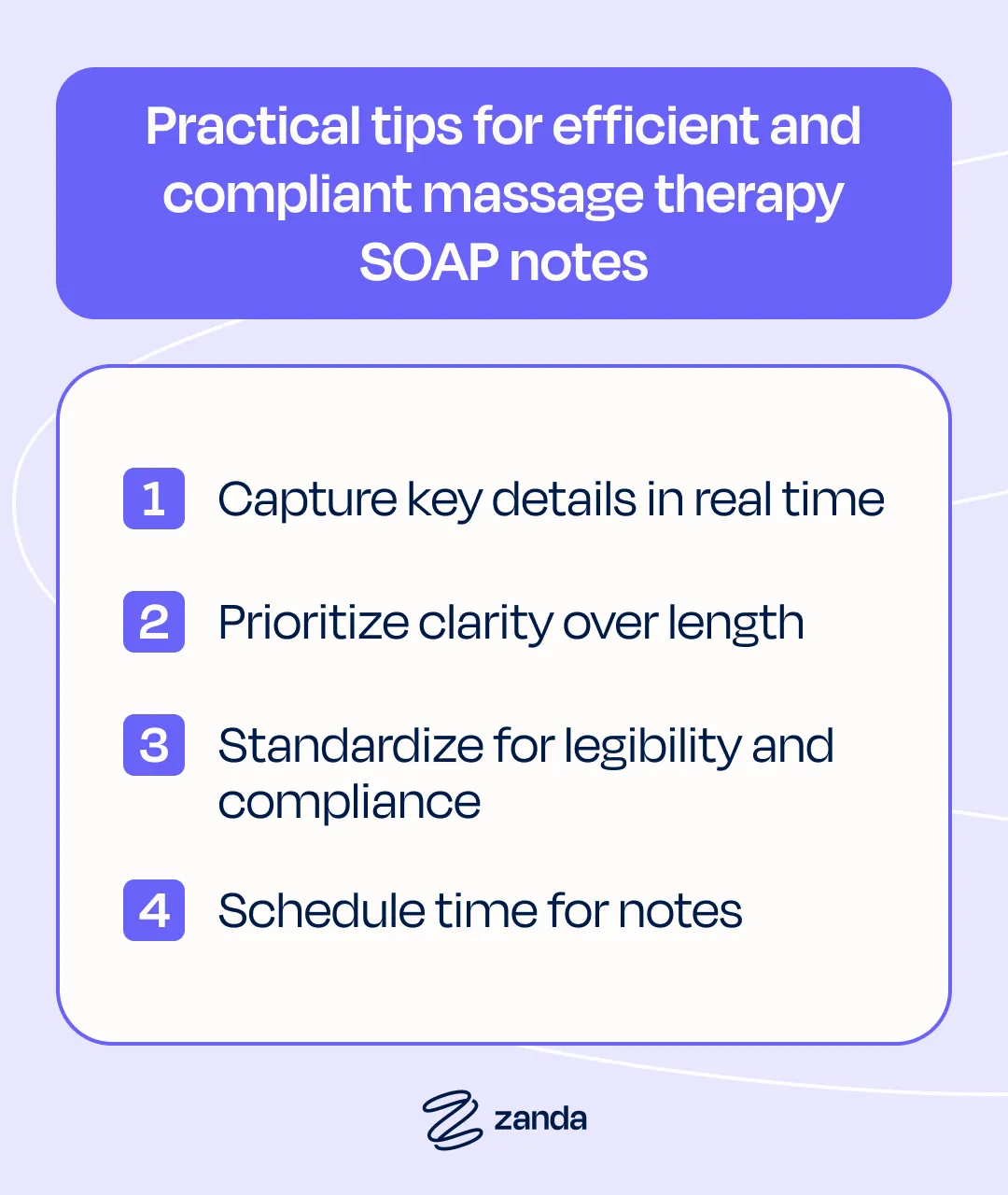
1. Capture key details in real time
- Jot down a few Subjective quotes and basic Objective findings during the session. This sometimes proves easier and more accurate than basing the entire note on post-session reflections.
- Use a structured template to make it easy and avoid forgetting critical elements.
2. Prioritize clarity over length
- Be thorough but brief. Instead of “Client mentioned soreness in left trapezius area after carrying heavy groceries,” write: “L trapezius soreness post-lifting (reports 4/10 pain).”
- Avoid vague terms. You don’t have to write an essay to be specific.
3. Standardize for legibility and compliance
- If writing by hand, print clearly–illegible notes defeat the purpose.
- Use approved abbreviations (e.g., “ROM” for range of motion, “WT” for weight-bearing), but skip ambiguous shorthand that wouldn’t easily be understood by other service providers.
4. Schedule time for notes
- Block 5 minutes between clients to finish notes while details are fresh.
- AI tools purpose-built for allied health can help you save time and organize information, cutting post-session admin. BizzyAI is an excellent partner in clinical note-taking and can help you create a note in the SOAP format more efficiently.
AI SOAP notes for massage therapists: Work smarter, not harder
Documentation shouldn’t drain your time or focus. Zanda developed BizzyAI to transform massage therapy SOAP notes from a chore into a seamless part of your workflow–without sacrificing quality.
BizzyAI is purpose-built for allied health, and designed with your practice’s needs in mind. With ISO 27001-certified security, your client data stays protected.
BizzyAI uses HIPAA-compliant artificial intelligence to:
- Auto-generate notes from your session details, reducing manual typing.
- Adapt to your style, learning common phrases and treatment patterns.
- Ensure all required critical information from the session is covered in the note, in alignment with your chosen template, prompts, and/or custom preferences.
Why massage therapists love it:
- Faster notes, fewer errors: Cut documentation time by up to 74%*
- Consistency without rigidity: Customizable templates keep notes structured but personalized.
- One less thing to remember: Integrated in Zanda, so notes tie directly to client records.
BizzyAI keeps you in control–review, revise, edit, and sign off before the note is finalized.
Based on a 2025 survey of BizzyAI Beta User Group
SOAP notes for massage therapy example: Headache & neck tension case
Client: Jane D. | Date: 10/15/2023 | Session: 60-min therapeutic
Subjective (S):
Client reported, “I’ve had tension headaches daily for the past week. It starts at the base of my skull and spreads to my temples. My neck feels ‘locked up,’ especially after long computer hours. Pain is 6/10 now, worse by afternoon (reaches 8/10). Advil helps slightly, but I’d rather avoid meds.”
- History: Sedentary desk job (8+ hrs/day), occasional yoga. No recent injury.
Objective (O):
- ROM: Cervical rotation limited to 45° bilaterally (normal: 80°), pain at end range.
- Palpation: Hypertonic suboccipitals and upper traps (R > L), tender at 4/10 pressure.
- Treatment: 20-min myofascial release to suboccipitals, 15-min PNF stretching for cervical rotators. Heat pack applied pre-treatment.
- Response: Immediate 30% ROM improvement in rotation; client reported “less pressure behind eyes.”
Assessment (A):
- Patterns: Headaches are likely cervicogenic (per localized tension and ROM deficits).
- Progress: Suboccipital release provided temporary relief, but chronic postural strain indicates the need for ergonomic intervention.
- Red flags: None identified; symptoms consistent with musculoskeletal stress.
Plan (P):
- Next session: Focus on scapular stabilization to reduce upper trap overload (1×/week for 3 weeks).
- Home care:
- Seated chin tucks (5 reps, 2×/day).
- Set hourly phone reminders to adjust workstation posture.
- Referral: Suggested ergo assessment if headaches persist.
Templates & resources
Free SOAP note templates
Streamline your documentation with our ready-to-use massage therapy SOAP notes PDF templates:
Go digital with Zanda
Why waste time shuffling paper? Zanda SOAP notes help you:
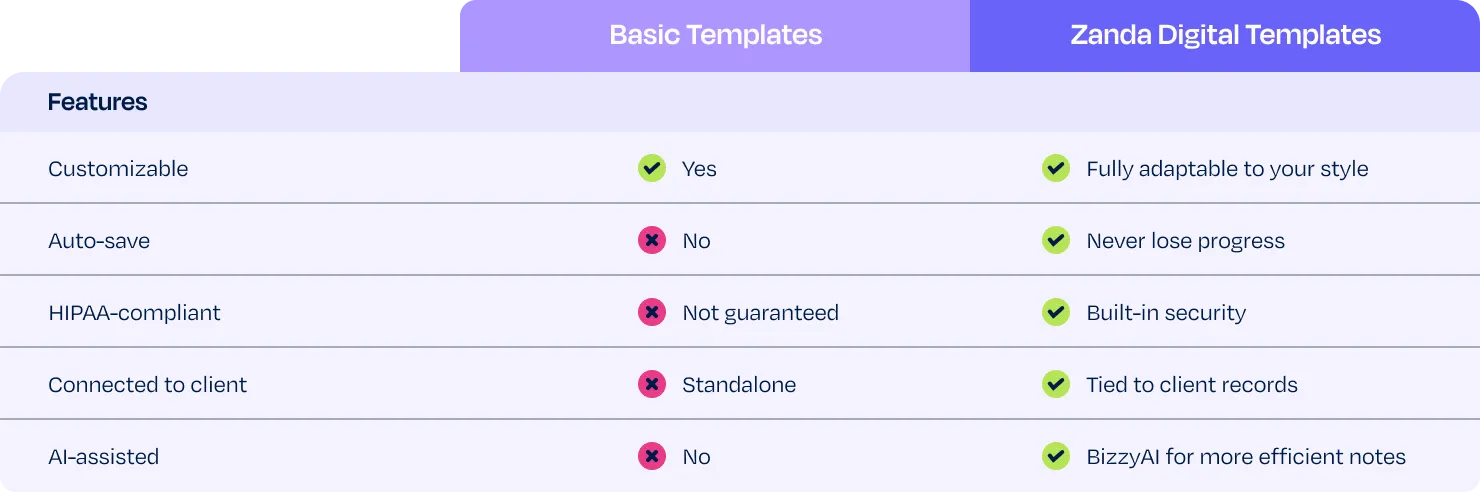
- Save time with auto-saving templates and configurable fields.
- Stay organized with client-specific note history.
Better notes, better care
Good SOAP notes will help you deliver the standard of care you dreamed of when you first started your massage therapy practice.
When your documentation is clear and consistent, you spend less time deciphering old notes and more time delivering effective treatment.
It doesn’t have to be complicated, and the goal is always the same: create professional notes that are useful today and still make sense six months from now. And, with Zanda, it’s never been easier to digitize your record-keeping and your processes.
Ready to run your practice as you imagined it? Experience Zanda for FREE and zip through that to-do list.