
How to Start an Occupational Therapy Private Practice: A Step-by-Step Guide

Occupational therapy (OT) sits close to real life. It helps people take part in the “job of living”, which includes everything from getting dressed after surgery to managing sensory needs at school or staying safe at home with age-related changes.
That’s what makes private practice such a meaningful path for occupational therapists. It gives you room to shape your services around the clients you’re best equipped to help, build a practice around your clinical strengths, and create a working life with more control than many employed roles allow.
The demand is there, too. The U.S. Bureau of Labor Statistics projects employment for occupational therapists to grow 14% from 2024 to 2034, much faster than the average for all occupations. Pediatric need is also growing in visibility, with the CDC estimating that about 1 in 31 children aged 8 has been identified with autism spectrum disorder. Together, these trends point to a wider demand for OT support across rehabilitation, aging care, pediatric services, disability support, and community-based care.
If you’re exploring how to start an occupational therapy private practice, the first move is getting your structure right. Strong preparation helps you avoid common setbacks and gives your practice a clear direction from the outset.
I. Preparation: The strategic blueprint
Before you commit to anything, you need a clear structure that supports how your practice will run day to day.
1. Defining your occupational therapy service delivery model
Your service delivery model sets the structure for how you deliver care.
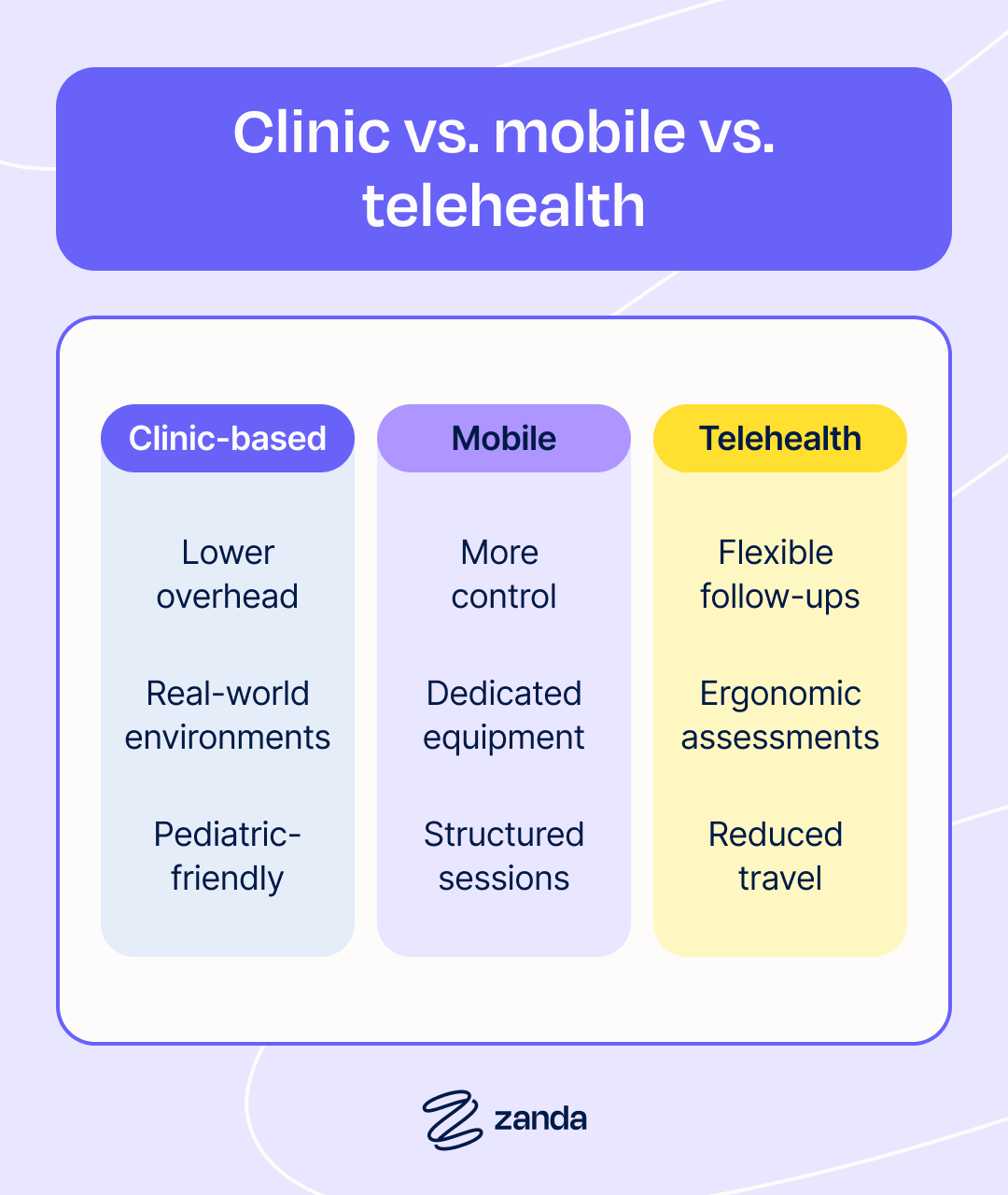
A home-based or mobile model keeps overhead low and works well for early intervention or clients who need support in their own environment. It’s often a strong starting point for a pediatric OT startup, where sessions are delivered in familiar, real-world environments like homes or schools.
A clinic-based setup gives you more control. You can create a consistent environment and invest in equipment like sensory swings or fine motor stations. It does require more upfront cost, so it needs a steady flow of clients to make sense.
Telehealth is becoming more relevant in OT. It’s often used for ergonomic assessments, where you review how a client’s setup supports their physical function. It also works well for follow-ups and guided support without needing to be on-site.
2. Occupational therapy legal and regulatory compliance
Getting your legal setup right early helps you avoid having to redo critical parts of your practice later, particularly around billing and compliance.
Start with your professional identifiers. In the U.S., that includes your National Provider Identifier (NPI), which is required for billing insurers, and your Tax ID or Employer Identification Number (EIN) for business and tax purposes. These form the foundation of how you’re recognized as a provider.
Next, look at direct access and referral requirements. Some states allow clients to see an occupational therapist without a physician referral, while others require one for certain services or for insurance reimbursement. Even in direct access states, insurers may still require a referral to approve payment, so it’s worth checking both state law and payer rules. It’s also worth documenting your process early because having a clear intake and referral workflow saves time down the road and reduces the risk of missed requirements.
Then there’s the decision between insurance and cash-pay. Accepting Medicare or Medicaid can bring consistent client flow, but it comes with strict documentation and reimbursement rules. A cash-pay model gives you more flexibility in pricing and service design, but you’ll need a clear value proposition and a client base willing to pay out of pocket. Many practices start with one approach and adjust as they grow.
3. Financial planning for your OT practice
Now you’re translating your idea into something workable. You don’t need perfect numbers, but they do need to be realistic.
Start with a simple startup cost checklist. Rent, insurance, and marketing are the obvious ones. Then factor in equipment, which is often where costs climb quickly depending on your model. Even a mobile setup still requires a baseline kit, while a clinic space can shift your budget significantly.
From there, build a basic OT business plan with clear, functional goals. Think in terms of activity, not just revenue. For example, how many clients do you need to see each week to cover costs? What does month three look like compared to month six?
Keep it practical. The goal isn’t to impress anyone, it’s to understand what your practice needs to stay sustainable and where your pressure points might be early on.
II. Operations: Space, equipment, and systems
When your space and systems work with you, not against you, you can focus on delivering care instead of constantly fixing small operational issues.
4. Designing an occupational therapy clinic space
Your space should support the way you deliver therapy, not limit it. A well-designed clinic makes sessions flow naturally and helps clients feel comfortable from the moment they walk in.
Start with accessibility. Your clinic needs to meet ADA (Americans with Disabilities Act) standards, with features that support safe and accessible movement throughout the space. Even if you’re working with higher-functioning clients, accessibility builds trust and keeps your practice inclusive.
Layout is just as important. Separate high-energy areas from quieter zones so different types of sessions don’t compete with each other. For example, a sensory gym or movement space works best when it’s distinct from fine motor or activities of daily living (ADL) stations, where clients need focus and minimal distraction.
It doesn’t need to be perfect from day one. What matters is creating a space that is structured and able to adapt to the client.
5. Occupational therapy equipment and inventory management
Your equipment should match how you deliver care, not just fill a room. Start with what you’ll use every week, then build from there as your caseload becomes clearer.
A practical way to approach this is to build your setup in phases. Start with the equipment you’ll use in almost every session, then expand based on the needs you’re seeing most often in your caseload. As your referrals become more consistent, you can invest in more specialized tools that support specific treatment plans or niche services.
This approach helps control upfront costs while still allowing your practice to evolve in a way that reflects how you actually work.
A simple occupational therapy equipment list might include bolsters, therapy balls, therapeutic putty, fine motor boards, visual timers, adaptive utensils, and a small range of weighted products. If you work with children, you may also need sensory tools and gross motor equipment. If you focus on hand therapy or adult rehabilitation, your early purchases will look different.
Inventory deserves more attention than it usually gets. Consumables like kinesiology tape, splinting materials, wipes, gloves, and hygiene supplies run out quickly in a busy clinic. A weekly stock check and a simple reorder point can prevent awkward mid-session gaps.
The retail opportunity is worth thinking through early because it directly affects how well clients follow through outside of sessions. Occupational therapists regularly recommend tools for home use, such as adaptive utensils, therapy putty, reachers, or weighted products. When clients need to source these themselves, there’s often a delay or drop-off.
When those same tools are available at your practice, clients leave with exactly what they need and a clear understanding of how to use it. This improves adherence and reduces the gap between what’s introduced in session and what actually happens at home.
From a business perspective, this can also support your revenue in a way that aligns with care delivery. Keep this practical and ethical. Only stock products you genuinely recommend, explain costs clearly, and make sure any equipment sales support the client’s home program rather than feeling like an upsell.
6. Choosing OT practice management software
The right system keeps your practice organized without adding more admin to your day.
This is where a platform like Zanda fits into the OT workflow. It brings scheduling, clinical notes, billing, and communication into one place, so you’re not switching between tools or duplicating work.
Documentation needs to clearly demonstrate why therapy is clinically necessary, what interventions were delivered, and how the client is progressing toward functional goals. This becomes especially important during insurance reviews or audits, where your notes need to stand on their own without additional explanation.
If documentation is unclear or incomplete, claims can be denied even when care was appropriate. Many practices only recognize gaps in their documentation when an issue like this arises, which puts them in a reactive position. Clear, structured notes help prevent that and make it easier to support ongoing care.

Scheduling quickly becomes easier to manage, especially if you’re mobile. You can factor in travel time and keep your day realistic instead of overbooked.
Invoicing is another piece to get right. When session fees and equipment sales sit in the same system, billing for occupational therapy is clear and reliable. Clients understand what they’re paying for, and you spend less time chasing payments.
III. Growth: Marketing your OT expertise
Once your practice is running, the focus shifts to visibility. You need a steady way for the right clients and professionals to find you and understand the value you offer.
7. Building an occupational therapy referral network
Referrals still drive a large part of most OT caseloads. Building relationships with the right professionals creates a steady, reliable source of clients who already trust your role in their care.
Think in terms of a circle of care. Pediatricians, orthopedic surgeons, neurologists, and primary care physicians often see the need for OT before a client does. When they know what you offer and who you help, referrals become a natural next step.
Start with a clear introduction to your services, then stay visible with occasional, relevant check-ins. In the long run, a steady presence builds professional trust and keeps you front of mind when referrals come up.
Getting the referral is only the first step. Follow-up is where many practices fall short. Sending brief progress updates after an initial referral shows how your work connects to outcomes. Using a system like Zanda makes it easier to share structured updates without adding extra admin, which keeps communication consistent and reinforces your value over time.
8. Digital marketing for OTs
Digital marketing helps you get found by people who are already looking for support. It doesn’t need to be complex, but it does need to be intentional.
Start with search visibility. Simple SEO basics go a long way, especially for local services. Phrases like “sensory integration therapy [city]” or “hand therapy [city]” reflect how people actually search. When your website speaks that same language, you’re more likely to show up when it matters.
Then think about how you present your work. Photos of your space or sessions help people understand what to expect before they commit. It helps people feel more comfortable, particularly parents or first-time clients.
You don’t need to be everywhere. A consistent presence in one or two places is usually enough to build awareness and keep your practice visible.
IV. Compliance and professional longevity
Running a practice means staying accountable over the long term, not just getting set up. The way you manage client data and maintain your clinical standards directly affects how your practice is perceived and how confidently you can run it.
Data security is non-negotiable. Clinical notes, intake forms, payment details, and client communication need to meet HIPAA or GDPR requirements, depending on where you operate. Secure systems and clear internal processes help protect clients while giving your team a safer way to work.
Strong data security isn’t just about meeting compliance requirements. It also shapes how confidently you can run your practice. When systems are secure and processes are clear, you reduce risk for both your clients and your business, and you spend less time second-guessing how information is handled.
Your clinical skills also need room to evolve. Continuing education shapes how your practice grows over time. Developing skills in areas like lymphedema therapy, hand therapy, or sensory integration can influence the types of referrals you receive and the services you offer. Being intentional about where you focus helps you build depth in your clinical work rather than spreading yourself too thin.
Professional longevity depends on keeping both sides of the practice strong, the clinical standards clients expect and the systems that protect the business behind the care.
Ready to start: Building your thriving OT practice
Starting a private practice in occupational therapy comes with a long checklist. You’re balancing space, equipment, compliance, systems, and a steady flow of clients. It can feel heavy at times, especially in the early stages when everything is new and decisions carry more weight.
But most OTs don’t take this path because they love the business side. You do it because private practice gives you a direct way to help people regain independence and navigate daily life in a way that works for you. That’s what makes the effort worthwhile, and it’s what keeps your practice grounded as it grows.
The risk is that admin starts to compete with the work your clients actually rely on. When systems become fragmented, it takes more time to manage the practice than to run it.
That’s where Zanda comes in. It brings everything into one place, so you can manage your practice without feeling buried in it. Less time on admin means more time with clients, and a practice that feels sustainable long term.
Ready to build a practice that runs smoothly? Start your 14-day free trial with Zanda today.