
What's the Difference Between Coaching and Counseling?

Confused about the difference between coaching and counseling? You’re not alone.
While the disciplines share some similarities, they differ in their focus and underlying fundamental practices. Understanding these differences is vital to providing appropriate support to clients. This article will cover these key points and explore some nuances that can be a source of confusion.
What is coaching?
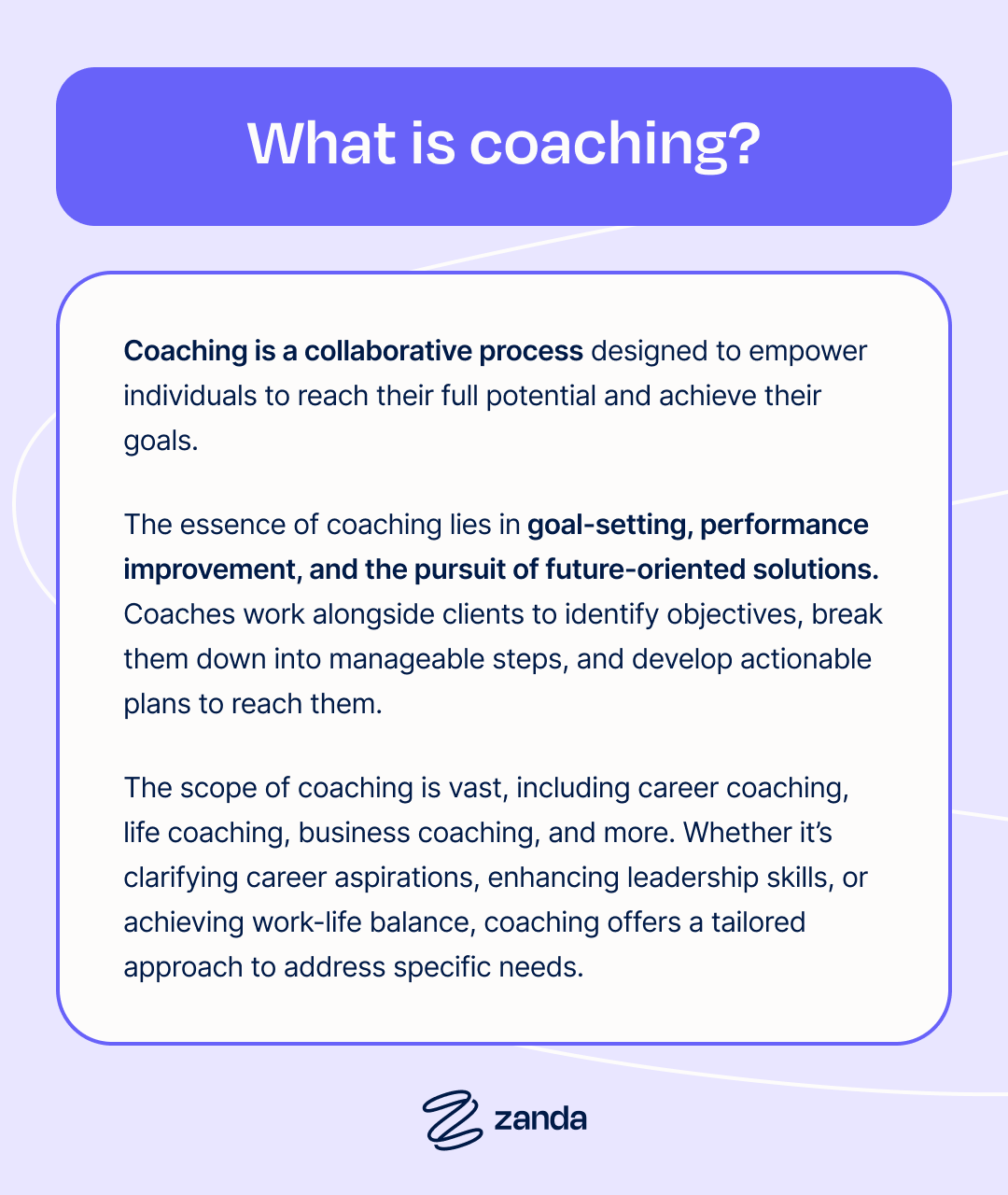
Coaching is a collaborative process designed to empower individuals to achieve specific goals. It tends to be structured and solution-oriented; there is a defined problem and a plan to resolve it.
The essence of coaching lies in goal-setting, performance improvement, and the pursuit of future-oriented solutions. Coaches work alongside clients to identify objectives. From there, they aim to break objectives down into manageable steps and develop actionable plans to achieve them.
With that in mind, the scope of coaching is vast, including career coaching, life coaching, business coaching, and more. Whether clarifying career aspirations, enhancing leadership skills, or achieving work-life balance, coaching offers a tailored approach to address specific needs.
What is counseling?
Counseling is the therapeutic process that promotes mental and emotional well-being. Counseling focuses more on fostering self-awareness to resolve personal challenges. While some approaches are more directive, the process doesn’t inherently need to be bound to action-oriented goals. Instead, although treatment does adhere to a treatment plan, the work is often more exploratory and reflective.
Counseling usually prioritizes exploring the client’s emotional and interpersonal history by providing a safe space to unpack emotions so that behaviors and reactions can be better understood, resolved, and managed.
Counselors employ active listening, empathy, and validation techniques to facilitate self-reflection and insight. Through this process, clients gain a deeper understanding of themselves, their relationships, and their challenges.
Different types of counseling address unique needs and concerns. For example, couples counseling may focus on improving communication and resolving conflicts within relationships, while trauma therapy helps individuals process and heal from traumatic experiences.
Key differences between coaching and counseling
| Counseling | Coaching | |
|---|---|---|
| Focus | Understanding and connecting both past and present experiences | Goal-setting and future outcomes |
| Practitioner credentials | Licensed mental health professional | Varies; may include certifications |
| Best suited for | Emotional distress, trauma, mental health conditions, family and couple dynamics | Motivation, specific goals, performance |
| Approach | Insight and resolution | Action and accountability |
Qualifications
Coaches and counselors typically follow distinct educational and licensing paths. While counseling requires formal education in psychology, social work, or counseling, along with relevant licensure or certification, coaching doesn’t require formal certification compliance.
Of course, coaches may receive training through programs or certifications, but their educational backgrounds and credentials are more variable.
Focus
Coaching adopts a present and future-oriented approach, concentrating on goal-setting, performance improvement, and action-oriented strategies.
In contrast, counseling takes a holistic perspective that isn’t bound to achieving action-based goals. Counseling unpacks past and present experiences and their impact on the individual’s emotions and behaviors.
Client needs
Choosing between coaching and counseling depends on what the client is trying to address and achieve.
Clients dealing with past trauma, unresolved emotions, or mental health concerns are typically better suited for counseling. This is where the focus is on exploring underlying issues and supporting emotional healing.
On the other hand, clients seeking support in setting career goals, building specific skills, or managing life transitions may benefit more from coaching. Coaching emphasizes practical strategies and forward-focused planning. It includes ongoing accountability to help clients reach defined goals within a specific timeframe.
Can I be a counselor and a coach?
Yes, many people provide both services. The roles can coexist, but they need clear separation to work well for you and for your clients. It is unethical to act as both a coach and a counselor for the same person.
The skill sets overlap more than the obligations do. Counseling comes with a clinical framework, a duty of care, and confidentiality rules that don’t simply carry over into coaching. You are bound to specific licensing laws and ethics.
Before offering both, it’s worth thinking through how you’ll structure the practice, how you’ll communicate the difference to clients, and what the boundaries are.
Overlap and hybrid models
The line between counseling and coaching can sometimes feel murky. In practice, clients may move between the two depending on where they are in their progress. However, this shift typically involves different providers, as having the same professional act as both counselor and coach for the same client can create a dual relationship and raise ethical concerns.
For example, a counselor working with a client on anxiety may reach a point where the core emotional or clinical concerns have been addressed. At that stage, the client may be ready to focus on setting goals and building momentum. This work may align more closely with coaching. In this way, counseling lays the foundation, and coaching builds on it.
The reverse can also happen. A coach helping a client with career direction might notice that unresolved grief or ongoing low mood is interfering with progress. These concerns fall outside the scope of coaching and are better addressed in a counseling setting.
How the two approaches can complement each other
Counseling and coaching can certainly work together in a complementary way. Counseling focuses on developing self-awareness and emotional regulation, while coaching emphasizes structure and forward action. Clients who have engaged in counseling often enter coaching with greater insight, making their goals more realistic and meaningful.
In settings where both services are available through different practitioners, cross-referral can provide a meaningful continuity of care. A counselor may support the client through clinical concerns, while a coach helps them move forward once those issues are resolved.
While these roles are typically kept distinct, collaboration between coaches and counselors is common and can offer well-rounded support without either professional stepping outside their scope of practice.
Business structure
If you offer both services, it is often advisable to maintain separate practices for counseling and coaching. This helps to avoid potential conflicts of interest and ensures clarity for clients regarding the services being offered.
Some practitioners choose to establish distinct brands, websites, and marketing materials for their counseling and coaching services to differentiate between the two.
Ethics
Practitioners providing both counseling and coaching services must navigate potential ethical dilemmas with care and integrity. This may involve seeking supervision, consultation, or additional training to ensure ethical practice across both roles.
If you run a practice with multiple counseling or therapy providers, consider creating a team conduct policy to ensure that every practitioner in your practice understands their ethical obligations.
Here are a few guidelines for counselors who also practice as a coach:
Ethics Tip 1: Adhere to Licensing Requirements
Regardless of whether you’re providing therapy or coaching, as a counselor you are still bound by the laws and regulations that govern your profession. This includes responsibilities such as mandated reporting and maintaining appropriate professional boundaries.
If you’re a counselor who also offers coaching services, it’s important to use clear informed consent documents. These should explain that, although the client is not receiving mental health treatment, they are still working with a licensed professional who must follow applicable legal and ethical requirements.
It’s generally acceptable to reference your education and credentials in your marketing. However, using your mental health license to promote coaching services may not be appropriate in all cases. When in doubt, consult your licensing board or malpractice insurance provider to ensure your marketing practices stay within professional guidelines.
Ethics Tip 2: Avoid Dual Roles
Maintain clear boundaries between your therapy and coaching roles. You should not provide both services to the same client, as this creates a dual relationship and can lead to ethical conflicts.
If a therapy client expresses interest in coaching, refer them to a separate provider for those services. If a coaching client shows needs that are more suitable for therapy, discuss your concerns and provide a referral to a qualified mental health professional. Clear role separation protects both you and the client and helps ensure ethical, effective care.
Ethics Tip 3: Respect Professional Boundaries
When a coaching client is also working with a therapist, be careful not to cross into the therapist’s scope of practice. Keep your focus on the client’s stated coaching goals and avoid addressing clinical or therapeutic concerns.
If tensions arise between coaching objectives and therapeutic priorities, defer to the client’s mental health needs and the therapist’s role.
Ethics Tip 4: Be Clear!
Clearly articulate the services you provide and to whom they’re available. Clarity fosters transparency and ensures clients have a comprehensive understanding of the nature of the support they’re receiving.
By clearly defining boundaries, practitioners empower clients to make informed decisions about their care and provide them with guidance to navigate the complexities of personal development and mental health support.
Ethics Tip 5: Reiterate Informed Consent
Informed consent is essential to ethical practice. As a counselor offering coaching services, clearly communicate that, although you are a licensed professional, you are not providing therapy or mental health treatment within the coaching relationship.
Be transparent about your obligation to follow state laws and professional regulations, and explain any differences in confidentiality between coaching and therapy. Make sure clients understand their rights and the scope of the coaching relationship.
Professional boundaries
Maintain clear distinctions between counseling and coaching roles to support client well-being. To do this, communicate openly about the scope, purpose, and limitations of each service so clients understand what to expect.
In all cases, you must be transparent about your qualifications and areas of expertise. Recognize when a client’s needs fall outside your scope and require referral to another professional, and always act in the client’s best interest.

Conclusion
For allied health practitioners seeking to support clients with a range of services, it’s essential to understand the distinctions between coaching and counseling.
Whether you choose to focus on coaching, counseling (or both), it’s imperative that you and your team comply with ethical guidelines.
If you’re looking to streamline your practice management, try Zanda today. With its user-friendly interface and comprehensive features, Zanda can help you manage appointments, maintain client records, bill efficiently and stay compliant.
Start your 14-day free trial now. No credit card required.
FAQs
What’s the difference between coaching and therapy?
Coaching is focused on goals, performance, and future outcomes. Therapy (including counseling) addresses mental and emotional health, such as past experiences, trauma, and diagnosable conditions. Therapists are licensed professionals; coaches typically are not. If a client has a mental health concern, therapy is the appropriate starting point. If they’re seeking direct advice or skill-building toward specific goals, coaching may be a better fit.
Can a coach diagnose mental health issues?
No. Diagnosis is within the scope of licensed mental health professionals. Coaches are not trained or authorized to assess or diagnose mental health conditions. If a coaching client shows signs of a possible mental health issue, they should be referred to a qualified professional rather than addressed within coaching.
Do coaches need a license?
No. Coaching is largely unregulated, so a license is not required to practice. Some coaches pursue certifications through organizations like the International Coaching Federation (ICF), which provides ethical guidelines, but participation is voluntary.
Is coaching covered by insurance?
In most cases, no. Health insurance typically covers services provided by licensed professionals (such as psychologists and counselors), not coaching. Some employee assistance programs (EAPs) or private plans may include coaching benefits, but coverage varies. Clients should check directly with their insurer for details.
How long does counseling versus coaching typically last?
There’s no fixed timeline for either. Counseling can be open-ended, especially for more complex concerns, though structured approaches like cognitive-behavioral therapy (CBT) often range from 12 to 20 sessions, sometimes extending further. According to the International Coaching Federation, coaching is usually more time-limited, often lasting three to six months for focused goals, though longer relationships are common depending on the client’s needs and pace.