
How to Successfully Market Your Podiatry Practice

Marketing a podiatry practice can feel like another full-time job. Patients expect more than just a street address and a referral. They want credibility online, signs of trust, and an experience that feels accessible and up-to-date.
The challenge isn’t a lack of ideas. It’s knowing which ones actually help a practice grow. In 2025, the strategies that work best are the ones built on connection and consistency, not shortcuts or vague promises of “page-one rankings.”
This guide is here to help you cut through the noise and focus on what works. You’ll learn what’s changed in patient behavior, what successful clinics are doing now, and how to build a marketing approach for your podiatry practice that feels sustainable.
Even if some of these marketing strategies sound familiar, consistent execution is what separates successful practices from the rest.
Define your ideal patient (targeting and messaging)
Before investing in ads or creating content, get clear about who you’re speaking to. Knowing your ideal patient makes it much easier to focus your marketing efforts.
When your message hits home, patients know you understand their needs. The right approach positions your practice to stand out in a crowded online space and reach people actively searching for podiatry care.
Segments to consider
Your patients naturally fall into groups based on their healthcare needs, activity levels, and recovery goals. When you understand these differences, you can develop messaging that helps you stay relevant, addressing their priorities and what drives their choices about care.
By age or life stage
For example:
- Elderly patients needing diabetic foot care, neuropathy support, or fall prevention
- Middle-aged adults managing orthotics or chronic heel and arch pain
- Active individuals recovering from sports injuries
By condition or complaint
Consider what you see in your practice, like heel pain, plantar fasciitis, bunions, or ingrown toenails.
Patients referred by GPs or physical therapists, walk-ins, or online searches.
By geography or location
This may include local neighborhoods, nearby suburbs, or commuting areas.
Consider the right communication approach for your chosen segments. Athletes may engage with recovery videos on YouTube, while other patients may prefer educational blogs or newsletters. Once you’ve defined your core audiences, you can start tailoring messages to them across your marketing channels.
Practical steps:
Create two or three patient profiles describing your main audience segments. Include age, lifestyle, concerns, and preferred communication methods.
- Review your website, blog posts, and ads to confirm that your messages align with these profiles.
- Pay attention to the type of content your patients mention, share, or ask about most. Use that feedback to guide your next marketing steps.
- For paid campaigns, focus on one audience segment at a time, measure the results, and expand on what performs well.
Add fresh, quality content to your website
Your website is one of your most valuable marketing assets. Just having a website is a good start, but consistent, high-quality content is what helps turn a website into a source for trusted information.
Think of your website as a hub of information for your patients and referral partners, not just a digital brochure. Fresh, relevant content expands your reach and reinforces your online credibility.
While search engine optimization (SEO) plays a key role in visibility, not all SEO services deliver lasting results. Some promise quick rankings but use tactics that can harm your site in the long term. If you’re considering professional SEO support, ask for references from healthcare providers who’ve seen measurable, sustainable growth.
There’s also plenty you can do in-house. Start by publishing informative, original content that demonstrates your expertise and addresses the questions patients are asking.
Consider creating:
- A detailed podiatry FAQ section addressing common conditions and concerns.
- Educational articles that showcase your clinical insights.
- Short, informative videos shared on your blog and social media channels.
Practical steps:
- Map out a six-month content calendar with article ideas and posting dates.
- Block 90 minutes a week to write or update one post.
A few small website tweaks can go a long way, too.
On-page SEO
Use clear, descriptive keywords so search engines understand what each page of your website covers. Terms like heel pain, custom orthotics, and sports injury care can help Google match your site to the right search queries.
Site structure
Organize your pages logically. Each service should have a dedicated, well-labeled page so visitors (and Google) can easily find what they need.
Mobile optimization
Many patients browse health information on their phones. A fast-loading, mobile-friendly design keeps users engaged and prevents drop-offs.
Google Business Profile
Update your Google Business profile regularly with your hours, contact info, photos, and reviews. It’s a simple way to appear in more local searches and build patient trust.
Social media and community engagement
If social media feels unfamiliar, think of it as an online extension of word-of-mouth. It’s another way to share your knowledge, stay connected with patients, and show the human side of your practice.
You don’t need fancy editing or a marketing team. A smartphone, good lighting, and consistent posting go a long way.
On Instagram and TikTok, share recovery tips, stretches, or shoe-fit advice. On Facebook, boost posts or highlight patient success stories (with permission). On LinkedIn, share professional insights such as referral collaborations or advances in gait analysis technology.
Here are a few ideas that may work for your podiatry practice:
- Educational tips: Managing minor foot pain at home, choosing supportive shoes, or diabetic foot care.
- Myth-busting posts: “Do orthotics fix flat feet?” or “Should toenails always be cut straight?”
- Local involvement: Share photos from races, health fairs, or community events.
- Seasonal reminders: Summer sandal safety, winter foot care, or back-to-school shoe checks.
Practical steps:
Choose two platforms where your ideal patients spend the most time, and post consistently. Try starting with one educational and one personal post each week to keep your feed balanced. Use simple visuals, respond promptly to comments or messages, and review your analytics to see what earns the most engagement. Over time, these insights reveal the type of content that strengthens your online presence.
Network with other health professionals in your local area
Podiatry marketing should include multiple channels. While having a solid online strategy can be one of the best uses of your marketing effort, having multiple client sources is a good, risk-averse long-term strategy.
As long as there are people, there will continue to be a need for healthcare providers, and there are dozens of potential referral sources (both medical and non-medical) based in the local areas around your practice. The easiest way to reach them is often to pick up the phone and introduce yourself. Maybe arrange to meet for coffee or attend an event together. There may also be specific networking events where you can meet other health professionals. If you’re not comfortable making cold calls, try sending referral introduction letters instead.
Many practitioners assume that area GPs already have contacts for referrals. Don’t let these assumptions hold you back! They might be looking for someone with your specific expertise, they just don’t know about you yet. Developing strong ties with referrers will mean that you’ll receive new clients who wouldn’t have known about your practice otherwise.
Practical steps:
- Set a goal of making three phone calls per week to potential new referral sources, one phone call to a referral source that you’ve visited before, and one physical visit to either a new or existing referral source.
- If making calls or in-person visits isn’t your strong suit, draft and send a batch of referral introduction letters. A great one can help your practice stand out from the pack.
Leverage your existing client base
Your existing and past patients are one of the most underused marketing assets in any podiatry practice. These are the people who already know your quality of care, trust your expertise, and are most likely to return, refer others, and share positive reviews online. Maintaining these relationships takes less effort and brings greater long-term value than constantly seeking new patients.
Research shows that:
- It costs six to seven times more to attract a new patient than to retain an existing one.
- Increasing retention by just 5% can boost profits by more than 25%.
- Reviews from existing patients influence potential new patients’ decisions.
- 91% of adults aged 18–34 trust online reviews as much as personal recommendations.
These numbers highlight a simple truth: strengthening relationships with current patients is one of the most effective ways to grow your practice.
Practical steps:
- Send a monthly newsletter with seasonal tips, clinic updates, and new service announcements.
- Acknowledge milestones with birthday or holiday messages.
- Follow up after appointments to check on satisfaction and invite feedback.
- Request online reviews from happy patients (if appropriate for your practice) and share direct links to your Google Business Profile, Facebook, or Yelp pages to make the process easy.
Emerging trends and innovations
Patients expect convenience and up-to-date care options. Integrating the right technology in your podiatry practice streamlines operations and shows your commitment to progressive, patient-centered care.
Telehealth podiatry makes it possible to consult with patients remotely, through secure video calls. It’s ideal for follow-ups, mobility challenges, or those living in rural areas.
Virtual gait analysis uses smartphone cameras or wearable sensors to assess how patients walk or run. The feedback supports orthotic recommendations and rehab plans while keeping patients engaged in their own progress.
Augmented reality (AR) apps give patients a glimpse of how custom orthotics or footwear adjustments might improve comfort or posture. Seeing potential results firsthand reinforces confidence in your recommendations.
AI-powered clinical notes capture and summarize consultations automatically. This reduces paperwork and frees up more time for patient care. Zanda has in-platform BizzyAI to securely transcribe sessions and generate clinical note drafts in minutes. It saves time, reduces administrative work, and helps ensure accurate records.
Practical Steps:
- Start small with one or two tools that fit naturally into your daily routine. Begin with something simple, like drafting a session note with BizzyAI: Scribe or telehealth follow-ups.
- Promote your new services on your website, email newsletters, and social channels. Highlight how innovations such as online consultations or gait analysis make treatment easier and more convenient for patients.
- Partner with reputable tech providers who meet healthcare privacy standards. Ask for demos, check reviews, and confirm their systems are secure and compliant before signing up.
- Ask patients for feedback once you introduce something new.
- Stay current through podiatry associations, workshops, and conferences. Learning how others use new technology can spark new ideas for your practice.
Podiatry practice marketing requires consistent action
This is the most powerful marketing tip of all: consistent action beats perfect planning.
You already know the strategies that will grow your practice; the difference lies in execution. Whether you manage it yourself or delegate to a team member or trusted partner, commit to small, consistent marketing actions each week.
Even a 30-minute block each day, like starting one blog article, making a referral call, or replying to social media comments, compounds over time. Momentum matters more than perfection.
When you view marketing as an ongoing process rather than a one-time project, you’ll see steady, measurable growth in both patient numbers and community awareness.
Track what works and build on it
To know where to focus your time, review your performance data each month.
Use the client marketing sources report in Zanda to identify which activities bring in new patients. If your newsletter brings in six new patients a month, and your Facebook ads bring none, you’ll know exactly where to direct your marketing efforts.
Over time, this approach turns marketing from guesswork into a predictable system that drives real results.
The path to a stronger podiatry practice
You’ve already got everything you need to make your practice a success, and now you have some practical steps that you can take to really accelerate your podiatry marketing.
It all comes down to having goals and a plan. Maybe you’re aiming to increase your profit by 10% this year, or perhaps you want to bring another staff member on board, but need to expand your client base first. Whatever your goal is, clarify it, write it down, measure your progress, then take consistent action.
When you know what you’re working towards, it’s much easier to plan out the steps you need to take.
Action steps: your mini marketing plan
If you’ve been jotting down ideas while reading, now’s the time to turn them into action.
Think of this as your quick-start plan, a focused, data-backed way to turn audience insights into action.
Each step aligns your marketing with the patients most likely to book and stay loyal.
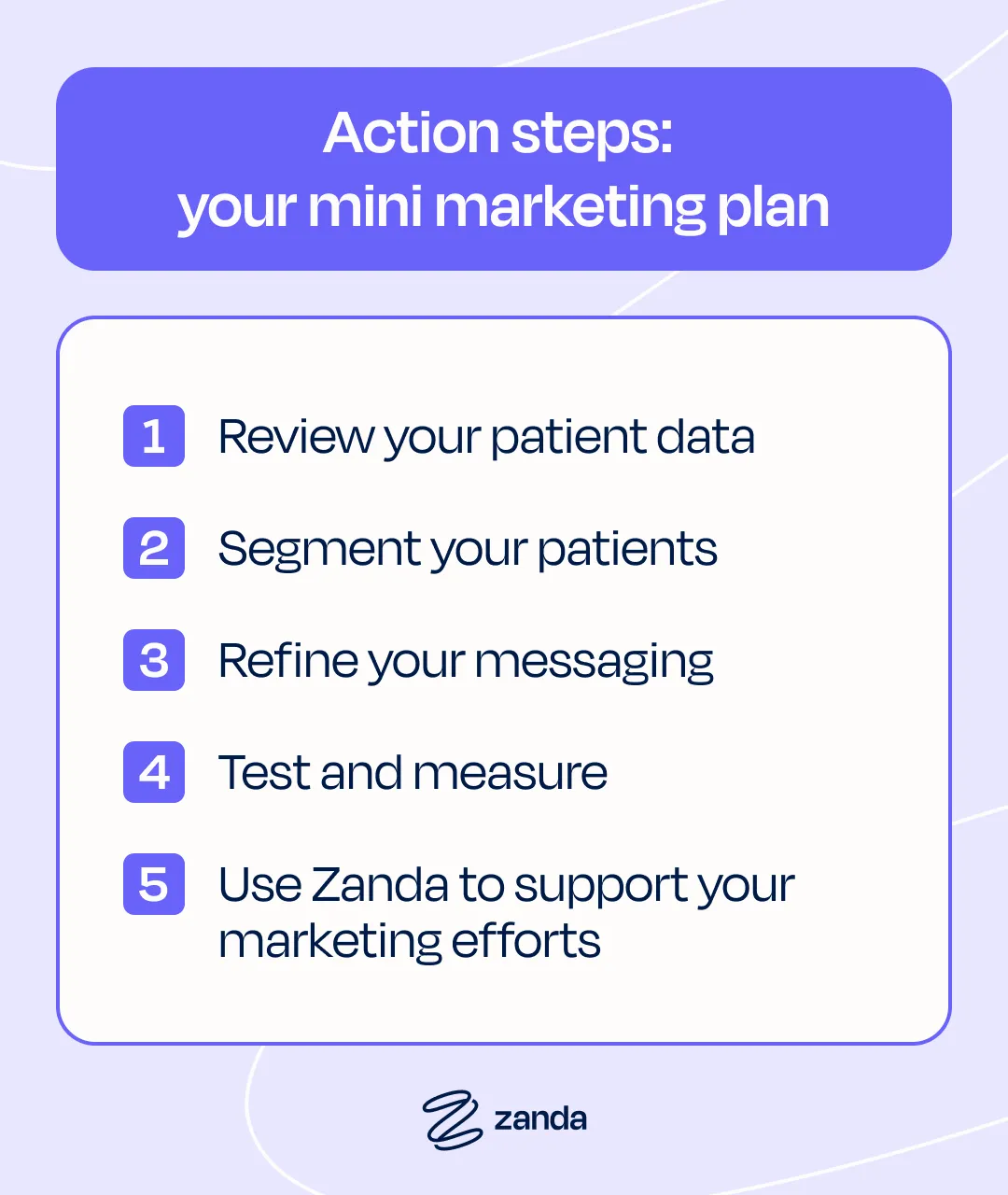
1. Review your patient dataIdentify the most common conditions or reasons patients visit your practice. These reveal your biggest areas of demand.
2. Segment your patientsGroup them into two or three categories with shared needs, such as athletes, diabetic foot care, or elderly mobility support.
3. Refine your messagingCreate short, benefit-focused phrases for each segment. For example, “Keep running without heel pain.”
4. Test and measureApply these messages in ads, newsletters, or referral outreach. Track clicks, calls, or bookings, and refine what performs best.
5. Use Zanda to support your marketing effortsIf you’re already using Zanda to streamline administrative work in your practice, you should also be using it to support your marketing efforts.
You can do this by focusing on:
- Client acquisition and retention: Use the online booking portal, in-built CRM features, automated email and SMS reminders, client recall automations, and integrated email marketing.
- Data-driven marketing decisions: Use client marketing source reports.
- Enhanced client experience: Set up the online booking portal on your site branded with your logo and color scheme, and use the new client automation combined with online forms.
Don’t wait to start growing your practice–start your 14-day free trial now!
*Important note from our Legal Eagles: We know you know this, but we need to say it anyway. The information in this article is general in nature and is not legal advice. The laws, regulations and professional guidelines relating to the use of reviews and testimonials can vary across jurisdictions, and health professions. If you’re unsure of the rules that apply to you, your professional association is often a good place to start.