
How to Write a Great Referral Re-Engagement Letter

One day, referrals are ticking along nicely. The next, you realize a familiar name has disappeared from your inbox. It happens all the time.
Referrers can be the most consistent source of clients for allied health clinics, and if you run a private practice, the scenario above may feel uncomfortably familiar. A referrer who once sent clients your way has gone quiet, with no explanation or warning.
A well-crafted referral re-engagement letter helps you restart that relationship in a way that is professional, thoughtful, and skips the awkwardness. Whether you’re sending a referral follow-up letter or a short referral re-engagement email, the goal is the same: reconnect and rebuild trust.
But before you start writing, it helps to understand why referrals stop in the first place.
Two common referral drop-off scenarios
1. A regular referrer who suddenly stopped referring
This scenario is often the most concerning. When a previously consistent referral partner goes silent, practices tend to assume the worst, and sometimes that fear is justified.
It’s possible that a client had a negative experience with your practice and shared that feedback with the referrer. But just as often, the reason is far simpler: you slipped off their radar. Referrers are busy, and without regular touchpoints, even strong professional relationships can fade.
2. A one-off referral that never turned into more
Some referrers send a single client and then disappear. This doesn’t mean they weren’t satisfied. It may be that they just had one specific client who needed to be referred for a service that you offer, but it was clearly an exception. However, in many cases, there was simply no follow-up, no feedback loop, and no obvious reason for them to refer again.
This is where referral outreach letters, and smart referral management for healthcare practices, can make a real difference.
Why re-engagement matters
Re-engaging referral partners is about reopening communication, reinforcing your value, and reminding referrers that you’re still here and focused on providing excellent care.
A well-written private practice referral letter can do all of that without pressure, defensiveness, or sales-heavy language.
Prevent referral drop-off before it happens
The most effective referral engagement strategy starts before referrals stop. When something doesn’t go as planned with a client, timing matters. Whoever speaks to the referrer first (assuming you’ve obtained the required consent from the client) frames the story, and, in healthcare referral relationships, that context can make all the difference.
If a client had a less-than-ideal experience
Sometimes a “bad experience” isn’t about the quality of care you’re providing. The fit can be off or misaligned. A client may have had expectations that your practice couldn’t meet. They may have been frustrated by boundaries, availability, or outcomes. That doesn’t mean you did anything wrong—but it does mean a referrer might receive one-sided feedback from the client.
This is where proactive referral management for healthcare practices comes in.
If you sense a client is unhappy, consider reaching out to the referrer first, either by phone or via email. Frame it as a professional heads-up, not an emotional explanation. Be mindful of confidentiality. In most cases, unless you have the client’s consent, you can’t speak about their care or even confirm meeting with them unless you have that explicit consent in writing.
Detached, neutral language works best:
- “We weren’t able to meet their expectations in this instance.”
- “They were unhappy with that outcome.”
- “We wanted to ensure you aren’t caught off guard if it comes up.”
This approach ensures the referral partner has context and can trust you to be transparent. By the time the client arrives, they feel informed rather than blindsided.
When you’ve simply dropped off their radar
Not all referral gaps signal a problem with a client. Often, the relationship just went quiet because your practice was no longer top-of-mind, or there are more providers offering similar services. In these cases, a referral outreach letter can be simple and effective. Think of it as a reminder instead of a pitch.
A short referral follow-up letter might:
- Thank them for their past support
- Share a relevant update (new practitioner, expanded services, improved availability)
- Clarify the types of clients you’re currently accepting
- Reaffirm your practice philosophy and approach to care
This kind of allied health referral marketing works best when it aligns clearly with the referrer’s client base. Make it easy for them to think, “Yes, this is a good fit for my clients.”
Don’t miss the opportunity with one-off referrers
When a referrer sends a single client and never refers again, it’s often because there was no follow-up.
If the referral was recent, and the required consent from the client was obtained, a referral re-engagement email can be a simple check in:
- Did everything go smoothly?
- Was the experience what they expected?
- Is there anything you could improve?
Even if something didn’t go perfectly, a timely follow-up shows professionalism and care.
Create a “Golden Experience” for new referrers
Your systems can help here. If a referrer is being entered into your practice management software for the first time, that’s your signal: this is a new relationship.
Make sure the process runs smoothly. Communicate clearly. And always send an acknowledgement (with the required client consent).
A brief, non-clinical letter from the practice manager works well:
- Thank them for their first referral
- Acknowledge their trust
- Express hope that the experience met expectations
- Let them know not to hesitate to reach out if they have any questions or concerns. Make it clear that you’re open to feedback and willing to collaborate as needed.
This marketing-oriented communication should be kept separate from clinical correspondence. It reinforces the relationship without crossing professional boundaries.
Find natural reasons to stay in touch
Strong referral relationships are built through consistent touchpoints. Keep the conversation flowing by checking in regularly.
Opportunities include:
- Welcoming a new practitioner
- Announcing a new service
- End-of-year or new-year messages
- A short note thanking them for their support over the past year
Even a handwritten card to the practice manager can leave a lasting impression.
Reaching out without making it awkward
It’s normal for referral streams to ebb and flow. When you reach out to a past referrer, whether they’re a GP, a fellow therapist, or a community contact, the goal isn’t to “win back” referrals. It’s to reconnect in a way that feels professional, useful, and easy to respond to.
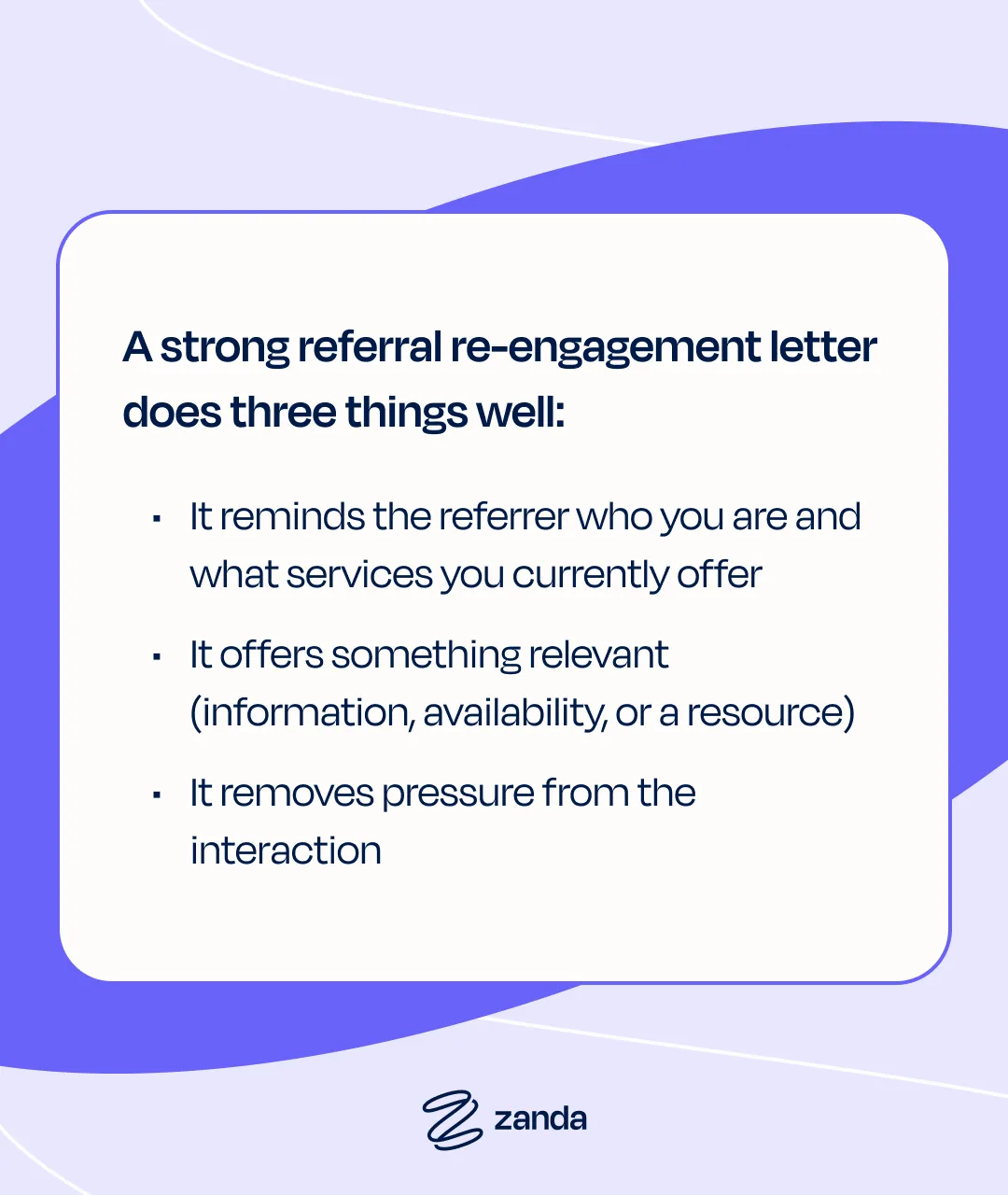
A strong referral re-engagement letter does three things well:
- It reminds the referrer who you are and what services you currently offer
- It offers something relevant (information, availability, or a resource)
- It removes pressure from the interaction
We’ve included three templates below with a basic framework for referral re-engagement letters. Depending on your relationship with the referrer and the context in which the letters are sent, they can easily be adapted.
Option 1: The “Practice Update”
Professional and informative
Best for: Formal professional contacts, such as GPs or psychiatrists.
Dear [Referrer Name],
I hope you are doing well and have been having a productive [season/quarter].
I’m reaching out as it’s been a while since we last connected, and I wanted to share a brief update from my practice. I’ve recently [added a new specialty / completed further training in X / expanded my availability], and am currently able to accept a small number of new clients.
I’ve always appreciated the opportunity to support the individuals you’ve referred in the past, as our clinical approaches seem to align well. If you have clients seeking support for [specific issue 1] or [specific issue 2], I’d be happy to assist.
I’ve attached my updated practice information for your reference. Please don’t hesitate to reach out if there’s anything I can do to support your work, or if you’d like to catch up over a quick coffee.
Kind regards,
[Your Name]
[Practice Name]
[Website link]
Option 2: The “Checking In”
Warm and personal
Best for: Colleagues with whom you have an established, friendly relationship.
Hi [Referrer Name],
I hope all is going well with you and your practice.
I was thinking about your practice recently, and realized it’s been a while since we last checked in. I’m still seeing clients in [location / via telehealth] and focusing primarily on [specialty area].
I wanted to let you know that I currently have availability for new referrals. I’d be glad to keep you in mind for outgoing referrals from my side as well.
If you’re up for a quick coffee or a 15-minute call to catch up, I’d love to hear how your year is going.
Warmly,
[Your Name]
Option 3: The “Resource Offering”
Value-First
Best for: Re-establishing yourself as a helpful expert resource
Dear [Referrer Name],
I’ve been developing some new resources around [topic], and it made me think of your practice and the valuable work you do with [population].
I’ve attached a [resource / guide / link / sample] here. Please feel free to share it with any clients who might find it helpful.
Since we haven’t connected in a while, I also wanted to mention that I’m currently accepting new clients for [individual / group] sessions, with a particular focus on [specialty]. If anyone in your care could benefit, I’d be glad to help.
Thank you for the work you do in supporting your community.
Best regards,
[Your Name]
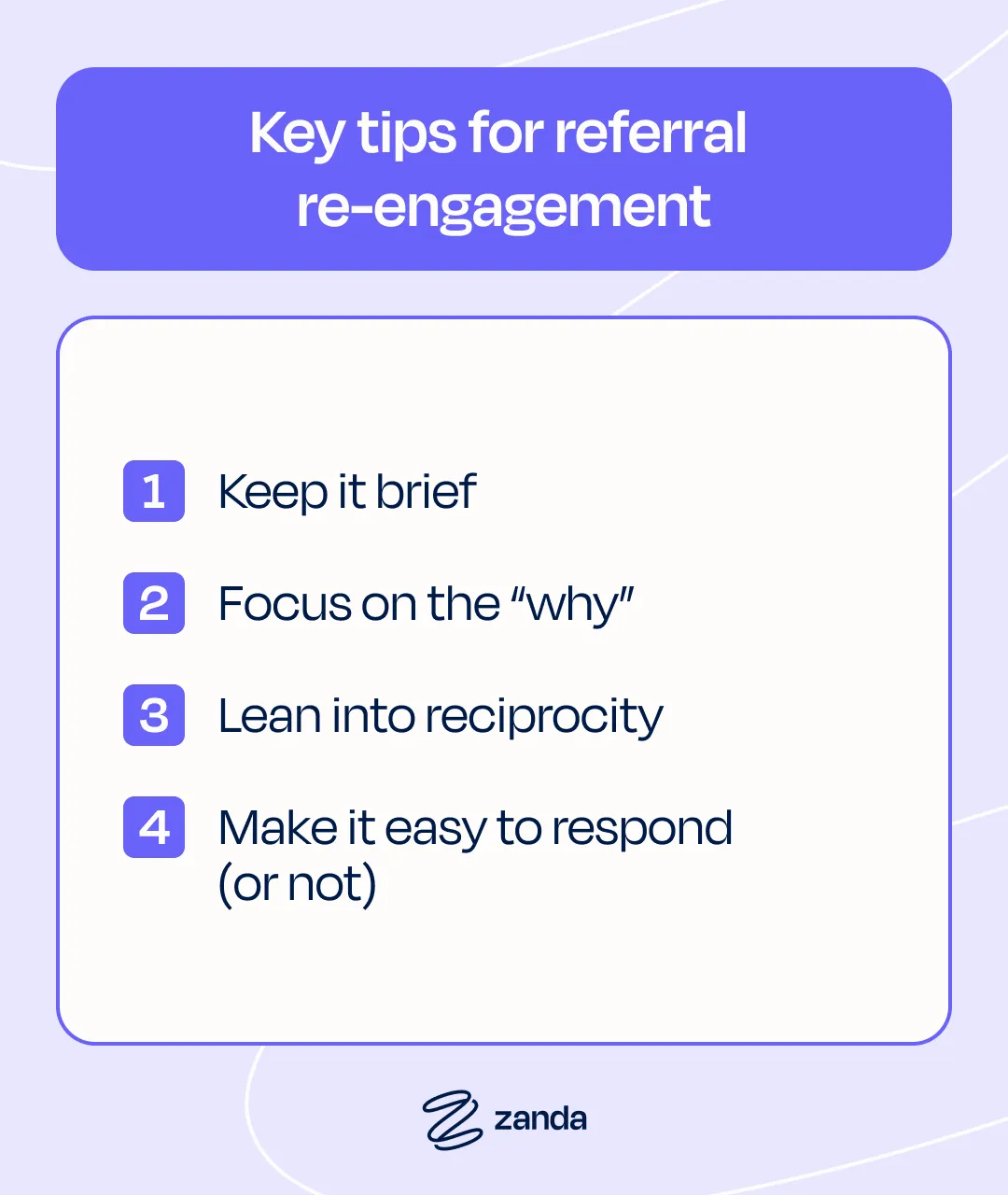
Key tips for referral re-engagement
- Keep it brief
Referrers are busy. Aim for something they can scan and read in under 30 seconds. - Focus on the “why”
Gently remind them why they referred to you in the first place, whether it’s your niche, approach, or shared philosophy of care. - Lean into reciprocity
The most enduring relationships are reciprocal. Referrers are far more likely to want to work with you if the relationship feels mutually beneficial. If you can, assure your referrers that you’d be pleased to return the professional favor wherever possible. - Make it easy to respond (or not)
Phrases like “no pressure at all” or “just wanted to stay on your radar” lower the stakes and keep the interaction comfortable.
Referrals for your practice
Referral relationships don’t need constant attention, but they do require intention and ongoing maintenance. A thoughtful referral re-engagement letter can reopen conversations, build (or rebuild) trust, and keep your practice visible to the people who support your work. With the right approach, re-engaging referral partners feels less like generic or salesy marketing and more like good professional care.
When your systems support that effort, staying connected becomes easy.
Zanda helps you manage referral details, track relationships, and spot opportunities to follow up. Experience Zanda–Try it free for 14 days to explore the full range of features that allow you to run your practice as you imagined it.