
Marketing Mindfully: Ethical Social Media Strategies for Therapists

The tension between visibility and ethics
This article is written by Nicole Arzt, LMFT
As a small business owner, growing your therapy practice requires a solid marketing plan, and many providers are including social media as a core element of their strategy.
At the same time, therapists need to maintain professional boundaries and protect client confidentiality. For these reasons, adhering to the ethics surrounding the creation and sharing of social media content may not feel straightforward.
This tension sits at the heart of ethical social media marketing for therapists. How do you show up publicly without compromising your therapeutic values? And how do you market your clinical services without breaching ethical lines?
Ideally, your marketing should feel like a natural extension of your practice. When you approach social media deliberately, the goal becomes less about “selling a paid service” and more about supporting clients in making informed choices about seeking mental health treatment.
Can therapists use social media ethically?
Yes, absolutely, with intention and boundaries. Ethical marketing for psychologists, counselors, and therapists can be grounded in the same principles that guide clinical care.
With that said, concerns around social media for therapists are understandable. Unlike traditional marketing efforts, social platforms can blur the line between personal and professional identities. Creating content automatically invites obvious visibility and commentary. And even if it’s unintentional, your posts can reinforce engagement in ways that seem incompatible with therapist social media ethics.
However, when you do it correctly, ethical social media marketing supports:
- Potential clients making informed choices about seeking therapy
- You being transparent about your clinical services and scope
- You demonstrating an accurate representation of your training and credentials
- You conveying respect for client autonomy and welfare
Ethical foundations therapists should keep in mind
Please note: This section offers general guidance and is not a substitute for seeking formal legal advice. Ethics and laws vary depending on your location and licensing board. Always consult your licensing board, liability insurance, and professional code of ethics if you have concerns.
Confidentiality and privacy
You already know that honoring all clients’ confidentiality is non-negotiable. This rule extends beyond obvious or generic disclosures.
Remember that even “anonymous” or indirect stories can be identified when combined with contextual details. Don’t share client reactions or what you talked about in sessions that day. Avoid sharing content about specific work you’re engaging in at the present moment.
In most cases, social media privacy for therapists requires taking a more conservative approach. If you’re hesitant about including a particular piece of content, consider leaving it out. It’s never worth breaching confidentiality, and it’s equally never worth risking a client’s discomfort.
Dual relationships and boundary management
Online interactions can unintentionally create dual relationships. For instance, following clients or engaging with their content blurs your professional role.
You should never engage with your own clients within comments or messages. Therapists’ professional boundaries online must be clear and consistent.
Avoiding client identification (even indirectly)
Even when omitting names, specific details like ages, occupations, presenting problems, and dialogue exchanged in session can feel recognizable to clients. Vignettes or composite stories about how you work with specific cases should be avoided or handled with immense caution.
Honesty and accuracy in representation
Your credentials and specialties must be presented accurately. Avoid exaggerated claims or implying guaranteed results. Never falsify expertise you don’t have.
Cultural sensitivity and non-exploitation
Marketing for therapists must avoid exploiting client vulnerability. Under this framework, you should be mindful when discussing sensitive topics. Most licensing boards prohibit inviting testimonials, and this likely extends to social media as well.
Each of these principles should inform everyday posting decisions. Before publishing any content, it’s a wise idea to ask yourself: Does this protect client welfare? Does it maintain my professional integrity? Could a client sense this post might be about them?
What ethical social media looks like in practice
Educational content over personal disclosure
Offering psychoeducation is generally considered to be one of the safest and most effective social media best practices. You can create education topics, including:
- General information about certain topics (anxiety, trauma, ADHD, etc.)
- Coping strategies and grounding exercises that can be used in daily life
- General information about the therapeutic process and attending therapy
Educational content can appeal to followers without replicating therapy in a public forum. Avoid posting content that feels like a “mini-session” directed at a specific type of client or that calls out real-life scenarios too closely resembling your caseload.
Moreover, avoid oversharing personal experiences in ways that shift focus from the audience to you. While personal touches can humanize your brand, they must be intentional and boundaried. Always consider that a past or current client may be viewing your content. If you would not say it in a session, do not say it on social media.
Boundaries around client interaction
No clinical guidance or therapy over messaging: Private social media messages are not secure, and offering therapeutic guidance through DMs can be both legally and ethically risky. If a follower sends a vulnerable message, respond with a neutral reply. If they are interested in learning more about your services, redirect them to your appropriate channels, such as your website. Avoid engaging in any clinical dialogue.
Do not follow current or former clients: This complicates boundaries and can introduce dual relationship concerns. Clearly state this policy upfront, as the clarity protects everyone.
Anonymity & privacy safeguards
Disclaimers can help clarify that content is educational and not therapy. However, they do not replace good judgment, and they do not make unethical posts inherently ethical.
Remember that even anonymous stories can be identifying. You should avoid sharing about “success stories” or showcasing before-and-after narratives. Displaying testimonials is also nuanced. While some directories allow them, mental health professionals are generally discouraged from soliciting testimonials due to power dynamics.
If testimonials are shared (for example, from public review platforms), ensure that you aren’t exposing sensitive details and that you aren’t incentivizing reviews in any form.
Platform-specific considerations
Each platform prioritizes different types of communication. Ethical social media marketing for therapists requires adapting without compromising values.
A successful Instagram presence largely hinges on how well you engage in visual storytelling via dynamic posts, stories, and reels.
Therapist Instagram best practices include:
- Clear educational graphics
- Compassionate, inclusive language
- Humorous or thought-provoking content
LinkedIn emphasizes professional credibility and thought leadership.
This platform works well for:
- Sharing or writing articles on relevant therapy trends
- Engaging in discussion about evidence-based approaches
- Highlighting your specific professional achievements or certifications
TikTok and short-form video
Short-form video requires clarity without oversimplification. Therapists need to be careful not to reduce complex situations into catchy labels. Avoid clickbait phrases like “If you do this, you have X disorder” formats. Although they may seem harmless, they can unintentionally encourage over-identification or self-diagnosis.
Personal vs. professional accounts
If your accounts are public, always operate under the notion that clients will look them up and see them. Make your personal accounts private. This separation supports therapist marketing without violating ethics and reduces the risk of boundary confusion.
What to avoid: common ethical pitfalls
Some missteps in social media marketing for counselors are obvious, but others may feel more covert or even confusing. However, it is always your professional responsibility to ensure your content is ethically sound and respectful.
In general, you should avoid the following:
- Sharing client stories
- Diagnosing or labeling people you have never met
- Over-promising outcomes (“I help clients heal trauma in 6 weeks”)
- Blurring personal and professional identities
- Reacting emotionally or defensively to comments
How to market mindfully (without burning out)
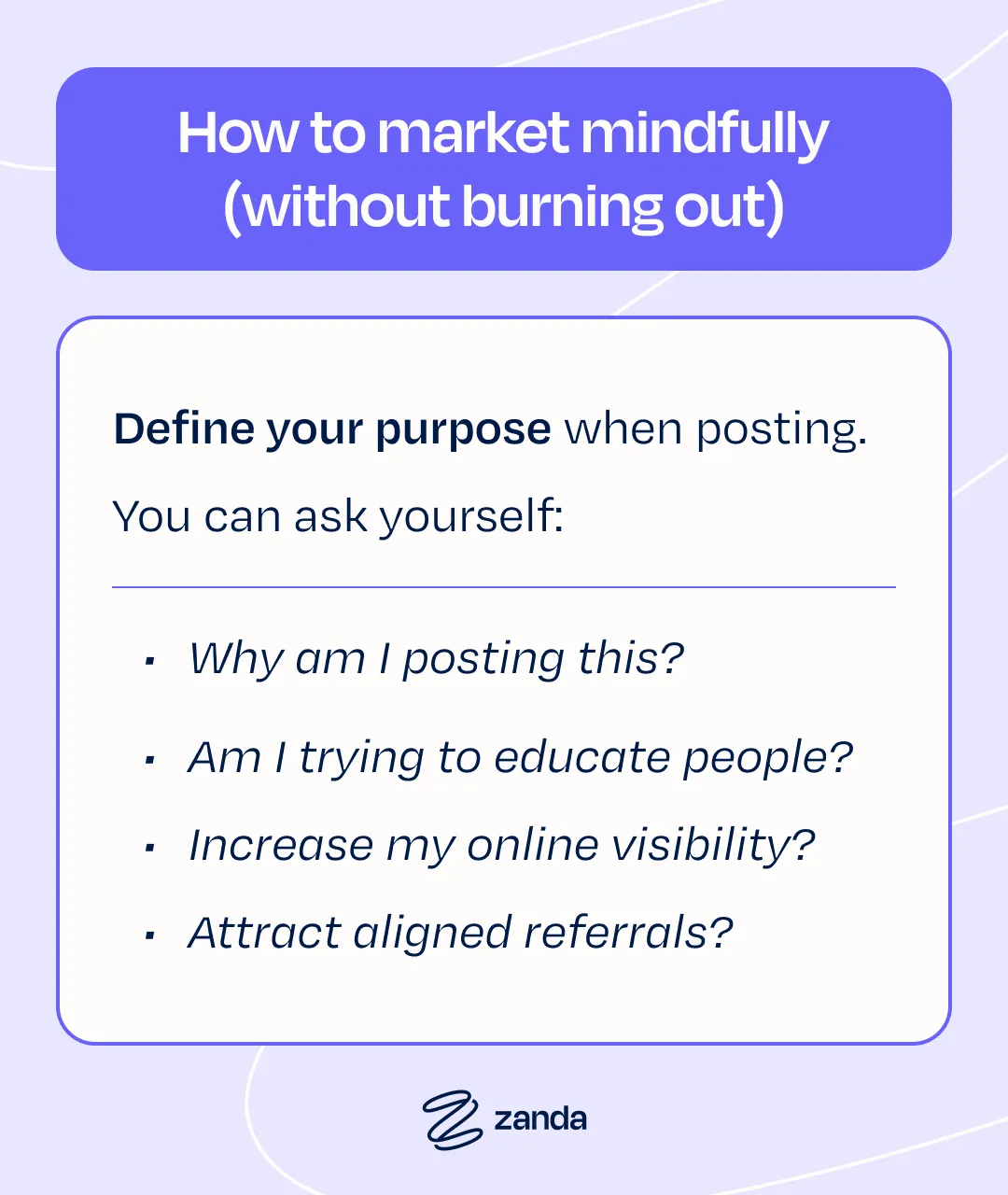
Ethical social media marketing for therapists should be sustainable, and it’s important to define your purpose when posting. You can ask yourself, Why am I posting this? Am I trying to educate people? Increase my online visibility? Attract aligned referrals? When your purpose feels clear, the content feels more focused.
Set clear boundaries upfront: Be explicit about certain social media parameters, including whether you’ll respond to direct messages or comments.
Consider creating content in batches: Many therapists find that pre-planning content in advance reduces emotional overwhelm and prevents impulsive posting.
Use neutral and inclusive language: Avoid speaking in absolutes or using pathologizing language. Be mindful of too much jargon—it’s quite possible your average follower has never been to therapy.
Review posts through an ethical lens first: Before sharing anything, triple-check: does this protect client confidentiality and does it align with my professional values? If you’re unsure, consider holding off.
Documentation, policies, & professional protection
It’s important to include social media policies within your informed consent. This should include information about how you use social media and your boundaries regarding interaction and sharing content.
Highlight that you will not “friend” or “follow” any past or current clients. Make a statement that there are inherent risks associated with active clients following your content. Let them know they are welcome to bring up any questions or concerns at any point in treatment.
More than anything, consistency with social media policies matters the most. For example, if you say you don’t provide therapy via social media, ensure your actions reflect that policy.
Marketing as an extension of care
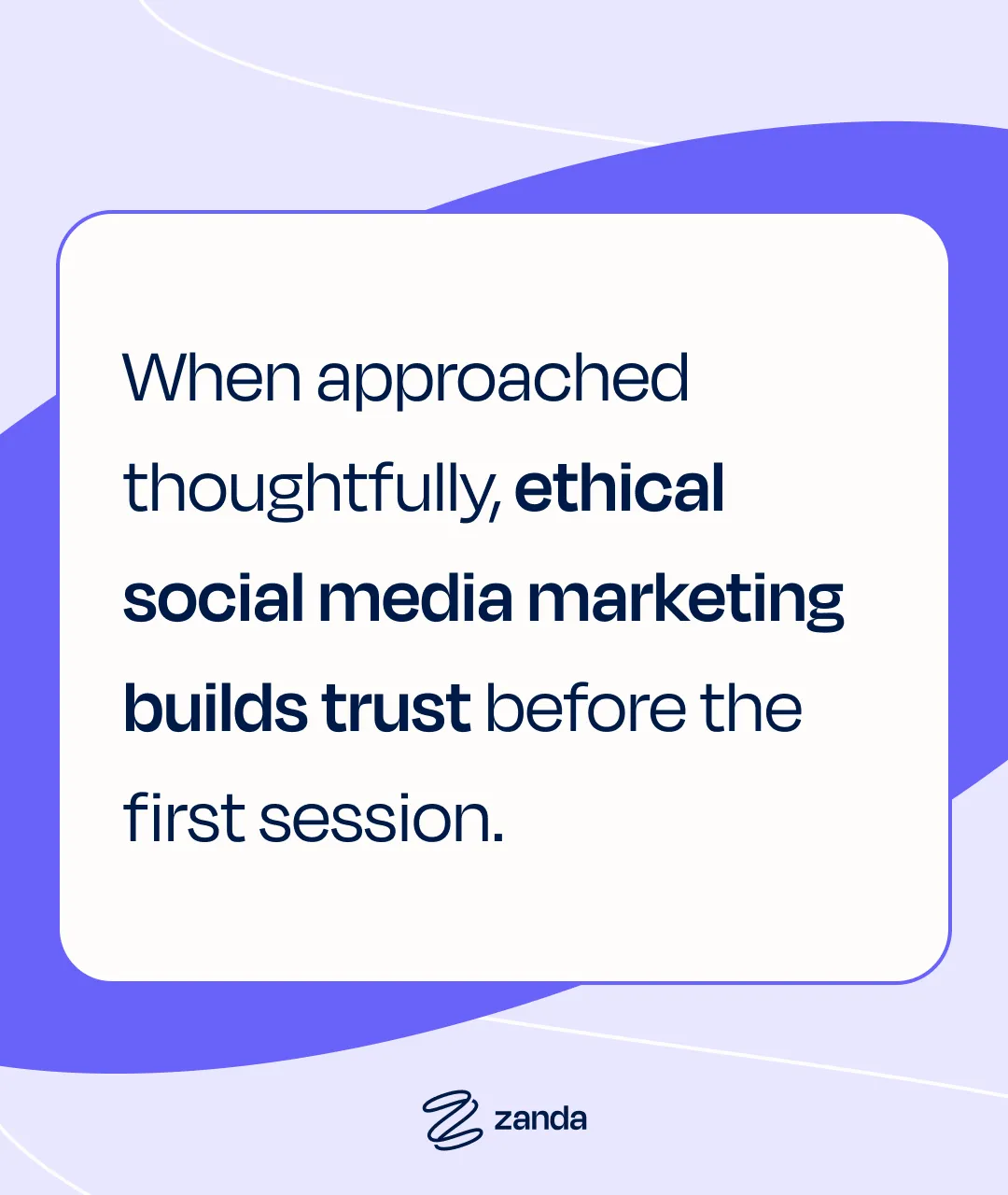
When approached thoughtfully, ethical social media marketing builds trust before the first session. In the best-case scenario, aligned marketing helps potential clients understand what therapy with you involves and what to expect from the process.
Social media can be conceptualized as a form of service. Depending on how you use your account, you may be providing free psychoeducation and encouraging help-seeking.
How practice systems support ethical marketing
Behind all visible marketing strategies are invisible systems keeping the nuts and bolts in place. As a therapist, it’s essential to be mindful of your professional presence. Marketing can support your practice, but excellent clinical care remains the top priority.
This is why it’s so important to have comprehensive practice management software to keep your practice running smoothly. When you have the right tools in place—and confidentiality and safety are prioritized to the highest standard—you have more time to focus on what matters most: attuned and excellent client care.