
How to Start a Psychology Private Practice: The Clinician's Essential Guide

You’ve spent years training and working as a clinician and now you’re thinking about becoming a business owner too. But the jump from clinician to business owner can feel bigger than it really is.
The American Psychological Association’s 2025 Practitioner Pulse Survey found that 46% of psychologists have no openings for new patients, with many reporting longer waitlists and patients presenting with more severe symptoms. The need for psychological care is clear, and a private practice gives you the room to meet it on your own terms.
So how do you start a psychology private practice? Your clinical skills are already there, so it’s just the operational side of starting a psychology private practice that needs a roadmap — and most of it can be learned surprisingly quickly with the right systems and support.
This guide covers what you need to know, in the order you’ll need to know it, from legal setup through to client retention.
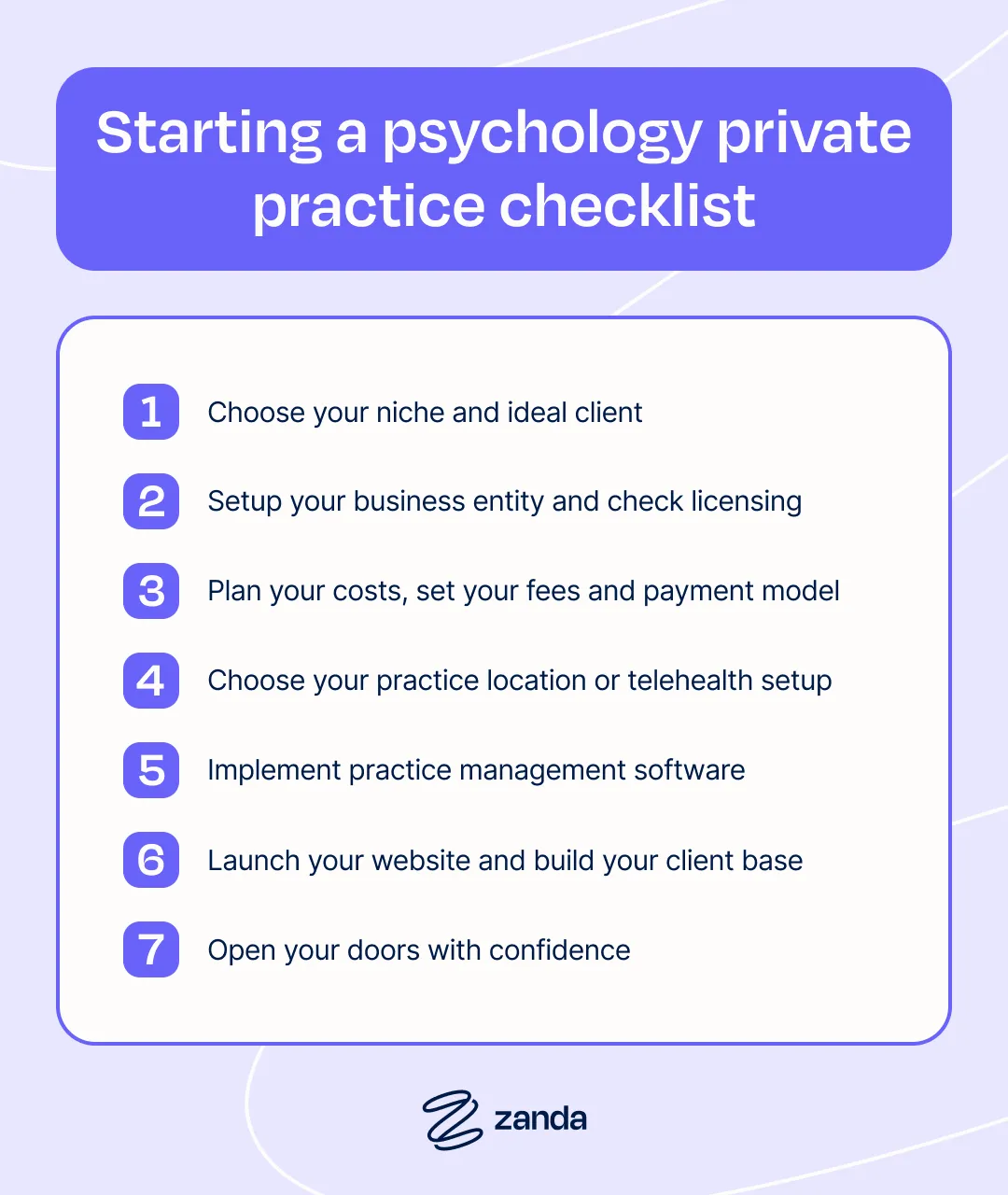
Quick checklist: Starting a psychology private practice
- Choose your niche and ideal client
- Setup your business entity and check licensing
- Plan your costs, set your fees and payment model
- Choose your practice location or telehealth setup
- Implement practice management software
- Launch your website and build your client base (starting with referrals)
- Open your doors with confidence
1. Find your niche as a psychologist
This might seem strange to be a first step in how to start a psychology private practice, but a clear niche makes everything else easier: your marketing, your referral conversations, even your clinical decision-making.
Trauma-focused work, CBT for anxiety, pediatric assessment, neuropsychological testing, perinatal mental health, and geriatric care are all viable specializations, and each one creates a distinct referral pathway. The narrower your focus, the easier it is for a GP, pediatrician, or psychiatrist to know when to send someone to your practice.
Your niche should start with the work you do best and care about most — think about the types of clients or presentations that you feel most comfortable with and feel that you make the biggest impact. From there, factor in local demand. Look at the practitioner directories in your area. If twelve psychologists in your area already specialize in adult anxiety, the gap might be in adolescent OCD or post-stroke neuropsychology. Google Trends, local hospital catchment data, and conversations with referrers will tell you where there is a need.
2. Sort out the legal and licensing requirements
Two things need to be locked in before you take your first booking: your business structure and your professional registration.
A sole proprietorship is the simplest setup, but it offers no separation between your personal assets and the business. An LLC, or its equivalent (a Pty Ltd in Australia, a limited company in the UK), creates that separation. The right choice depends on your jurisdiction, your tax position, and your appetite for risk, so an accountant’s advice here will usually pay for itself.
On the registration side, confirm your psychology license is active and that it covers every state or region where you intend to practice. Telehealth complicates this as many licensing boards require you to be registered in the state where the client is physically located during the session, not where you are. Check with your licensing board before you list yourself as available across borders.
Insurance is the third area to look at. Professional indemnity (sometimes called malpractice cover) protects you against claims arising from your clinical work and is non-negotiable for psychologists. Public liability is different. It covers physical risks on your premises, such as a client tripping in the waiting room. If you’re working from home or renting a consulting room, check what the building’s existing policy covers, because it often won’t extend to your practice.
Disclaimer: Please note that this is general guidance only, and is not specific to your situation. We highly recommend speaking to a qualified accountant and lawyer in your jurisdiction before locking in your business structure, registration, or insurance arrangements.
3. Build your financial framework
Money decisions shape everything else in your practice, so it’s worth getting them right early. The biggest one is how you’ll be paid: insurance panels, private pay, or a mix of both, and this decision forms a key part of your psychology business plan.
Working through third-party payers (insurance panels in the US, Medicare in Australia, or private health funds in the UK) brings steady referral volume, but rates are lower and every session adds claiming admin. Private pay means higher fees and fewer hoops, but you’ll spend more time and money attracting clients. Many psychologists run a hybrid with private pay for individual therapy, and insurance billing for assessments. For many new private practices, that balance offers stability while your reputation and referral network grow.
Once you’ve decided how you’ll bill, build a realistic startup budget. Rent or coworking fees, indemnity premiums, basic furniture, a website, and practice management software for psychologists are the obvious line items. Less obvious are the testing kits and assessment licenses, if your work calls for them. For example, a single WAIS-5 kit runs into four figures, and practices that use them will likely need more than one instrument.
But many of the assessments you already use can also be set up as scored forms and assessment reports inside your practice management system, which saves you on paper-based scoring and keeps results in the client file.
In reality, most new psychology practices start with minimal investment and add extra assets and expenses once the practice is profitable and can justify the spend.
When you’re building your financial framework, add a buffer of three to six months of operating costs. Early caseloads may not fill as fast as you’d like, and the buffer is what gets you through the first slow stretch without panicking about how you’ll meet your expenses. Our psychology business plan guide breaks the numbers down line by line.
4. Set up your therapeutic space
This is where it gets more exciting. The room you practice in, whether it’s an office, a home consultation space, or a video call, it’s all part of the clinical experience. Clients read the environment before they say their first sentence, so it’s worth finding a space where you can create the right kind of ambience for your clients.
In-person practice considerations
For an in-person psychology practice, three things matter most: soundproofing, accessibility, and waiting-room privacy. Walls between consulting rooms need to be solid enough that clients can’t overhear each other. Wheelchair access is important for clients with mobility issues, and clear signage makes the practice easy to find. The waiting area is also worth thinking about, as two clients shouldn’t be forced to sit in eye contact while they wait.
Telehealth setup requirements
For telehealth, the standards are different but just as strict. You need a HIPAA-compliant (or GDPR-equivalent) secure platform, a quiet room with a door that closes, a neutral background, and a backup plan for when the connection drops. Telehealth that’s built into a practice management system is usually a better choice than free consumer video apps. Clients get a more professional experience joining from your portal rather than a personal video link, you’re not juggling four browser tabs between sessions, and the compliance picture is simpler when everything sits in one platform.
If telehealth will be a significant part of your offering, our online therapy guide covers the trade-offs between in-person and telehealth sessions in more detail.
5. Set up the systems that run your practice
The right practice management software is what quietly determines how much of your week is admin and how much is clinical work. The wrong setup, or no system at all, leaves you stitching together five free tools and reconciling them at the end of every week. Done well, a proper platform handles the work that sits between sessions, so clients stay engaged and you stay out of the inbox, leaving you with more time for your clients.
When selecting between the different practice management software for psychologists, one thing to consider is what happens before the first session. Online intake forms can capture history, presenting concerns, consent, and outcome measures (DASS-21, PHQ-9, GAD-7, and similar) so the client arrives with the paperwork already done. That changes the first session from a form-filling exercise into productive clinical work.
Note templates configured for psychology (SOAP, DAP, BIRP, PIE, plus risk assessment and progress note formats) are also worth checking for. You shouldn’t have to build each one from scratch. Built-in AI goes further and automatically transcribes the session and generates the draft note, in your preferred style and format, while you’re still with the client.
Sharmaine McHenry, Operations Manager at Vida Psychology, described the change: “BizzyAI is a huge timesaver… Our clinicians are able to commit their full attention to their clients and not be distracted by note taking.”
Then there’s the day-to-day client communication that keeps people coming back. A Kaiser Permanente study of 33,000 mental health visits found that SMS reminders alone cut no-shows by 11%. To run a professional psychology practice, your practice software should also incorporate:
- SMS and email reminders sent the day before a session, with an option to confirm or reschedule.
- A client portal that lets clients book, reschedule, complete forms, and pay without needing to phone you. It removes the bottleneck of you-as-receptionist.
- Automated invoicing that handles the awkward shift from clinical hour to payment without you having to ask for money in the room.
- A recall workflow for clients whose treatment has paused. A short, warm message six or eight weeks later, along the lines of “just checking in to see how you’re going,” brings them back.
Even if you don’t need every feature from day one, choose a system that can grow with your practice.
6. Build your client base
Yes, you need to market yourself, but think of private practice therapist marketing as how you connect the work you do with the clients who need it. A clear strategy, online and offline, makes that connection easier.
Start with the people who already know you
The fastest source of early referrals isn’t a directory or an ad campaign. It’s the people who already know you. Friends, family, former colleagues, supervisors, university classmates, and clinicians you’ve worked alongside in public mental health roles all have networks of their own, and many of them will want to help.
You can make the process easier by giving them something concrete to work with. Tell them specifically who you can help and what you treat, not just that you’ve opened a practice. “I’m now seeing adults with anxiety and trauma, and I have availability on Tuesdays and Thursdays” gives them everything they need. “I’ve started a private practice” gives them nothing to work with.
Send a short message or email to your immediate network in the first few weeks. Include your specialization, your location (or that you offer telehealth), and a link to your booking page. Most won’t have an immediate referral to send, but some will, and the rest will hold onto the information for when someone in their life mentions they’re struggling.
Develop a digital presence that earns trust
For many prospective clients, your website is the first point of contact. They’ll read it before they set up an appointment. Cover the basics: who you are, what you specialize in, your fees, how to book, and what to expect from the first session. Include a photograph of yourself, and of any other team members. Clients want to see who they’ll be sitting across from before they pick up the phone or click your “Book Now” button.
When self-paying clients look for a psychologist, they might search Google for: “psychologist in [city],” “anxiety therapist near me.” Local SEO will get your practice into those results, and you can boost your listing by:
- Claiming and completing your Google Business Profile. Keep your name, address, and phone number consistent everywhere they appear online.
- Writing a dedicated page on your site for each specialization you offer, so that someone searching for “perinatal psychologist [city]” lands on a page that explicitly says you do perinatal work.
- Setting up social media pages to build awareness and credibility. The catch is that confidentiality, scope of practice, and dual-relationship risks make it trickier to navigate than for most small businesses. Our ethical social media guide covers how to show up publicly without crossing professional lines.
Build referral relationships with GPs and pediatricians
An absolute must for therapist marketing is building a network of GPs who trust you and send you many clients over a few years. This means your best marketing investment might not be an ad budget, but rather a referral introduction letter. A single page covering who you are, what you treat, your availability, and how to reach you, sent to local GPs, pediatricians, and psychiatrists, is enough to start.
Damien Adler, Co-Founder of Zanda and a registered psychologist, calls referral introduction letters “the most powerful, yet underused, marketing tools for health professionals.” Once a referral comes through, follow up with a brief feedback letter after the assessment and at key treatment milestones to keep the relationship live. Our referral re-engagement letter covers how to reactivate referrers who’ve gone quiet.
Professional directories also generate steady inquiries for any private practice therapist, particularly from clients who are paying out of pocket and shopping around. Psychology Today is the most-trafficked, and the directories run by your professional association (APS in Australia, BPS in the UK, APA in the US) are worth listing on for the same reason.
7. Take the leap with confidence
So now you know how to start a psychology private practice. It comes down to a stack of small operational decisions, combined with the discipline to keep moving forward on tasks that may be unfamiliar, but are very doable. And through all of it, don’t lose sight of why you’re doing this: to help more clients through the unique skills and support you can offer.
Once your practice starts growing, the operational side becomes what determines whether your days feel manageable or chaotic. That’s where your systems matter. Choosing the right practice management system from the beginning makes a significant difference. The right platform can simplify much of the setup process, reduce admin stress, and help you build a smoother, more sustainable practice from day one.
Amanda Wilkinson at Headspace Leeds, a recognized psychotherapy service in the UK, described the impact: “We would most certainly recommend Zanda to anyone who is considering an online system… it has saved us approx. 15 hours per week in admin time.”
Zanda combines clinical notes, online forms, an integrated client portal, telehealth, automated reminders, invoicing, and BizzyAI: Scribe in one system designed to meet the needs of a psychology practice.
Zanda’s Starter Plan is built specifically for new practices getting up and running. It gives you the core tools to take bookings, send reminders, write notes, and invoice clients without paying for features you won’t use in year one. It even comes with a 12 month Money-Back Guarantee for extra peace of mind.
If you’re ready to set up the systems your practice needs before you see your first private client, start a 14-day free trial. No credit card required.
Frequently Asked Questions About Starting a Psychology Private Practice
How much does it cost to start a psychology private practice?
The cost of starting a psychology private practice can vary widely depending on your setup. A lean telehealth-only practice may cost only a few thousand dollars to launch, while a fully furnished clinic with assessment tools and multiple consulting rooms can require a much larger investment.
Typical startup costs include:
- Business registration and licensing
- Professional indemnity insurance
- Office rent or telehealth setup
- Website design and branding
- Practice management software for psychologists
- Furniture and equipment
- Assessment tools and testing kits
Many psychologists start small and expand once their caseload becomes consistent and profitable.
Do psychologists need a business plan before starting private practice?
A psychology business plan is strongly recommended, even for solo practitioners. It doesn’t need to be a complicated corporate document, but it should help you think through:
- Your niche and ideal clients
- Pricing and billing structure
- Startup costs and ongoing expenses
- Referral and therapist marketing strategy
- Revenue goals
- Your long-term vision for the practice
A simple business plan helps you make clearer decisions early and avoid expensive mistakes later.
What business structure should a psychologist choose?
This depends on your country, tax position, and risk profile. Many psychologists begin as sole proprietors because it’s simple and inexpensive, while others choose an LLC, Pty Ltd, or limited company structure for additional legal protection.
Because the right structure can affect tax, liability, and future growth, it’s worth speaking with an accountant or lawyer before making a decision.
Can psychologists run a private practice entirely online?
Yes. Many psychologists now operate successful telehealth-only practices. Online therapy can reduce overhead costs, offer greater flexibility, and make it easier to reach clients in rural or underserved areas.
If you plan to work online, make sure you:
- Use a secure and compliant telehealth platform
- Understand licensing rules across state or regional borders
- Have a private, professional space for sessions
- Use systems that support online intake forms, payments, and client communication
Integrated telehealth inside your practice management software is usually simpler and more professional than relying on separate video apps. Zanda includes integrated telehealth, online forms, client portals, reminders, and invoicing in one connected system, which can make running an online psychology practice much easier from day one.
How long does it take a new psychology practice to build a full caseload?
There’s no universal timeline. Some psychologists fill their caseload within a few months, while others take longer depending on location, niche, referral relationships, fees, and marketing activity.
Referral networks are often the biggest factor. Strong relationships with GPs, pediatricians, psychiatrists, schools, and allied health professionals can dramatically speed up growth. This guide for Marketing to Health Practices includes practical tips suitable for new psychology practices.
Most practices grow steadily rather than instantly, which is why having a financial buffer during the first six months is important.
Do psychologists need malpractice insurance?
Yes. Professional indemnity or malpractice insurance is considered essential for psychologists in private practice. It protects you if a complaint or legal claim arises from your clinical work.
You may also need:
- Public liability insurance
- Cybersecurity or data breach cover
- Contents insurance for your office equipment
Insurance requirements vary by country and profession, so check local regulations carefully.
What is the best practice management software for psychologists?
The best practice management software for psychologists is one that reduces admin while supporting the full client journey from intake to invoicing.
Key features to look for include:
- Online booking and scheduling
- Intake forms and consent forms
- Clinical note templates
- Telehealth
- SMS and email reminders
- Invoicing and payments
- Secure client records
- Automated workflows and recalls
- Built-in AI tools for session notes
Choosing software that can grow with your practice will save significant time later, especially once your caseload becomes busier.
Zanda is designed specifically for psychology and allied health practices, combining clinical notes, online forms, telehealth, automated reminders, invoicing, a client portal, and AI-powered documentation tools in one platform. For new private practices, having everything connected in a single system can make the operational side of running a clinic significantly easier from day one.
How do psychologists get their first private practice clients?
Most psychologists get their first referrals through existing professional relationships. Former colleagues, supervisors, GPs, pediatricians, schools, and allied health providers are often the first sources of new clients.
Effective therapist marketing usually includes:
- A professional website
- Local SEO and Google Business Profile optimization
- Professional directory listings
- Referral introduction letters
- Networking with local clinicians
- Educational content or social media presence
Trust and reputation tend to matter more than aggressive advertising in psychology private practice marketing.
Should new psychologists accept insurance or private pay clients?
Many new practices use a hybrid model. Insurance or government-funded referrals can provide consistent client flow early, while private pay offers greater fee flexibility and less administrative work.
The right mix depends on:
- Your financial goals
- Local market demand
- Your niche
- Administrative capacity
- The type of clients you want to work with
There’s no single correct model, and many psychologists adjust their approach over time as their practice grows.
Is it better for new psychology practices to rent an office or start from home?
Both options can work well. Renting a consulting room can create a more established professional presence, while working from home keeps startup costs low.
The right choice depends on:
- Your budget
- Your client demographic
- Privacy considerations
- Whether you plan to offer telehealth
- Your long-term growth plans
Many psychologists begin with telehealth or part-time room rentals before moving into a dedicated clinic space later.