
How to Start a Chiropractic Practice: A Comprehensive Startup Guide

More people are looking for ways to manage pain without medication or surgery. That shift has been good for chiropractors, which is why so many chiropractic practitioners are thinking seriously about opening their own clinic.
But going from practitioner to practice owner is a different skill set and something to consider before you launch in head first. If you’re figuring out how to start a chiropractic practice, the real question is whether you can run a profitable business that doesn’t burn you out by year two.
This guide walks through what it actually takes to open a chiropractic private practice: the planning, operations, and growth work behind a sustainable clinic.
Preparation: Aligning Your Chiropractic Business Strategy
Before the first adjustment, you need to build a stable foundation for your business.
Defining Your Chiropractic Practice Philosophy
Begin by defining the specific type of chiropractor you intend to be. Not in a vision-board sense, but a practical one, because it changes the decisions you make in setting up and importantly, the clients you attract.
Your technique matters here. A Diversified practice needs different equipment than a Gonstead or Activator practice. If you’re planning to offer flexion-distraction or drop-table work, that gets factored into your floor plan and your budget from day one.
Patient demographics is the other piece. A sports medicine clinic near a CrossFit box looks nothing like a pediatric wellness practice in a family suburb, or a geriatric-focused clinic near a retirement community. Everything from your location to your hours to your case mix flows from this choice. Pick one. You can always expand later.
Building Your Chiropractic Business Plan
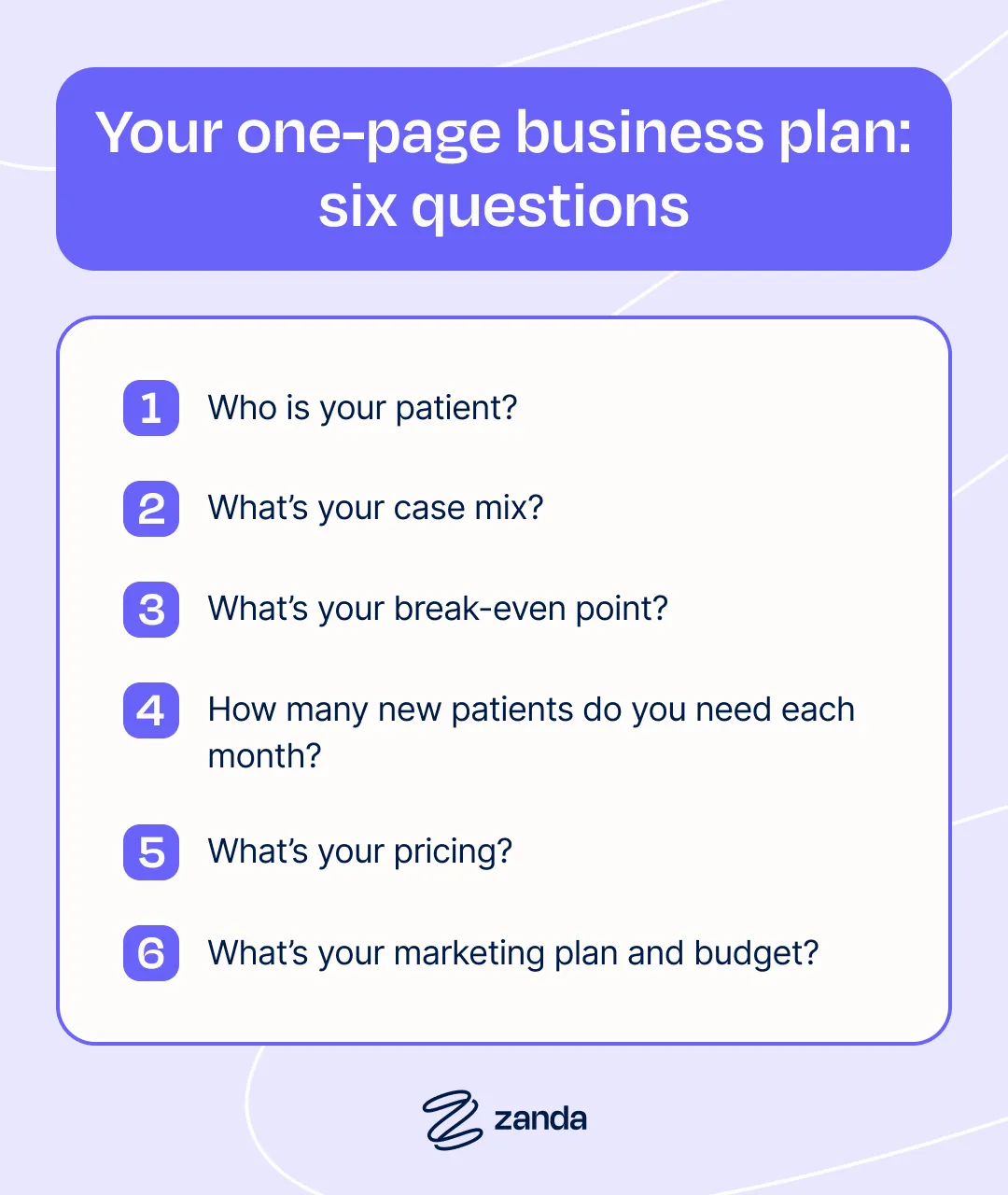
Your chiropractic business plan is the document that forces you to be honest with yourself before you sign a lease. It doesn’t need to be a 40-page bank-ready prospectus unless you’re applying for finance. It just needs to answer a few questions honestly.
Who is your patient? What’s your case mix? What’s your monthly break-even point? How many new patients do you need each month to hit it? What’s your pricing? What’s your marketing plan and budget?
If you can’t answer those questions on one page, you’re not ready to open. The good news is that working through them takes a weekend, not a quarter.

Legal and Regulatory Compliance for Chiropractors
For most chiropractors, this is the most boring part of opening a clinic. It’s also where the biggest expensive mistakes happen.
You’ll need to confirm your licensing is current with your state board (or the equivalent regulator in your region) and that your continuing education credits are logged. If you’re moving across state or country lines, check reciprocity rules early because some regions require a separate exam.
Business structure comes next. In the US, most new clinic owners choose between an LLC, an S-corp, or a professional corporation, depending on their tax situation and liability exposure. Other markets have their own equivalents, like Pty Ltd structures in Australia or limited companies in the UK. Whatever the terminology, the principle is the same: talk to an accountant who has worked with healthcare practices before. Generic small-business advice often misses the nuances of a regulated profession.
If you’re planning on-site X-ray, there’s a whole additional layer. In the US that means state radiation safety certification, equipment registration, and ongoing inspections. Elsewhere, check with your local radiology and health department authorities. Either way, build the time and cost of this into your opening timeline from the start.
Chiropractor Startup Costs and Financial Planning
Chiropractor startup costs vary widely, but the big line items are predictable. Tables, diagnostic equipment, your lease deposit, build-out costs, software, and enough working capital to cover six to twelve months of operating expenses while your patient base grows.
For most new clinics, you’re looking at somewhere between $70,000 and $250,000 to open the doors, depending on whether you’re buying or leasing equipment, how much build-out your space needs, and whether you’re doing on-site X-ray.
X-ray equipment is often the single largest capital decision. Buying new gives you the latest technology and a long asset life, while leasing chiropractic equipment keeps your upfront costs down and bundles maintenance into a predictable monthly payment — which can be the difference between opening this year and waiting another twelve months. Refurbished sits somewhere in the middle. The right choice depends on your patient volume projections and your cash position.
The bigger strategic decision is your payment model. An insurance-based practice can drive high patient volume but comes with billing complexity, reimbursement delays, and margin pressure. A cash-pay wellness model gives you cleaner economics and simpler operations, but it requires stronger marketing and a clearer value proposition to patients who are used to someone else covering their care.
Some clinics run a hybrid. Whichever you pick, build your financial model around it honestly. Don’t assume insurance reimbursements will land faster than they actually do.
Operations: Building a High-Performance Chiropractic Clinic
Efficiency is the key to managing a high-volume chiropractic schedule without burnout.
Chiropractic Clinic Layout and Equipment
Your floor plan is an operational decision, not a design decision.
Think about the flow. A patient walks in, checks in at reception, moves to a diagnostic or consultation room if needed, then to an adjusting bay, then back out. The fewer steps and the less backtracking, the more patients you can comfortably see in a day.
Multiple adjusting bays let you stagger appointments so you’re never standing idle while a patient gets ready. A dedicated space for adjunctive therapies keeps those sessions from clogging up your main treatment area. If you’re doing on-site X-ray, that room has specific shielding and placement requirements you’ll want to design around early.
Table choice matters more than people expect. Manual drop tables are reliable, lower cost, and give you tactile control, but they’re slower in a high-volume setting. Automatic drop tables speed up your throughput and reduce physical strain on you over a long career, at a higher upfront cost. Flexion-distraction tables are a separate category again, and worth investing in if disc-related care is a meaningful part of your case mix. Match the table to how you actually practice, not to what the equipment catalog pushes hardest.
Diagnostic and Treatment Tools for Chiropractors
On-site X-ray versus external referral is worth thinking through carefully. On-site gives you immediate imaging, better patient experience, and additional revenue. It also comes with high capital costs, regulatory overhead, and the responsibility of reading or having someone read the films. Out-referral is cheaper and simpler but adds a delay and a referral step that some patients won’t follow through on.
Adjunctive therapies are the other common decision. Treatments like electrical muscle stimulation, cold laser, and decompression therapy can expand your case mix and your revenue per patient. They also take up space and require training. Add them when they match your patient base — not because the equipment rep is persuasive.
Chiropractic EHR Software and Practice Management
Running a high-volume clinic on paper notes or general-purpose software is possible. It’s also exhausting, error-prone, and far less secure. Chiropractic EHR software, or practice management software suitable for chiropractors, makes a real difference.
SOAP notes are where most chiropractors lose time. You’re seeing twenty, thirty, sometimes fifty patients a day. If each note takes five minutes of typing, that’s hours of admin you’re doing after close. AI transcription features, templates, or voice-to-text functionality let you complete a note in seconds, not minutes.
Scheduling is the other big one. Chiropractic practices often run recurring care plans — a patient might come in three times a week, then twice, then once — and walk-ins can be common. Your system needs to handle recurring appointments, waitlists, and last-minute availability without you having to rebuild the schedule every week.
Integrated billing ties it together. When your notes, your schedule, your invoices, and your claims all live in one place, you spend less time reconciling and more time treating. Zanda is built for this kind of high-throughput chiropractic workflow, and it’s worth looking at what integrated chiropractic EHR software can do before you stitch together three or four tools that don’t talk to each other.
Growth: Marketing and Patient Retention for Chiropractors
Attracting new patients is vital, but keeping them is what builds a legacy practice.
Marketing for Chiropractors: Local SEO and Online Presence
Most people find a chiropractor the same way they find a coffee shop: they search online for someone nearby. That means local SEO is probably your highest-leverage marketing investment.
Effective marketing for chiropractors starts with a fully optimized Google Business Profile. Accurate hours, good photos, correct service categories, regular posts. Then make sure your website ranks for the searches your future patients actually use. “Chiropractor near me” is one. “Back pain [your suburb or neighborhood]” is another. “Sports chiropractor [your city]” if that’s your niche.
Client reviews also matter more here than almost anywhere else. A clinic with 200 reviews at 4.8 stars will out-convert a clinic with 20 reviews at 5.0, even if the care is identical. Ask happy patients to leave a review. Keep it simple and don’t offer incentives. Automated prompts after a visit work well, as long as you’re asking for honest feedback rather than steering people toward a specific rating.
Community Networking and Chiropractic Outreach
Digital marketing gets you found. Community relationships get you trusted.
Corporate wellness is one of the most underused plays in chiropractic. Local businesses want their employees to have fewer sick days and better ergonomics. A lunch-and-learn at a nearby office, or a quick ergonomic assessment day, puts you in front of dozens of potential patients who already have a reason to book.
Fitness partnerships work the same way. Gyms, CrossFit boxes, Pilates studios, and yoga spaces all see clients who occasionally get hurt or want to move better. Build referral relationships with the owners and trainers and offer to do a free screen for their members. These relationships pay off for years to come.
Chiropractic Patient Reactivation and Care Plans
Most clinics have a leaky bucket problem. New patients come in the front door, but inactive patients quietly drop off the back, and the net growth ends up far smaller than it should be. People get busy. Symptoms ease. They don’t come back — not because they didn’t like the care, but because nothing reminded them to.
Plugging the leaky bucket starts with visibility. A good chiropractic EHR can show you exactly who hasn’t been in for 60, 90, or 180 days. That list is gold. A simple SMS or email campaign checking in on how they’re feeling, offering a reactivation appointment, or reminding them about maintenance care can bring a meaningful percentage of them back.
Recurring care plans are the other half of this. When a patient commits to a plan upfront — a block of visits over a set period — retention stops being a weekly fight. Patients get better outcomes, and you get predictable revenue.
Additional Considerations for Chiropractors
A few things that don’t fit neatly into the sections above, but matter once you’re up and running.
Staffing for Scale
A good chiropractic assistant can double your capacity by handling intake, prep, insurance verification, and follow-up so you stay in the adjusting bay. Hire one sooner than it feels comfortable. The return on investment is usually obvious within a few months.
Inventory for Chiropractors
If you’re selling supplements, pillows, topical analgesics, or other ancillary products, track them properly from day one. It’s a small revenue stream that can quietly turn into a mess if you’re not watching stock levels and margins.
Take Action for Your Chiropractic Practice
Figuring out how to start a chiropractic practice takes two things working together: clinical skill and business systems. You already have the first. The second is what this guide is about, and it’s learnable.
Get your strategy right before you sign a lease. Build operations that let you see patients without drowning in admin. Invest in local visibility and patient retention from day one. Get those right and you’re ahead of most new clinics.
Zanda has a learning academy for business operations and regular webinars that can help you build the operational habits and owner mindset that make a clinic last.
Focus on the spine, while we handle the grind.