
How to Use AI for Authentic Private Practice Marketing

If you’re like many health practitioners, marketing is the part of the job you put off. It takes time you don’t have and creative energy you’ve already spent on clients.
Used well, AI tools for therapists can take a lot of that work off your plate. This article walks through how to do that, as well as the privacy rule that isn’t negotiable and where BizzyAI fits in. It’s based on our recent Zanda Talks webinar.
Marketing is more than advertising
Most practitioners avoid the word marketing because it sounds like another way of saying advertising. The two aren’t the same.
Advertising is one channel. Marketing is the bigger picture: communicating, educating, and engaging your audience over time. It’s a continuous conversation, not a one-off campaign, and there’s no single right way to do it.
What you’re trying to do is own a piece of people’s mental real estate. When someone encounters your name or your practice, you’re shaping how they think of you before they ever sit down with you. Will they feel welcome? Will they feel like you’re the right fit? Will they want to come back? Those answers get built through every touchpoint a person has with you, usually well before the first appointment.
The real cost of marketing your practice
Good marketing takes time. To do it consistently, you need a steady stream of content: referral letters, blog posts, social media, website copy, educational videos. Each one takes brain power, energy, and time you might not have after a full day of clients.
You could hire someone to do it. But the challenge is finding a person who can write in your voice, understands your clinical context, and fits your budget. This is where AI tools for therapists are useful. AI doesn’t replace your thinking, rather it helps you get the thinking that’s already in your head out into content, faster.
Where AI tools for therapists earn their keep
AI can fill the gaps marketing creates. It can help you build a content plan, refine your ideas, write first drafts, repurpose a webinar or podcast into written articles, and sense-check what you’ve written before you publish it. Some practitioners use it to flag potential legal or compliance issues in content they’re planning to share.
The most useful shift is to stop treating AI like a machine you instruct and start treating it like a colleague. If you asked a new team member to write a social post for your practice without telling them anything about your audience, your tone, or your point of view, you’d get something generic. AI works in the same way — the more detail you give it, the better the output.
The other side of this is what happens when you don’t give it detail. It’s often called “AI slop”: content that’s technically correct and completely forgettable. The fix is putting more of yourself into the prompt, including the beliefs you hold and the examples you’d actually include in a piece of content.
Dial in your voice
The webinar covers two ways to give AI a voice style guide before you ask it to write anything:
Method 1: feed it your existing content
If you’ve written blog posts, recorded videos, or have website copy you wrote yourself, give AI a sample and ask it to extract a style guide. Ask it to describe how you write, what your tone is, and what you avoid. That guide becomes the foundation for every prompt afterwards.
Method 2: ask AI to interview you
If you don’t have existing content, this prompt works:
“I want to create a voice style guide that any AI could use to write in my voice. I’m a [profession], [age], [gender], based in [location]. Ask me questions one at a time to understand my communication style, tone, register, and audience.”
Answer honestly and AI will build the guide for you, then refine it as you go.
When AI drifts and you correct it, ask: “What should I add to the style guide so this correction applies to future content? Rewrite the guide with those changes.”
Each correction makes the next output closer to what you want.
Write content that sounds like you
The voice style guide handles the tone of your content. The directions you give AI for each piece of content will handle its substance.
Don’t start with a blank prompt, start with your perspective. AI tools for physical therapists, psychologists, OTs, and counsellors all work the same way: they need your point of view to produce anything worth publishing. If you’re a physiotherapist who believes most patients give up on their home exercises for the same two or three reasons, say so. Tell AI the reason, explain the examples you’d use, and let it draft from there. This is the difference between a generic prompt and your prompt.
Context matters as much as content. Tell AI the goal of the piece, the audience it’s for, and the platform it’ll live on. A LinkedIn post for referrers reads differently from a blog post for clients, and AI needs to know which it’s writing.
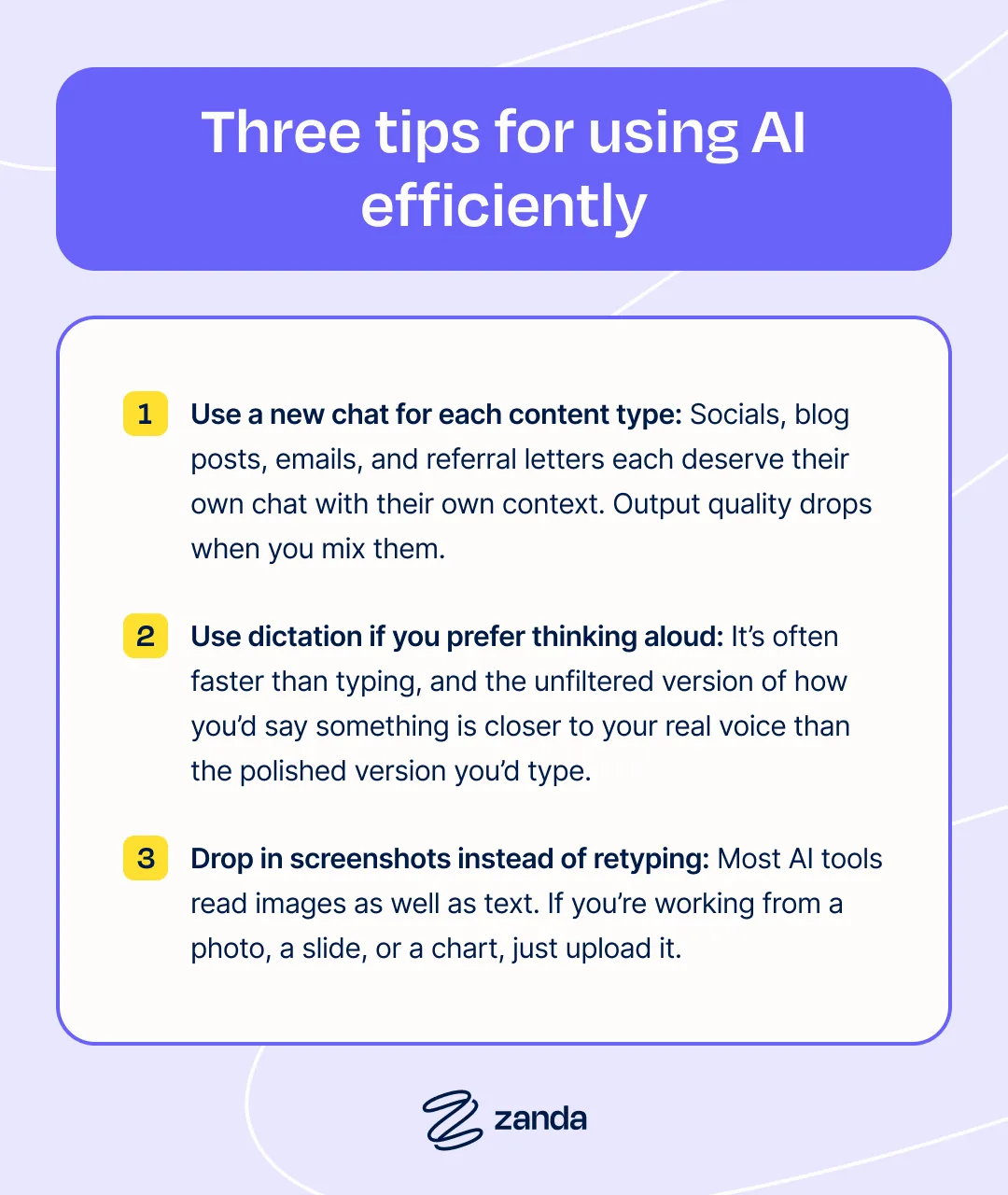
Three efficiency tips from the webinar are worth pulling out:
- Use a new chat for each content type. Socials, blog posts, emails, and referral letters each deserve their own chat with their own context. Output quality drops when you mix them.
- Use dictation if you prefer thinking aloud. It’s often faster than typing, and the unfiltered version of how you’d say something is closer to your real voice than the polished version you’d type.
- Drop in screenshots instead of retyping. Most AI tools read images as well as text. If you’re working from a photo, a slide, or a chart, just upload it.
Manage AI like a team member
AI doesn’t get offended, so feedback can be direct. If a draft is too formal, too vague, or just doesn’t sound like you, say so: “This is too generic. Here’s what I actually want to say: [your version]. Rewrite it closer to that.”
Call out laziness and any drift from the style guide. This works the same way managing a team member does: sharp, direct corrections, focused on what to change.
If you spot a recurring problem — a word AI overuses, sentences that all start the same way, adverbs everywhere — flag it and ask AI to update the style guide so the correction sticks for next time.
You can also direct AI to review your own content. Feed it a piece that performed well and one that didn’t, and ask it to identify what made the difference. Use that to shape what you write next.
Make sure AI tells the truth
AI gets things wrong. It can state inaccurate information confidently, and it will sometimes invent sources that don’t exist.
The webinar’s recommendation is to use a Truth Protocol: standing instructions you include in your prompts that tell AI to flag uncertainty and cite real sources rather than speculate. Zanda has published a ready-to-use Truth Protocol document you can adapt.
But even with a protocol in place, never trust AI 100%. Treat every output as a draft and verify it before you publish. The golden rule of privacy: never feed real patient information into a general AI tool. No names, no identifying details, no session content.
ChatGPT, Gemini, Claude, and Perplexity are built for general use, not healthcare. They’re not designed to meet the privacy standards your practice is bound by, and most are not HIPAA-compliant AI tools for therapists. For clinical documentation and patient communications, you need AI built for healthcare.
BizzyAI is built for health practice
BizzyAI is built for healthcare. Unlike general-purpose AI, healthcare practice AI tools are designed for the specific demands of running a clinic, with truth protocols and privacy safeguards already included. BizzyAI functions differently from ChatGPT or Gemini because it’s built for one job: helping you run a health practice.
BizzyAI: Scribe handles clinical note-taking. It records sessions and generates notes that match your selected template. You can configure it to match your style — for example: “I want my notes to be brief and to the point, provide key points, use narrative and direct quotes from the client, and list action items numerically.” Scribe will follow that format consistently. Think of it like onboarding a new practitioner to your documentation: tell it how you take notes, and it learns to match.
BizzyAI: Write handles written communications inside your practice: letters, templates, policies, and replies. Because it’s designed for health practice use, the safeguards are already included so you don’t need to add your own Truth Protocol to every prompt.
BizzyAI: Refine focuses on improving the quality of your existing documentation without requiring you to start over. It edits, rewrites, and enhances clinical notes to improve clarity, tone, and structure in seconds. This helps maintain consistency across your documentation while making it easy to quickly clean up notes or elevate their overall quality, without adding extra time to your workflow.
Start using AI in your practice
Start with what’s already in your head. Your thinking is what AI needs to produce content that sounds like you instead of content that sounds like everything else. The webinar this article is based on goes deeper into prompting examples and live demonstrations. You can watch the full replay here.
If you want to see how BizzyAI handles the clinical side of your documentation, start a free trial of Zanda and try it for yourself. No credit card required.