
Gamifying Rehabilitation: How Physiotherapists and OTs Can Boost Patient Engagement
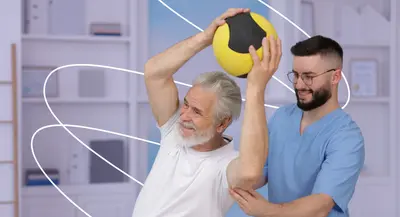
Even the best treatment plan can fall flat without enough participation from patients. For physiotherapists and occupational therapists, it’s a familiar frustration. Research suggests that 50% to 70% of rehabilitation patients are non-adherent or only partially adherent to their prescribed programs.
By introducing gamification into rehabilitation, you can offer practical ways to close that gap. This approach borrows mechanics from games — points, progress bars, challenges, streaks — and embeds them into therapeutic exercises, turning monotonous rep counts into something patients actually want to complete. It’s not new, but it’s becoming more accessible and more evidence-backed.
This article will unpack proven ways to apply rehab engagement strategies, so you can keep your patients motivated and help them see results.
What is gamification in rehabilitation?
Gamification in rehabilitation uses elements of game design to enhance therapeutic tasks. It transforms your clinical program by adding mechanics that make progress feel tangible and motivate patients to continue their rehab.
Common game mechanics used include points and scoring systems. These help to quantify effort, levels, or tiers that mark progression through a program. Gamification includes streaks that reward consistency, such as three consecutive days of home exercises. It also uses progress bars or completion charts to make progress visible.
For example, a physiotherapist tracking grip strength on a hand dynamometer can chart each session’s peak force and challenge the patient to beat last week’s number.
An occupational therapist might use a sticker chart for a pediatric client mastering fine-motor tasks or introduce timed challenges for an adult working through post-surgical range-of-motion drills.
Why gamification works: The psychology behind it
Gamified therapy works because it activates the same psychological drivers that make games compelling.
Self-determination theory, one of the most widely applied frameworks in gamification research, identifies three core psychological needs that drive human motivation:
- Autonomy: the feeling of choice and control
- Competence: the sense of mastery and progress
- Relatedness: connection to others
If you match gamification mechanics with a patient’s goals, you can increase the likelihood that they stick with their rehab program.
For example, patients choose which challenge to attempt (autonomy), see measurable improvement (competence), and can compare progress with peers or share milestones with their clinician (relatedness).
Gamification reinforces motivation by making progress visible, tapping into the patient’s neurochemistry. Achieving a visible milestone activates the brain’s reward pathways, reinforcing the behavior that led to it. This creates a positive feedback loop: effort produces a visible result, the result feels good, and the patient repeats the effort.
This makes gamification especially effective if motivation is the primary barrier. Gamification can help:
- Long-term rehab patients facing months of repetitive exercise
- Clients completing home exercise programs unsupervised
- Pediatric patients whose attention spans demand variety
- Clients managing chronic pain or post-surgical recovery
Evidence and outcomes: Does gamified rehab actually work?
It really does. Multiple systematic reviews show that gamification improves rehab adherence and motivation across age groups. It’s not a replacement for standard care — the exercises still need to be clinically sound — but gamification increases patients’ likelihood of following through.
Gamification for adults with chronic illness
A 2025 scoping review in Nursing Research analyzed 24 studies on gamification in rehabilitation for adults with chronic illness. The review found positive outcomes across physical function, psychological well-being, and self-management.
Gamification in chronic disease care
A systematic review of gamification in chronic disease care examined three intervention categories: active video games, virtual reality-based programs, and digital gamification. The review identified improvements in therapy adherence, motivation, and engagement.
Gamification in pediatrics
In pediatric populations, a systematic review of game-based therapy for rehabilitation in neurological motor conditions found benefits of increased motivation and therapeutic adherence.
Gamification in OT
A commentary in the Hong Kong Journal of Occupational Therapy argues that gamification elements have been present in OT practice for decades, whether it’s stacking cones or timed pegboard tasks. Occupational therapy digital tools make these mechanics more structured, enabling outcomes to be measured.
Examples of gamified rehab in practice
1. Simple low-tech gamification ideas
You don’t need expensive technology to gamify your practice. Some of the most effective rehabilitation motivation techniques are entirely analog:
- Time-based challenges: “Complete 10 reps before the timer runs out” turns a routine set into a race against the clock.
- “Beat your score” tracking: Record the number of reps, range of motion, or hold duration each session.
- Visual progress charts: A chart where patients mark completed home exercise sessions creates accountability and a visible streak.
- Completion streaks: “You’ve completed your home program five days in a row” taps into the same streak psychology that keeps people returning to fitness apps.
2. Advanced game-based therapy tools and apps
Digital rehab tools bring gamification to life through scoring, tracking, and interactive feedback. The growing role of technology in physiotherapy means there are already apps for physiotherapy exercises that include:
- Apps with real-time motion tracking, achievement badges, and adaptive difficulty that increases as patients improve.
- Sensor-based rehab games that use wearables or motion capture to translate physical movements into on-screen actions.
- VR and AR to immerse patients in environments where reaching, stepping, or gripping produces an immediate visual result.
3. Pediatric versus adult applications
Pediatric occupational therapy gamification can rely on color, characters, storytelling, and immediate rewards. For example, a child completing a hand-strengthening exercise might feed a virtual pet with each squeeze.
In contrast, adult gamification focuses more on data, progress tracking, and self-competition. For example, a post-surgical knee patient might track weekly flexion gains on a chart and aim to hit a clinician-set milestone.
How physiotherapists and OTs can implement gamification
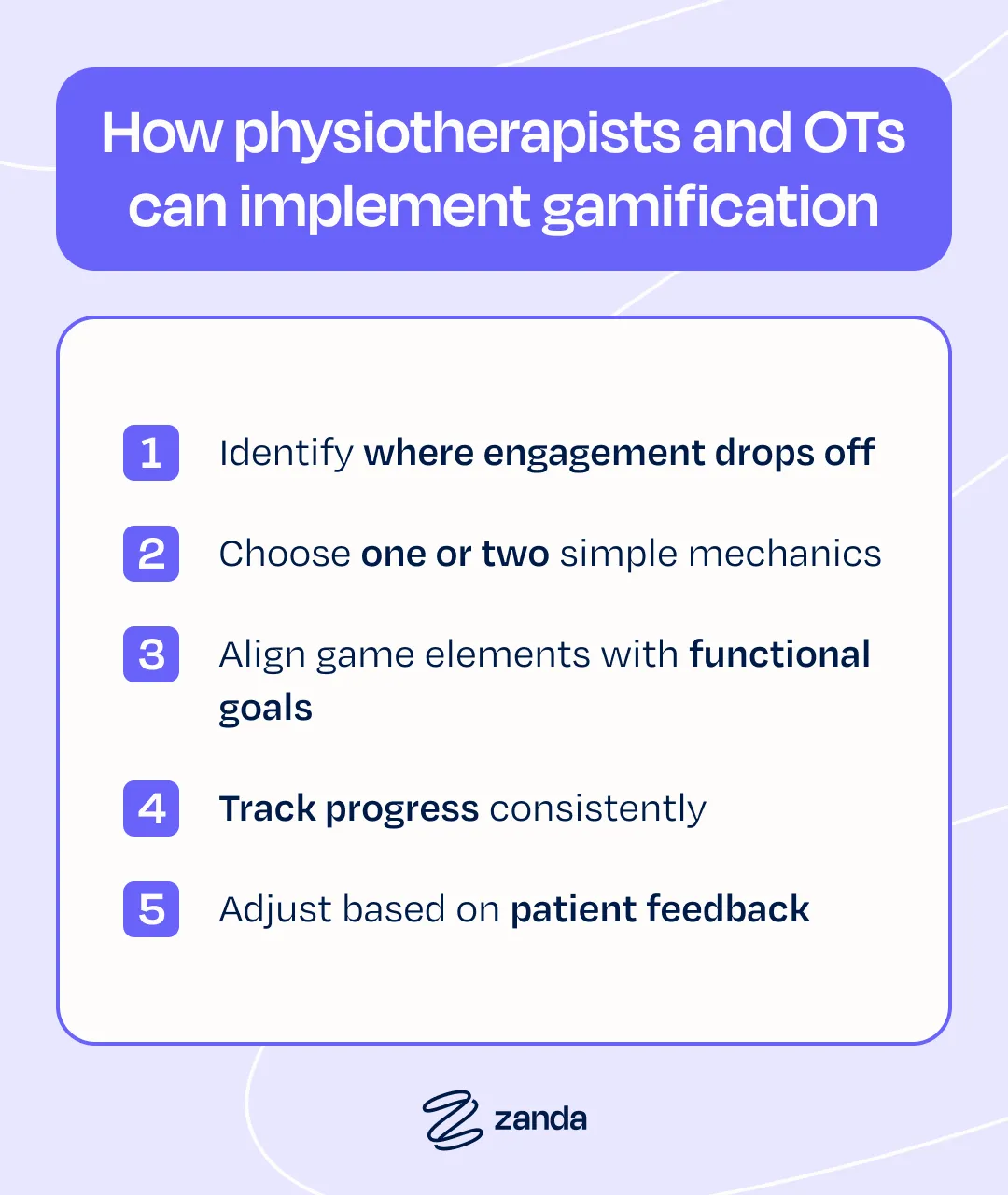
You don’t need to overhaul your practice. Here’s a five-step framework for adding rehab engagement strategies to your existing workflow:
- Identify where engagement drops off: If you want to improve patient adherence in physiotherapy, start with data. Are patients skipping home exercise programs? Dropping out after week three? The drop-off point gives you insight into where you need to rethink how you motivate and support your patients.
- Choose one or two simple mechanics: A progress chart or a streak tracker is enough to start. Too many elements at once can overwhelm patients and complicate your workflow.
- Align game elements with functional goals: The gamification should serve the clinical outcome. If the goal is increased shoulder flexion, the score should track degrees of motion.
- Track progress consistently: Whether you use a whiteboard or an app, the system only works if the data is visible and up to date.
- Adjust based on patient feedback: Not every patient responds to the same game mechanics.
Common pitfalls to avoid
Gamification only works when it serves clinical goals. Watch for these missteps:
- Over-gamifying at the expense of outcomes: If patients are chasing points instead of performing exercises with proper form, the gamification is working against you.
- Choosing technology that’s too complex: A VR headset might excite a 25-year-old athlete but frustrate an elderly patient with limited tech literacy. Match the tool to the user.
- Applying a single approach to every patient: Occupational therapy gamification demands careful matching, as functional goals vary widely across clients.
- Ignoring accessibility and cognitive limitations: Patients recovering from neurological events or managing cognitive impairments may need simplified interfaces and reduced sensory input.
Engagement is a clinical tool
Patient engagement in physiotherapy predicts outcomes. A patient who completes 80% of their home program will almost always outperform one who completes 30%, regardless of how well that program was designed.
Technology in physiotherapy gives clinicians new ways to measure and maintain client engagement, but a chart or a weekly text message can do the job as well.
Every clinician already uses some form of motivation, to varying degrees. Whether it’s verbal encouragement or visual demonstrations of progress, gamification in rehabilitation formalizes what you’re already doing. These rehabilitation motivation techniques work because they make effort feel meaningful. A progress bar operates on the same principle as a verbal “you’re ahead of schedule.”
The practitioners who get the most out of it tend to share one trait: they’re willing to experiment. Try something small this week, see how patients respond, and go from there.
The role of practice management and digital platforms
Gamification only works for clients if the systems around it keep up. Patient engagement in physiotherapy depends on systems like exercise tracking, follow-up reminders, and outcome monitoring to run smoothly.
Zanda integrates with Physitrack, a dedicated exercise prescription platform with built-in gamification features. The combination gives you a single workflow: schedule, document, prescribe, track, follow up, and adjust — without juggling separate platforms.
Try Zanda free for 14 days and see how we make practice management easy.