
AI for Allied Health: Why It Won't Replace You (But a Practitioner Using It Might)

What separates the practices that last from the ones that don’t
A tale of two practitioners
This is a story about the same Tuesday for two very different practitioners.
Practitioner A, let’s call him Mark, is a physical therapist with 15 years under his belt and a full client roster. He runs his practice the way he always has. It’s gotten him this far, so why change now? Ample time with clients means his notes get pushed off to the end of the day when he’s wracking his brain trying to remember what happened in that 10am appointment. A cancellation earlier threw off his afternoon and probably cost him money (he’s been meaning to check his financials). After a full day of clients, he still has admin filling his to-do list. Reminder emails. That unpaid invoice. Setting up a virtual session for a client who’s traveling next week. Mark just wanted to help people, but he feels overwhelmed and exhausted by the weight of running his own solo practice.
Practitioner B, Nancy, is eight years into her career as a therapist and recently launched her own solo practice after getting experience by working under someone else’s roof. She should be underwater. She isn’t, and here’s why. Sessions are recorded and transcribed, churning out neatly summarized notes in minutes. Reminder texts go out to tomorrow’s clients while she sips her morning coffee. A last-minute cancellation this afternoon? Someone from the waitlist gets a text, books the slot, done. Clients that don’t rebook get an automated recall message. Invoices send themselves. Payments land before clients even walk in the door. At the end of the week she peeks at her dashboard, gets a clear picture of cash flow, no-show rates, and client retention, and closes her laptop at 5 pm.
Same profession. Same pressures. Very different Tuesdays.
Why allied health lags behind on AI adoption
The real adoption gap (27% vs. 80%)
So, what is the point of this riveting anecdote?
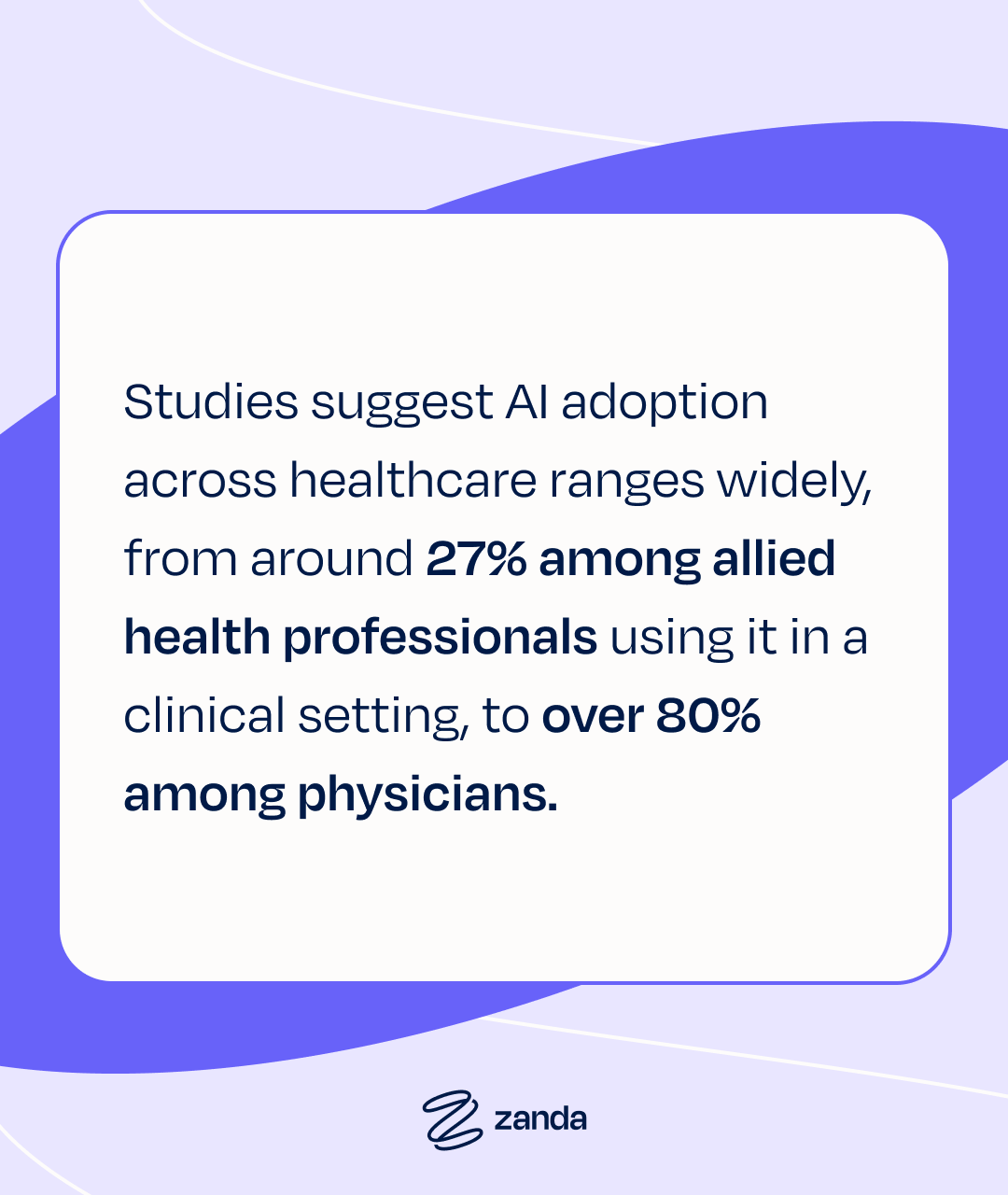
Studies suggest AI adoption across healthcare ranges widely, from around 27% among allied health professionals using it in a clinical setting, to over 80% among physicians. The gap between those numbers says something. Medicine, broadly speaking, is moving. Allied health is still deciding.
Legitimate concerns: data security, human connection, learning curve
And we get it. Security concerns around client data are legitimate. The idea of introducing technology into a space built on human connection raises questions. And for a practitioner already stretched thin, the prospect of learning a new system can be daunting. This makes sense. Smart people don’t resist change without reason.
What AI actually does for your practice
What AI can do is take admin off your plate so you show up to sessions more present and less depleted. It can reduce no-shows and cancellations so your business isn’t quietly bleeding in the background. It can follow up with clients, handle the paperwork, and keep things moving while you actually enjoy your life. For a lot of practitioners, that means rediscovering the parts of the job they fell in love with in the first place.
Automating clinical documentation
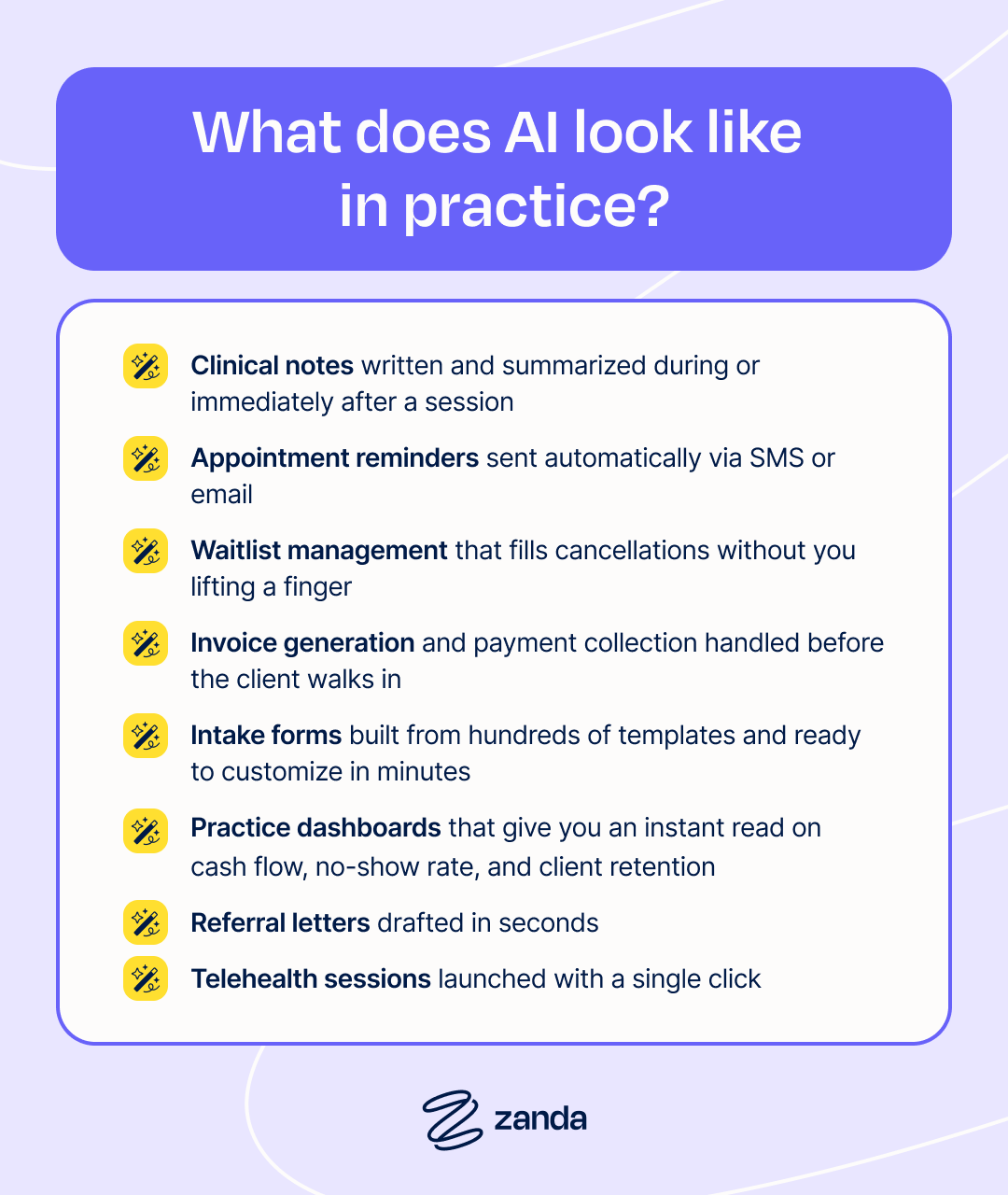
Clinical notes can be written and summarized during or immediately after a session, instead of being reconstructed from memory at the end of a long day.
Reducing no-shows and cancellations
Appointment reminders go out automatically via SMS or email, and waitlist management fills cancellations without you lifting a finger.
Streamlining billing and invoicing
Invoice generation and payment collection can be handled before the client even walks in, referral letters can be drafted in seconds, and practice dashboards give you an instant read on cash flow, no-show rate, and client retention.
Simplifying intake and telehealth
Intake forms can be built from hundreds of templates and ready to customize in minutes, and telehealth sessions can be launched with a single click.
Let’s be clear: AI isn’t going to be the empathetic listener in a therapy session. It’s not the hands-on adjuster in a physical therapy appointment or the careful, practiced touch of a massage therapist. It will never replicate the nurturing, supportive presence you bring into a room. And it won’t bring the wisdom and judgement needed to provide the advice that gets the best outcome for your clients. AI can’t and won’t replace you. But the practitioners using AI right now? They might.
AI and practitioner burnout
The research is pretty consistent. Administrative burden and disjointed workflows are leading contributors to burnout across healthcare professions. The practitioners pulling ahead right now are not necessarily more skilled or more driven than the ones falling behind. They have just stopped doing manually what technology can handle. Notes written in session rather than after hours. Referral letters generated in seconds. A full suite of intake forms built from templates in minutes. One click to start a telehealth session. Zero time spent chasing invoices.
Mark is good at what he does. So is Nancy. The difference is that Nancy has more time to show it.
Building a sustainable practice over the next five years
The practitioners who build sustainable, profitable practices over the next five years will not necessarily be the most talented in the room. They will be the ones who found the right tools, used them well, and got back to the work that actually matters.
Zanda was built with practices like yours in mind. It’s quick to set up, covers the full range of what you need to run a practice, and you get 14 days free to decide if it’s the right fit.
- Marley, J., et al. 2026. Sage Journals. https://journals.sagepub.com/doi/10.1177/20552076261437342
- O’Reilly, K., et al. 2026. American Medical Association. https://www.ama-assn.org/practice-management/digital-health/more-80-physicians-use-ai-professionally-ama-survey